

Publishing your book no longer requires months of manual formatting, endless version control headaches, or sacrificing your creative vision to technical complexity. AI-powered automation now handles repetitive publishing tasks while you maintain complete control over your story. Understanding how these tools work transforms confusion about automation into clarity about streamlining your author journey efficiently.
Table of Contents
- How Automation Is Transforming The Publishing Process
- Leveraging AI Tools For Manuscript Development And Organization
- Implementing Automated Publishing Workflows For Scaling And Quality Control
- Choosing The Right AI Publishing Tools For Your Needs
- Explore Librida's AI Publishing Solutions
- Frequently Asked Questions
Key takeaways
| Point | Details | |-------|---------|| | Speed and cost reduction | AI-powered publishing workflows cut time-to-market by automating formatting and distribution, reducing operational costs significantly. | | Creative control preserved | Hierarchical AI tools support authors in organizing manuscripts while keeping creative decisions entirely in human hands. | | Scalable operations | Automated pipelines enable managing multiple titles without hiring additional staff or increasing workload proportionally. | | Platform-specific strengths | ChatGPT excels at structure, Gemini at worldbuilding, and TreeWriter at iterative editing, each serving distinct author needs. | | Quality consistency | AI validation checkpoints ensure uniform formatting and error reduction across all publishing outputs. |
How automation is transforming the publishing process
Authors traditionally spend countless hours on repetitive tasks like converting manuscripts to multiple formats, updating metadata across platforms, and manually checking for consistency errors. AI-powered publishing workflows eliminate these bottlenecks by automating format conversions, enforcing quality rules, and processing batches of files simultaneously. This shift lets you focus on writing instead of technical publishing mechanics.
Automation delivers four core benefits that reshape your publishing timeline:
- Eliminates manual formatting tasks like converting DOCX to EPUB or adjusting margins across formats
- Enforces consistent style rules automatically, catching typos and formatting errors before publication
- Processes multiple books or editions simultaneously through batch automation routines
- Reduces operational costs by replacing repetitive human tasks with algorithmic precision
Traditional publishing workflows require authors to track versions manually, apply formatting changes one file at a time, and verify metadata consistency across dozens of retail platforms. Automated systems handle these steps in minutes, not days. You upload a master file, define your parameters once, and the AI generates store-ready files for Kindle, Apple Books, and other retailers without additional intervention.
Pro Tip: Start small by automating your most time-consuming task first, like format conversion or metadata entry, then expand your automated workflows as you gain confidence with the tools.
The cost savings extend beyond time. Self-publishers who previously hired formatters or virtual assistants can now generate audiobooks and handle distribution through AI-driven platforms. This shift democratizes professional-quality publishing for authors at every budget level, making scalable operations accessible without venture capital or traditional publisher backing.
Leveraging AI tools for manuscript development and organization
Different AI platforms serve distinct creative needs during manuscript development. TreeWriter improves idea exploration through hierarchical document structures that let you edit nested sections while maintaining context across your entire manuscript. This tool particularly helps authors managing complex plots or multiple character arcs that require frequent reorganization.
ChatGPT excels in structural organization by generating detailed outlines and following precise instructions for chapter breakdowns or scene sequences. When you need a clear framework before drafting, ChatGPT provides systematic scaffolding that respects your creative direction. It handles procedural writing tasks like summarizing chapters or creating beat sheets with remarkable consistency.
Gemini specializes in worldbuilding depth and character psychology, making it ideal for fantasy, science fiction, or any genre requiring rich backstory and complex character motivations. Authors using Gemini report stronger internal consistency in fictional worlds and more nuanced character development. The platform generates detailed story bibles that maintain continuity across series or sprawling narratives.
Choosing the right tool depends on matching AI personality to your writing style:
- Use ChatGPT when you need structured outlines, precise instruction following, or procedural writing support
- Choose Gemini for deep worldbuilding, character psychology exploration, or thematic development
- Select TreeWriter for iterative editing, hierarchical organization, or managing long documents with complex interdependencies
| AI Tool | Primary Strength | Best For | Limitation |
|---|---|---|---|
| ChatGPT | Structural clarity | Outlines, beat sheets, procedural tasks | Less creative in character depth |
| Gemini | Worldbuilding depth | Fantasy, sci-fi, character psychology | Can over-elaborate details |
| TreeWriter | Hierarchical editing | Complex manuscripts, nested revisions | Learning curve for interface |
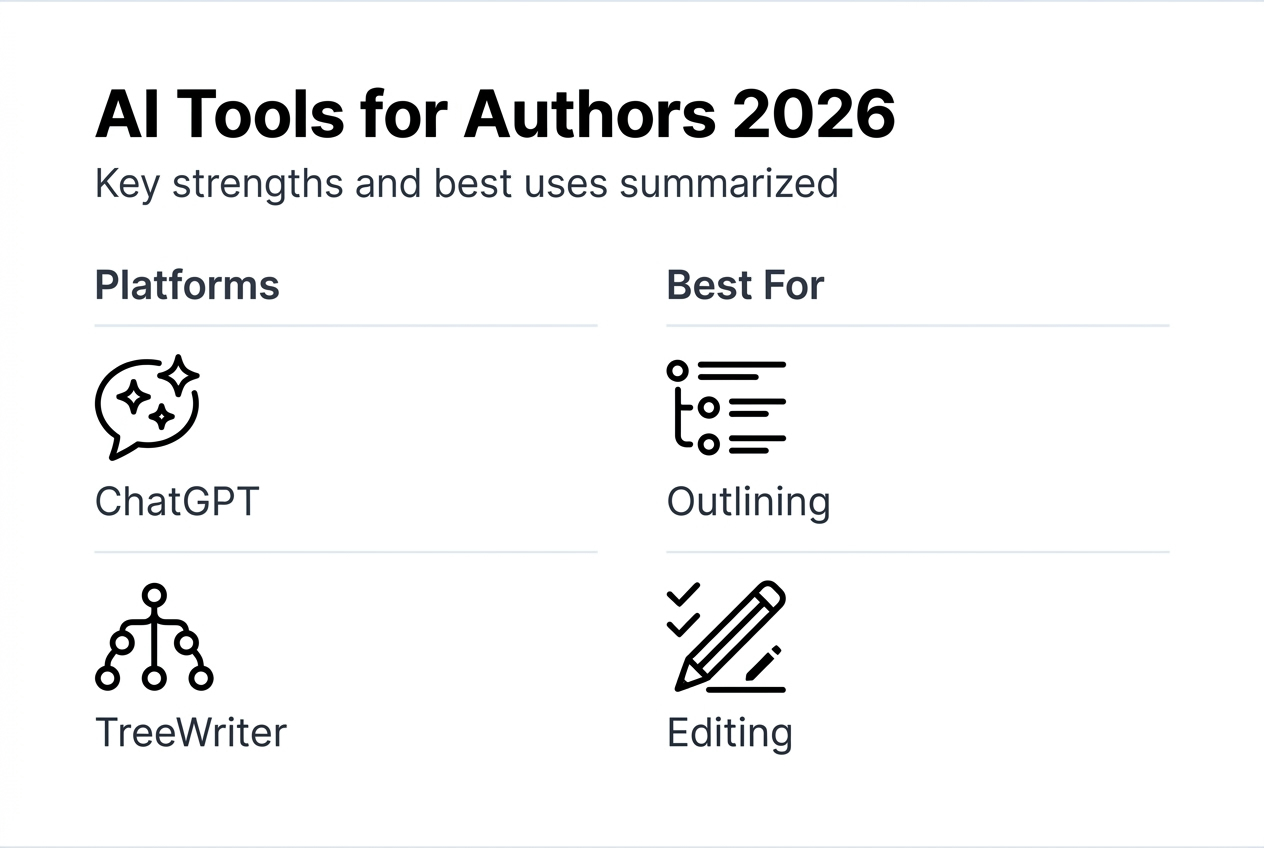
Pro Tip: Combine tools strategically by using ChatGPT for initial outlining, Gemini for character development, and TreeWriter for manuscript editing to leverage each platform's unique strengths.
The key to maintaining creative control lies in treating AI as a collaborative assistant, not a replacement for your authorial voice. Define clear boundaries for AI input by specifying exactly which aspects you want help with, like generating setting descriptions but not character dialogue. Review every AI suggestion critically and modify outputs to match your style. This approach preserves authenticity while benefiting from AI's capacity to support interactive fiction and dynamic storytelling.
Implementing automated publishing workflows for scaling and quality control
Effective automation starts with three foundational principles: simplify inputs, standardize processing, and validate outputs. Create a single source master file in a clean format like Markdown or DOCX, paired with a metadata spreadsheet containing ISBNs, pricing, categories, and keywords. This standardized input structure enables automated tools to process your content reliably without manual intervention at each step.
Designing your automated pipeline requires mapping the minimum necessary steps from manuscript to published product:
- Upload your master manuscript file and completed metadata spreadsheet to your automation platform
- Configure format conversion rules for EPUB, MOBI, PDF, and any other required output formats
- Set up automated error checking routines that flag formatting inconsistencies or metadata gaps
- Define validation checkpoints where AI reviews file integrity and platform compliance requirements
- Schedule batch processing for simultaneous uploads to Amazon KDP, IngramSpark, and other distribution channels
- Implement version control tracking so updates automatically propagate across all published formats
Validation checkpoints maintain quality by catching errors before publication. Automated systems check for missing page numbers, inconsistent headers, broken internal links, and formatting glitches that slip past human review. These checkpoints run in seconds and provide detailed error reports highlighting exactly what needs fixing, eliminating the guesswork in troubleshooting publication issues.

| Publishing Approach | Time to Market | Cost per Title | Scalability | Quality Consistency |
|---|---|---|---|---|
| Traditional manual | 4-6 weeks | $500-$1,500 | Limited by staff hours | Variable, human error |
| Automated workflow | 2-5 days | $50-$200 | Unlimited, parallel processing | High, algorithmic validation |
Pro Tip: Test your automated workflow with a short story or sample chapter first to identify configuration issues before processing your full-length manuscript.
Scaling operations becomes straightforward once your pipeline functions reliably. Authors managing multiple pen names or rapid release schedules use Librida's AI API to publish dozens of titles monthly without proportionally increasing workload. The automation handles repetitive distribution tasks while you focus on writing new content. This operational efficiency enables ambitious publishing calendars that would overwhelm manual processes.
Advanced implementations incorporate AI swarm approaches where multiple AI agents collaborate on different manuscript aspects simultaneously. One agent handles dialogue polish while another optimizes pacing and a third ensures worldbuilding consistency. This parallel processing accelerates editing cycles and catches issues individual review might miss.
Choosing the right AI publishing tools for your needs
Selecting appropriate AI tools requires evaluating your priorities across speed, creative depth, control level, and ease of use. Each platform has distinct personalities that align better with certain author workflows and creative styles. Understanding these differences prevents frustration from using powerful tools in contexts where they underperform.
ChatGPT serves authors who value organizational clarity and precise instruction execution. It generates clean outlines, follows detailed prompts accurately, and maintains consistent formatting across outputs. Authors writing non-fiction, procedural fiction, or any work requiring systematic structure benefit most from ChatGPT's methodical approach. The platform struggles with nuanced emotional depth but excels at logical progression and clear communication.
Gemini targets authors building immersive fictional worlds with complex character relationships and rich thematic layers. Its strength lies in generating detailed backstories, exploring character motivations, and maintaining internal consistency across elaborate settings. Fantasy and science fiction authors report significant time savings in worldbuilding documentation. However, Gemini can over-elaborate details, requiring editorial discipline to prevent bloat.
TreeWriter focuses on iterative editing for long documents where maintaining context across chapters proves challenging. The hierarchical structure lets you collapse or expand sections while editing, keeping related content visible without scrolling through hundreds of pages. Authors revising complex manuscripts or managing multiple character viewpoints find TreeWriter's contextual awareness invaluable for maintaining coherence.
| Tool | Core Strength | Ideal Genre | Creative Control | Learning Curve |
|---|---|---|---|---|
| ChatGPT | Process precision | Non-fiction, structured fiction | High author control | Low, intuitive prompts |
| Gemini | Deep worldbuilding | Fantasy, sci-fi, literary fiction | Moderate, needs editing | Medium, detailed outputs |
| TreeWriter | Iterative editing | Any long-form manuscript | Very high, granular control | Medium, interface complexity |
Balance human creativity with AI strengths by assigning tasks that play to each platform's capabilities while reserving creative decisions for yourself. Use AI to generate options, not make choices. When ChatGPT suggests three plot directions, you select which fits your vision. When Gemini builds character backstory, you extract elements that resonate and discard the rest.
Your writing style should drive tool selection. Planners who outline extensively before drafting benefit from ChatGPT's structural support. Discovery writers who develop stories through drafting prefer TreeWriter's flexible editing environment. Authors who iterate heavily on character and theme lean toward Gemini's exploratory depth. Experimenting with each platform on small projects reveals which aligns best with your natural creative process.
Pro Tip: Audit your most time-consuming writing tasks, then match each task to the AI tool that handles it best rather than forcing one platform to serve all needs.
Maintaining authentic voice requires conscious boundaries around AI input. Define which creative elements remain entirely human, like character voice, thematic messaging, and emotional beats. Use AI for technical support like grammar checking, formatting consistency, or generating research summaries. This division preserves your unique authorial fingerprint while benefiting from automation's efficiency gains. Readers connect with authentic voices, and content safety considerations become more manageable when human judgment guides creative direction.
Explore Librida's AI publishing solutions
Applying these automation strategies becomes seamless when you have integrated tools designed specifically for author workflows. Librida combines AI-assisted writing, automated publishing pipelines, and scalable distribution into one platform that supports your creative autonomy while handling technical complexity. Whether you're developing your first manuscript or managing a growing catalog, our AI API streamlines every step from initial outline to live publication.

Our publishing roadmap includes continuous improvements to automation features, ensuring you always have access to cutting-edge tools without switching platforms or learning new systems. Explore Librida's publishing roadmap to see upcoming features that further reduce manual tasks and expand creative possibilities. Authors like those behind The Lady and The Quill have already transformed their publishing timelines using our integrated solutions, and you can too.
Frequently asked questions
What are the benefits of automation in publishing?
Automation reduces publishing costs by eliminating repetitive manual tasks like formatting and metadata entry, cutting time-to-market from weeks to days. It improves quality consistency through algorithmic validation that catches errors human review might miss. Self-publishers scale operations without hiring additional staff, managing multiple titles through batch processing and parallel workflows. Automation supports rather than replaces author control by handling technical mechanics while leaving creative decisions entirely in your hands.
How does AI improve manuscript development?
AI tools like TreeWriter and ChatGPT support structural outlines, idea exploration, and editing efficiency by providing contextual assistance tailored to your specific manuscript needs. TreeWriter enhances authorial control through hierarchical editing that maintains context across complex documents. These platforms generate creative suggestions and organizational frameworks while you retain final decision-making authority over plot, character, and theme. AI accelerates the development process without dictating creative direction.
Can automation help self-publishers reduce operational costs?
Yes, AI-driven pipelines enable scaling without hiring formatters, cover designers, or distribution assistants by automating these functions through integrated workflows. Automation cuts costs associated with repetitive tasks and human errors, like reformatting files after corrections or resubmitting to retailers due to metadata mistakes. Self-publishers using AI-generated audiobooks and automated distribution save thousands annually while maintaining professional quality standards. The time savings alone justify automation investment for authors publishing multiple titles yearly.
Which AI publishing tools are best for different writing styles?
ChatGPT excels for authors who value structural clarity, precise instruction following, and systematic organization in outlines and procedural content. Gemini serves writers focused on deep worldbuilding, character psychology, and thematic exploration in fantasy or literary fiction. TreeWriter supports iterative editors managing complex manuscripts with multiple character viewpoints or nested plot structures. Authors should select tools matching their creative process and project requirements rather than adopting platforms based solely on popularity or marketing claims.