

TL;DR:
- Collaborative writing involves shared responsibility throughout the entire process, not just dividing chapters.
- Successful collaboration requires structured workflows, clear roles, and mutual accountability to produce coherent, high-quality work.
Collaborative writing is far more than splitting a manuscript into chapters and hoping it all fits together at the end. Co-authoring is when two or more people share genuine responsibility for producing a written work, from the first idea through the final edit. Most aspiring writers assume the hard part is finding someone to write with. In reality, the harder part is building the structure that makes collaboration work. This article breaks down proven methods, practical frameworks, and honest lessons that will help you write better together.
Table of Contents
- Understanding collaborative writing: What it is and isn't
- How the collaborative writing process works
- Rules and frameworks for successful collaboration
- Advanced strategies: Voice, style, and editor involvement
- Does collaboration actually change writing outcomes?
- A seasoned author's take: Collaborative writing is a managed workflow, not a group free-for-all
- Ready to try collaborative writing? Connect with helpful tools and expert guidance
- Frequently asked questions
Key Takeaways
| Point | Details |
|---|---|
| Collaboration is structured | The most effective collaborative writing relies on clear roles, planning, and explicit workflow steps. |
| Rules prevent friction | Agreeing on rules for drafting, revision, and style protects against common group writing pitfalls. |
| Voice management matters | Unified style and scheduled reviews help maintain a consistent voice across co-authors. |
| Outcomes are measurable | Research shows collaborative writing changes the process, affecting speed, organization, and text quality. |
| Practical tools help succeed | Access to collaboration tools and writing platforms can help implement best practices and smooth out teamwork. |
Understanding collaborative writing: What it is and isn't
A lot of writers have tried collaboration and walked away frustrated, usually because they went in with the wrong picture of what it involves. They split up the chapters, wrote separately, then tried to stitch everything together and called it a co-authored book. That is not quite right.
As a starting definition: "collaborative writing is when two or more people work together to produce a written document" with shared ownership at every stage. That means both writers are responsible for planning, shaping, drafting, and revising the material, not just occupying different sections of a document.
"Collaborative writing is when two or more people work together to produce a written document (sometimes called group writing or co-authoring)." — ThoughtCo
The myth worth busting early: collaboration does not require everyone to type at the same time or be in the same room. What it does require is that all contributors engage with the full work, not just their assigned slice of it.
Here are the most common forms collaborative writing takes in publishing and storytelling:
- Co-authored novels, where two writers share creative and editorial control from concept to final draft
- Mentor and mentee projects, where an experienced author guides a newer writer through a full manuscript
- Writers' room formats, common in TV and fiction series, where multiple writers develop story arcs together
- Anthology collections, where contributors write independently but within shared guidelines and editorial oversight
- Ghost-assisted authorship, where one person provides the ideas and another handles most of the writing under collaborative guidance
Understanding which model fits your project is the first real decision you need to make.
How the collaborative writing process works
Once you understand what collaborative writing actually is, the next step is mapping out how it runs in practice. Most successful collaborations share a predictable structure, even if the details vary from project to project.
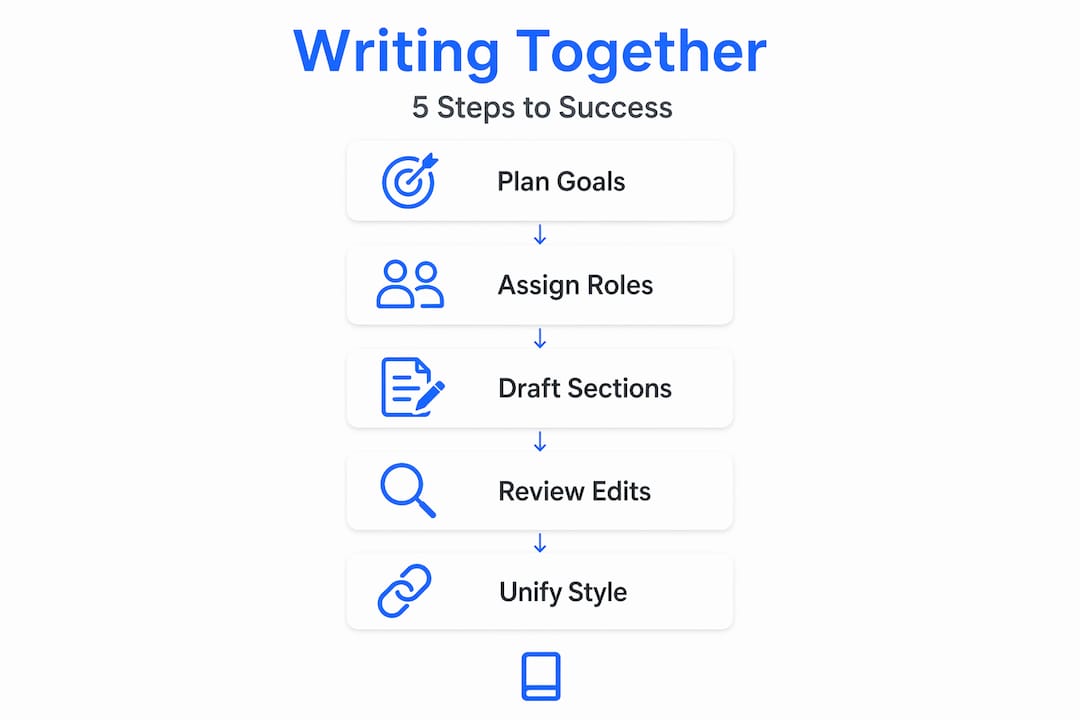
Effective collaboration commonly uses a planning, then drafting, then revising structure, and not every step requires the whole group at once. Here is a numbered breakdown of how a typical collaborative project flows:
- Establish the shared vision. Before anyone writes a single sentence, the team agrees on the project's core concept, intended audience, tone, and scope.
- Assign roles and responsibilities. Decide who drafts which sections, who handles research, who leads structural revisions, and who makes the final submission.
- Set timelines and checkpoints. Agree on specific deadlines for drafts, feedback rounds, and editorial reviews.
- Draft individually or simultaneously. Depending on the project, writers may draft in sequence (one person finishes before the next begins) or in parallel (everyone drafts their sections at the same time).
- Review and revise as a group. Bring the full draft together for collective editing, focusing on consistency, voice, and flow.
- Finalize and submit. One person typically handles formatting and submission, but this role should be agreed on in advance.
Role and process alignment at the start, including who drafts, who edits, and who submits, is one of the most frequently overlooked steps. When those roles are vague, friction follows almost immediately.
Pro Tip: Before your first drafting session, create a short written document (even a one-page outline will do) that names each collaborator's role, their specific deliverables, and the timeline. Treat it like a lightweight contract. It removes ambiguity before it becomes an argument.
Here is a simple comparison of how traditional solo writing differs from collaborative writing at each stage:
| Stage | Traditional writing | Collaborative writing |
|---|---|---|
| Planning | Solo brainstorm | Group discussion and shared outline |
| Drafting | One writer, full draft | Assigned sections or parallel drafting |
| Revising | Self-editing | Peer feedback and group revision rounds |
| Voice control | Naturally consistent | Requires active alignment and style guides |
| Final review | Author reviews alone | All collaborators sign off |
| Submission | Solo responsibility | Designated submitter, agreed in advance |
This table makes one thing clear: collaboration adds steps, not shortcuts. The benefit is depth and resilience in the final product.
Rules and frameworks for successful collaboration
Even the most enthusiastic writing partnerships fall apart without structure. Friction between collaborators almost never comes from creative disagreements alone. It usually comes from undefined processes that create confusion about who owns what.
Collaborative writing partnerships improve when teams use explicit, shared rules designed to reduce predictable friction. Think of these rules as guardrails, not restrictions. They free up creative energy by eliminating unnecessary negotiation mid-project.
Here is a practical look at common pain points and the rule frameworks that address them:
| Pain point | Suggested rule framework |
|---|---|
| Conflicting edits overwriting each other | Use version-controlled documents with edit history |
| Unclear who has final say on changes | Designate a lead editor with tiebreaker authority |
| Tone inconsistency across sections | Develop and share a project style guide before drafting |
| Missed deadlines by one collaborator | Set internal deadlines earlier than the actual deadline |
| Disagreements about structural changes | Schedule a structured revision meeting before implementing changes |
| Credit and ownership confusion | Agree on attribution terms in writing before the project begins |
Beyond the table, here are the core rules every collaborative writing team should commit to from day one:
- Put agreements in writing. Verbal agreements fade. Written ones do not.
- Use a shared style guide. Pick consistent rules for formatting, punctuation, point of view, tense, and character naming conventions.
- Respect drafting windows. Avoid editing someone's active draft. Wait for the agreed handoff point.
- Separate drafting feedback from structural feedback. Line edits and big-picture revision require different conversations.
- Build in buffer time. Collaborative projects almost always take longer than solo projects. Plan for it.
These rules sound simple because they are. The challenge is not knowing them; it is actually following them when creative momentum builds and the temptation to skip steps feels justified.
Advanced strategies: Voice, style, and editor involvement
Once you have the logistics figured out, the real creative challenge of collaborative writing shows up: keeping the work sounding like one coherent voice, even when it was written by two or more people.
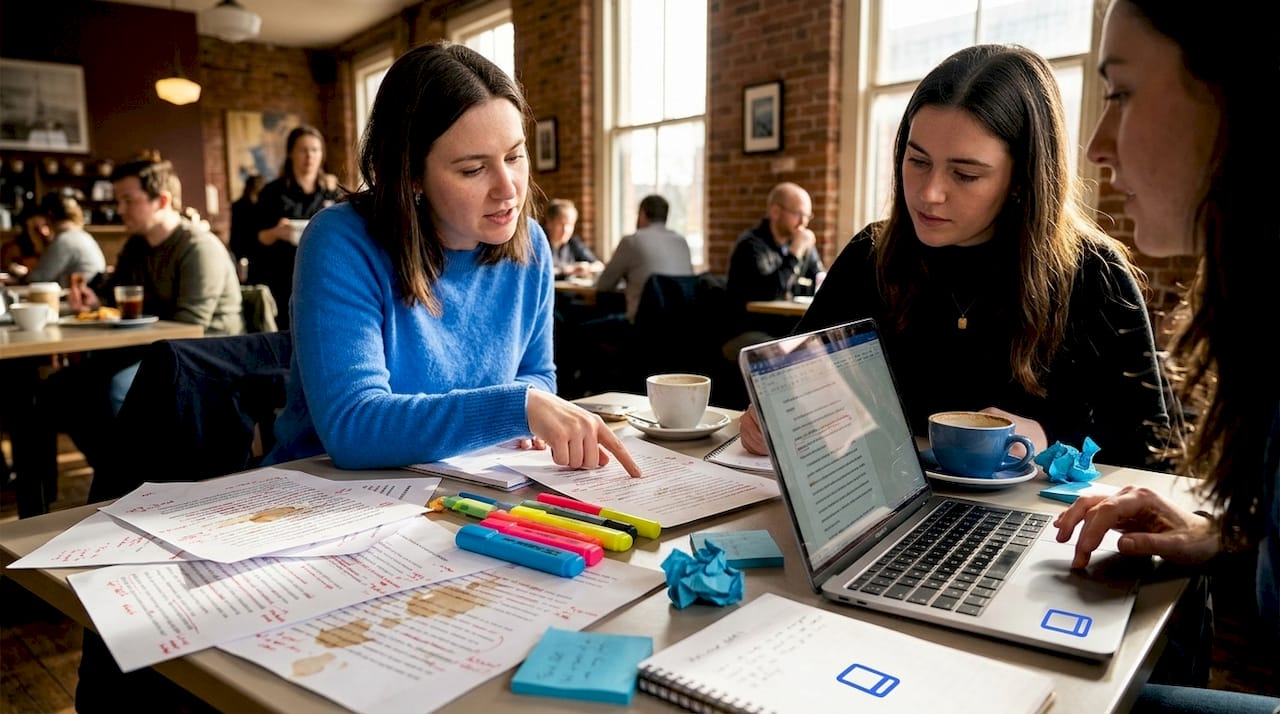
Voice drift is one of the most common problems in multi-author manuscripts. It happens when contributors write in isolation for too long, each pulling the tone in slightly different directions. The result can feel jarring to readers, even if they cannot identify the exact cause.
Voice and coherence can drift when multiple writers contribute unevenly or sequentially without shared constraints. The fix is not just editing the draft; it starts with unified style and voice planning before the first word is written.
Practical strategies for maintaining a consistent voice include:
- Create an "anchor" document. Before drafting begins, write two or three paragraphs that represent the ideal tone, pace, and perspective of the finished work. Every contributor refers back to it throughout the project.
- Hold periodic voice-check sessions. Schedule regular read-alouds where the group listens for tonal shifts across sections.
- Limit point-of-view jumping. Decide upfront whether the narrator's voice is warm, distant, ironic, or earnest, and protect that choice throughout.
Editorial involvement is another powerful lever most new collaborators underuse. A skilled editor does not just catch typos. They hold the structural vision and flag when the work is drifting from its original intent.
"Successful co-authoring can depend strongly on an editor's involvement and on periodically meeting in person to generate new angles and maintain shared understanding." — O'Reilly Radar
An editor's involvement can be the difference between a manuscript that feels unified and one that reads like a patchwork. Even an informal editorial role, assigned to one of the collaborators, makes a measurable difference.
Pro Tip: Schedule a short video call (30 minutes is enough) at the end of each major drafting phase. Do not use it to critique each other's word choices. Use it to read a section aloud together and flag anything that feels off-tone or out of character for the project. This is faster and more effective than written feedback alone.
Does collaboration actually change writing outcomes?
Here is a question that aspiring co-authors often avoid asking directly: does writing together actually produce better work? The honest answer is more nuanced than a simple yes.
Research has tracked measurable differences in the writing behavior and output quality of collaborative versus solo writing projects. Collaborative writing shows measurable differences in process and writing behavior, meaning it is not just a social preference but can genuinely change what the writing looks like.
Key outcome differences found in research include:
- Organizational structure. Collaborative works tend to show stronger structural organization, likely because multiple people challenge weak logic before it reaches the final draft.
- Linguistic complexity. Co-authored texts frequently show greater variety in sentence structure and vocabulary.
- Analytical depth. When writers challenge each other's assumptions during the planning and revision phases, the final argument or narrative tends to be more thoroughly developed.
- Speed variability. Collaboration does not always speed up the process. In early stages, group planning and negotiation can slow things down significantly.
The honest balance is this: collaboration amplifies the strengths of your team and amplifies the weaknesses too. A pair of disciplined, communicative writers will produce something richer than either could alone. A pair of writers who avoid hard conversations will produce a manuscript that reflects exactly that avoidance.
Statistic to know: Studies on collaborative writing in academic and creative contexts consistently show that writers in collaborative settings spend significantly more time in the planning phase than solo writers do, which often leads to more organized and coherent final outputs.
Collaboration works best for complex, multi-perspective projects, long-form manuscripts, and structured storytelling with multiple characters or plot threads. It introduces the most friction in projects with a singular, deeply personal voice or a tight creative vision that does not naturally invite outside input.
A seasoned author's take: Collaborative writing is a managed workflow, not a group free-for-all
Most collaborative writing failures are not about personality clashes. Writers love to believe the problem was a bad creative match, but the more honest explanation is that the workflow was never defined. When no one knows who owns what, even the most compatible writing partners will eventually run into trouble.
Treating collaborative writing as a managed workflow is the most transferable lesson from writing-center guidance and real-world co-authoring experience. The creative part comes naturally to most writers. The structural part is what they avoid.
Here is what experienced collaborators learn the hard way: assuming a shared vision is not the same as building one. Two writers can both say "we want to write a gripping thriller" and picture completely different books. The early planning conversations that feel redundant are actually the most important ones. Skip them and pay for it later.
Accountability is the other piece most writers underestimate. In solo writing, you answer only to yourself. In collaborative writing, missed deadlines affect someone else directly. Building explicit accountability into the workflow, through agreed handoffs, named responsibilities, and honest timeline setting, is not bureaucratic. It is respectful.
The meeting cadence matters more than most writers expect. Infrequent, high-stakes check-ins (one big meeting every month) create pressure and misalignment. Frequent, low-stakes check-ins (a 20-minute call every week) keep everyone oriented without turning collaboration into a second job.
The collaborations that produce genuinely good books share one trait: the writers treat the workflow as seriously as they treat the writing itself. Structure does not kill creativity. It creates the conditions where creativity can actually do its work.
Ready to try collaborative writing? Connect with helpful tools and expert guidance
The gap between understanding collaborative writing and actually doing it well is where most aspiring co-authors get stuck. Reading about frameworks is useful. Applying them to your own manuscript is where the real learning happens.

Librida is built for exactly this stage of the journey. Whether you are refining a co-authored manuscript, building out a story with an AI collaborator, or just trying to take a raw idea and turn it into a structured, publishable book, Librida gives you the tools and guidance to move forward with confidence. The platform combines AI-powered writing support with practical templates and editorial features designed to take writers from concept to completed manuscript without getting lost in the process. If collaboration has felt overwhelming in the past, Librida makes it manageable and even enjoyable.
Frequently asked questions
What is the difference between collaborative writing and co-authoring?
Collaborative writing refers to any group writing effort, while co-authoring typically implies formal shared authorship credit on a published document or book.
Do all collaborators need to write at the same time?
No. Most collaborative projects combine group planning sessions with individual drafting phases and scheduled feedback rounds, so simultaneous writing is rarely required.
How do collaborators avoid voice and style clashing?
Teams create a shared anchor document before drafting begins, and unified style and voice planning helps merge distinct writing styles into a consistent finished work.
Does collaborative writing improve quality?
Collaboration produces measurable differences in writing organization, analytical depth, and linguistic complexity, though it also introduces new challenges around consistency and communication.
When should you avoid collaborative writing?
Collaborative writing tends to create more friction than value when the project has a deeply singular personal voice, a very tight solo creative vision, or when the timeline is too short to accommodate the planning overhead that good collaboration requires.