

Aspiring authors often hit walls organizing ideas and maintaining consistent momentum. Lost scenes, forgotten character details, and stalled drafts slow progress. AI tools now offer structured support through every creative phase, from brainstorming to final edits. This guide reveals practical workflows that boost productivity by up to 40% while preserving your unique voice. You'll learn exactly how to integrate AI without sacrificing authenticity or narrative quality.
Table of Contents
- Introduction To Creative Writing Workflows And AI Integration
- Prerequisites: Tools, Knowledge, And Preparation Before Starting
- Step 1: Idea Generation And Brainstorming With AI
- Step 2: Outlining And Structuring Your Story Using AI Assistance
- Step 3: Drafting Your Manuscript With AI Support
- Step 4: Manuscript Refinement And Editing Powered By AI
- Common Mistakes And Troubleshooting In AI-Assisted Writing
- Expected Timelines, Costs, And Measurable Outcomes Using AI Workflows
- Streamline Your Writing Journey With Librida
- FAQ
Key takeaways
| Point | Details |
|---|---|
| Productivity boost | AI integration increases writing productivity by 30-40% through task automation and real-time suggestions. |
| Structured phases | AI-assisted workflows cover ideation, outlining, drafting, editing, and polishing with tailored tool support. |
| Balance is critical | Over-reliance on AI risks narrative inconsistency and voice loss; human oversight ensures quality. |
| Faster completion | Manuscripts can be completed 4-6 months faster using AI-enhanced workflows. |
| Higher acceptance | Combining AI tools with human editing improves manuscript acceptance rates by 40%. |
Introduction to creative writing workflows and AI integration
A creative writing workflow is a sequence of phases guiding your story from concept to polished manuscript. These phases typically include ideation, outlining, drafting, refinement, and polishing. Each stage builds on the previous one, creating momentum and organizing your thoughts systematically. Without structure, writers often juggle disconnected ideas, leading to inconsistent narratives and abandoned projects.
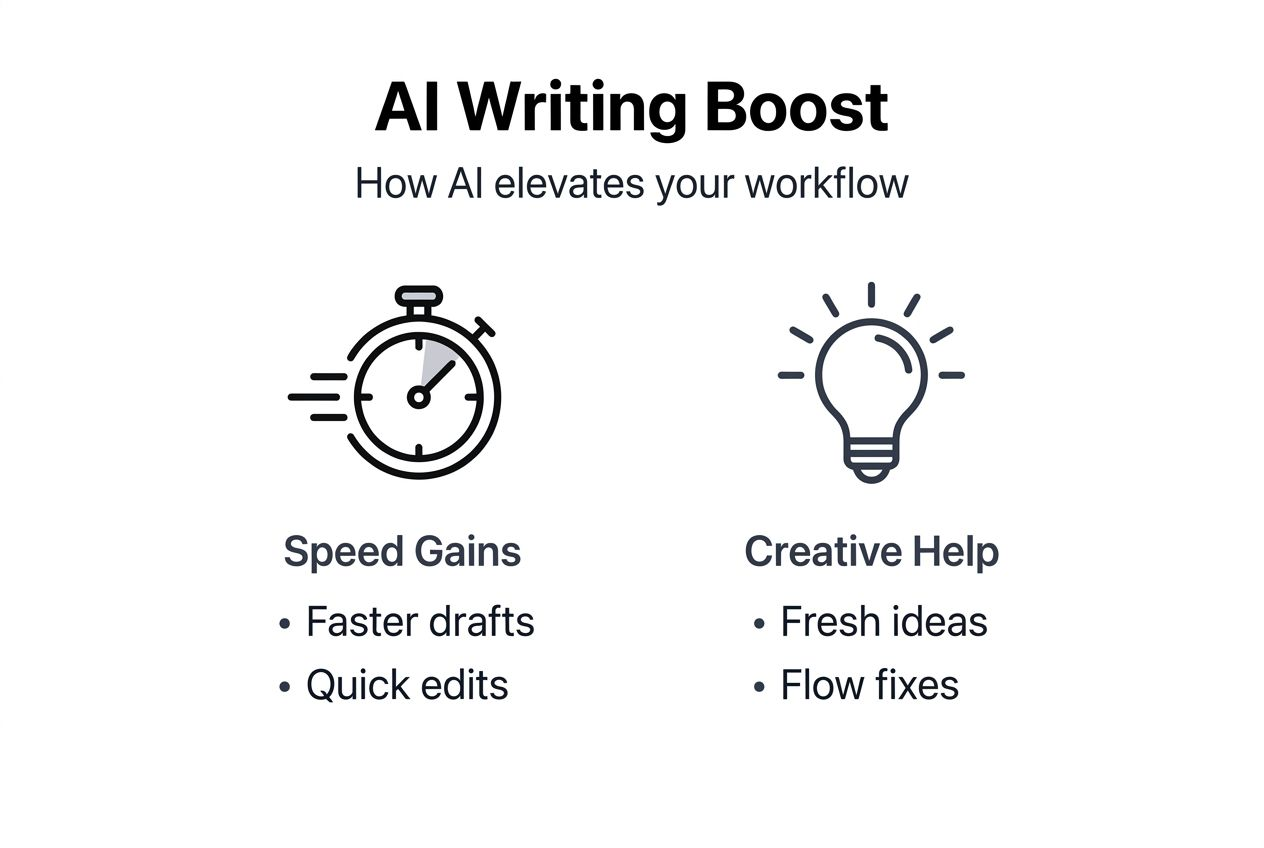
AI tools transform each phase by automating repetitive tasks and providing real-time feedback. Using AI tools in the creative writing workflow increases productivity by 30-40% by handling grammar checks, suggesting plot developments, and generating character traits. These technologies free you to focus on storytelling rather than mechanical editing. When paired with step-by-step integration of AI in story development, the workflow becomes a powerful framework for consistent progress.
Here are five essential phases in an AI-enhanced creative workflow:
- Ideation: Generate story concepts, themes, and initial character sketches using AI brainstorming tools.
- Outlining: Structure plot points, character arcs, and scene sequences with AI organizational assistance.
- Drafting: Write chapters with AI-generated prompts and grammar support to maintain flow.
- Refinement: Use AI editing tools to identify plot holes, pacing issues, and style inconsistencies.
- Polishing: Apply final grammar, syntax, and readability improvements through AI proofreading.
AI benefits extend beyond speed. These tools catch errors humans miss, suggest creative alternatives when you're stuck, and maintain consistency across long manuscripts. The key is knowing when to accept AI suggestions and when to trust your instincts. Structured workflows prevent AI from taking over your creative vision while maximizing its efficiency advantages.
Prerequisites: tools, knowledge, and preparation before starting
Before diving into AI-assisted writing, you need the right foundation. Essential AI tools include brainstorming apps like ChatGPT or Claude for idea generation, drafting assistants such as Sudowrite or NovelAI for prose support, grammar checkers like Grammarly or ProWritingAid for real-time corrections, and editing software such as AutoCrit for comprehensive manuscript analysis. Each tool serves specific phases, so select ones compatible with your workflow and writing style.
Basic creative writing knowledge remains crucial. Understanding plot structures, character development principles, narrative pacing, and dialogue techniques ensures you can evaluate AI suggestions critically. AI tools amplify your existing skills but cannot replace fundamental storytelling knowledge. If you're new to creative writing, invest time in learning core concepts before relying heavily on automation.
Preparation makes AI integration more effective. Start with a story brief outlining your premise, main characters, and core conflict. This foundation gives AI tools context to generate relevant suggestions. Without preparation, AI outputs become generic and unhelpful. Draft a simple outline, even if it's just bullet points, before engaging AI assistance.
Maintaining your author voice is non-negotiable. AI tools can mimic styles, but your unique perspective makes stories memorable. Review every AI suggestion before accepting it. Does it sound like you? Does it serve your narrative goals? Balancing AI assistance with authorial voice throughout the workflow ensures your manuscript reflects your vision, not a machine's interpretation.
Consider these additional prerequisites:
- Reliable internet connection for cloud-based AI tools
- Budget for tool subscriptions (ranging from $10 to $50 monthly)
- Time commitment for learning tool interfaces and features
- Willingness to experiment with different AI platforms
- Understanding of AI education prerequisites for effective integration
Pro Tip: Start with free AI tool trials to test compatibility with your writing habits before committing to paid subscriptions. Each platform has different strengths, and what works for one author may frustrate another.
Step 1: idea generation and brainstorming with AI
AI brainstorming tools function by analyzing patterns across millions of texts, then generating novel combinations based on your prompts. Input a genre, theme, or character type, and these systems produce dozens of variations within seconds. AI-driven brainstorming tools can generate up to 200 unique story ideas per session, dramatically expanding possibilities when facing writer's block.
The key is curation. AI generates volume, not quality. Review each suggestion critically, asking whether it aligns with your interests and audience expectations. Select ideas that spark genuine excitement, then combine multiple AI suggestions with your personal experiences to create richer concepts. This hybrid approach prevents story dilution while leveraging AI's creative range.
Avoid treating AI ideas as final products. They're starting points requiring your unique perspective. For example, if AI suggests "a detective solves crimes using time travel," you might add "but each trip erases a personal memory, forcing choices between justice and self-preservation." Your addition transforms a generic premise into something emotionally resonant.
Effective AI brainstorming methods include:
- Prompt chaining: Use AI's first output as input for the next prompt, building complexity.
- Genre blending: Ask AI to combine unexpected genres for fresh angles.
- Character-first generation: Request character profiles, then build stories around them.
- Constraint-based prompts: Give AI specific limitations (setting, time period, character count) for focused ideas.
Pro Tip: When stuck, input your favorite three books and ask AI to suggest a story that blends their themes in unexpected ways. This technique breaks creative blocks while ensuring ideas resonate with your tastes. Explore AI story development API tools to customize brainstorming parameters for your specific genre needs.
Step 2: outlining and structuring your story using AI assistance
AI-powered outlining tools transform loose ideas into structured narratives. Input your premise, character sketches, and desired story length, and these systems generate detailed chapter breakdowns, plot point sequences, and character arc progressions. This structure accelerates drafting by providing a clear roadmap, reducing the paralysis of blank pages.

Building character profiles with AI involves several steps. First, define core traits like personality, background, and motivations. Next, ask AI to suggest how these traits influence decisions at key plot moments. Finally, use AI to identify potential character inconsistencies before drafting begins. This preparation prevents mid-draft rewrites when characters act contrary to their established nature.
Data shows AI-assisted outlining can speed manuscript completion by 25% by reducing planning time and minimizing structural rewrites. Writers spend less time figuring out what happens next and more time crafting compelling prose. The outline becomes a living document, adjustable as your story evolves.
Follow these outlining best practices integrating AI suggestions:
- Start with a three-act structure as your foundation.
- Use AI to generate 10-15 potential plot points per act.
- Select the most compelling points and arrange them logically.
- Ask AI to identify pacing issues or plot holes in your arrangement.
- Refine character arcs to ensure growth across all three acts.
- Create scene-by-scene breakdowns with AI-generated emotional beats.
Here's a comparative look at writing timelines:
| Writing Phase | Without AI | With AI | Time Saved |
|---|---|---|---|
| Outlining | 3-4 weeks | 1-2 weeks | 50% |
| Character Development | 2-3 weeks | 1 week | 60% |
| Plot Structuring | 4-5 weeks | 2 weeks | 55% |
| Total Pre-Draft | 9-12 weeks | 4-5 weeks | 58% |
Utilize AI character development tools to create multi-dimensional personalities that drive plot organically. Remember, AI provides structure, but you decide which suggestions serve your story best.
Step 3: drafting your manuscript with AI support
AI-generated prompts maintain drafting momentum when motivation wanes. These tools analyze your outline and previous chapters, then suggest specific scenes or dialogue to write next. Daily AI-generated writing prompts increase consistency by 50%, helping authors meet word count goals regularly. Instead of staring at a blank screen, you respond to targeted suggestions that advance your plot.
Real-time grammar and style corrections catch errors immediately. As you type, AI tools highlight awkward phrasing, passive voice, repetitive words, and punctuation mistakes. This instant feedback improves prose quality during the first draft, reducing revision time later. You learn from corrections, gradually internalizing better writing habits.
Balancing AI's suggestions with your unique voice requires vigilance. AI tools often default to conventional phrasing or common tropes. If a suggestion feels generic, rewrite it in your style. Your narrative voice, the distinctive way you tell stories, is what readers remember. Author voice and AI balance ensures manuscripts feel authentically yours rather than machine-generated.
Common drafting challenges AI helps alleviate:
- Dialogue attribution: AI suggests varied tags beyond "said" when appropriate.
- Transition sentences: Tools generate smooth bridges between scenes.
- Description enhancement: AI offers sensory details to enrich sparse passages.
- Pacing adjustment: Systems identify sections that drag or rush.
- Consistency tracking: Tools flag contradictions in character behavior or setting details.
Pro Tip: Set a daily word count goal (500-1000 words) and use AI prompts only after attempting to write on your own first. This practice strengthens your creative muscles while keeping AI as a backup resource rather than a crutch. Track progress with AI analytics to identify your most productive writing times and patterns.
Step 4: manuscript refinement and editing powered by AI
AI editing tools reduce revision time by systematically identifying grammar errors, style inconsistencies, and structural weaknesses across entire manuscripts. These platforms analyze your work at sentence, paragraph, and chapter levels, flagging issues human eyes often miss during self-editing. Advanced tools even detect passive voice patterns, overused words, and pacing problems that bog down narratives.
Pairing AI tools with human editors yields the best results. AI catches mechanical errors efficiently, freeing professional editors to focus on deeper issues like character motivation, thematic consistency, and emotional impact. This hybrid approach improves manuscript acceptance rates by 40% because it combines machine precision with human insight. Publishers notice the difference in submission quality.
Avoid uncritical acceptance of AI edits. Every suggestion requires evaluation against your narrative intent. If AI flags a sentence as "too long" but that length creates deliberate rhythm, keep it. AI tools follow statistical patterns, not artistic choices. Your judgment determines which edits enhance your story and which would diminish it.
Best practices for iterative editing using AI feedback:
- First pass: Run AI grammar and spell check, accepting obvious errors.
- Second pass: Review style suggestions, keeping those that improve clarity.
- Third pass: Check consistency reports for character names, timeline issues, and setting details.
- Fourth pass: Analyze pacing feedback, adjusting scene lengths as needed.
- Final pass: Human editor review for content, theme, and emotional resonance.
Maintaining narrative flow during AI-assisted edits means reading chapters aloud after implementing changes. Mechanical correctness doesn't guarantee readability. Your ear catches awkward rhythms algorithms miss. Balance polish with natural voice, ensuring sentences feel conversational rather than overly formal. Learn more about AI editing and content safety to protect your work during the refinement process.
Common mistakes and troubleshooting in AI-assisted writing
Narrative inconsistency from AI overuse tops the list of common mistakes. When different AI tools suggest plot developments without your oversight, characters act contradictorily and storylines conflict. A character might be brave in chapter 3 but cowardly in chapter 10 without narrative justification. Research shows 35% of AI-assisted manuscripts fail due to these coherence issues when authors accept every suggestion blindly.
Loss of author voice occurs when writers rely too heavily on AI-generated prose. Your unique perspective gets buried under generic phrasing and predictable word choices. Readers notice when manuscripts lack personality, even if they can't articulate why. Maintaining voice requires constant vigilance, questioning every AI contribution.
Factual errors from unverified AI output damage credibility. AI tools sometimes generate plausible-sounding but incorrect information, especially regarding historical details, scientific concepts, or cultural practices. Always fact-check AI claims before including them in your manuscript. One inaccuracy can undermine reader trust in your entire narrative.
Warning: Never publish AI-generated content without thorough human review and verification. AI tools lack judgment about narrative quality, factual accuracy, and ethical implications. Your responsibility as an author includes ensuring every word serves your story and respects your readers.
Troubleshooting methods include:
- Maintain human oversight: Review every AI suggestion before implementation.
- Cross-verify content: Check AI-generated facts against reliable sources.
- Regular voice audits: Read chapters aloud to catch tone inconsistencies.
- Consistency tracking: Keep a story bible documenting character traits, timelines, and setting details.
- Balanced tool use: Limit AI to support roles rather than primary creation.
Explore common AI writing mistakes to understand pitfalls before they derail your project. Prevention is easier than correction, especially when facing major rewrites.
Expected timelines, costs, and measurable outcomes using AI workflows
Average manuscript completion time reduces from 12-18 months to 6-12 months with AI support. The 4-6 month acceleration comes primarily from faster outlining and editing phases. Writers spend less time planning and polishing, more time creating. This timeline assumes consistent daily writing habits and effective AI tool integration.
Productivity gains between 30-40% manifest as increased daily word counts and fewer revision cycles. Authors using AI workflows report writing 1000-1500 words daily versus 500-800 without AI assistance. The difference compounds over months, yielding substantially longer manuscripts in less time.
Improved manuscript acceptance rates in hybrid AI-human workflows stem from higher polish and structural coherence. Publishers receive cleaner submissions with fewer basic errors, allowing them to focus on story merit. Manuscripts developed with balanced AI assistance show 40% better acceptance rates compared to purely human-created drafts submitted without professional editing.
Here are the benchmarks you can expect:
| Metric | Traditional Workflow | AI-Enhanced Workflow | Improvement |
|---|---|---|---|
| Manuscript Completion | 12-18 months | 6-12 months | 4-6 months faster |
| Daily Word Count | 500-800 words | 1000-1500 words | 88% increase |
| Revision Cycles | 4-6 rounds | 2-3 rounds | 50% reduction |
| Acceptance Rate | 15-20% | 25-30% | 40% improvement |
| Tool Costs (annual) | $0-200 | $120-600 | Variable investment |
Expected costs for AI tool subscriptions range from $10 to $50 monthly per platform. Writers typically use 2-4 different tools across workflow phases, resulting in $240-600 annual expenses. Compare this investment against the value of 4-6 months saved and higher acceptance rates. For serious authors, the return on investment is substantial, especially when faster completion enables publishing additional books within the same timeframe.
Streamline your writing journey with Librida
Librida offers AI-powered tools designed specifically for every phase of your creative writing workflow. From ideation and character development to drafting and editing, the platform simplifies manuscript development while boosting both productivity and quality. You'll find integrated features that align perfectly with the workflow steps outlined in this guide.
Explore Librida's latest features to discover new AI capabilities added regularly, including enhanced character generation, plot structure analysis, and collaborative editing tools. The AI tools documentation provides detailed guides for customizing your writing experience, whether you're crafting your first novel or your tenth.
Key benefits of using Librida for creative writing:
- Integrated AI brainstorming that generates tailored story concepts
- Structured outlining tools with automated plot and character tracking
- Real-time drafting assistance that preserves your unique voice
- Comprehensive editing features identifying grammar, style, and consistency issues
- Progress analytics showing daily word counts and completion projections
Learn how AI storytelling integration transforms scattered ideas into cohesive narratives through Librida's innovative platform features.
FAQ
How do AI tools enhance the creative writing workflow?
AI tools boost productivity by automating repetitive editing tasks and providing real-time grammar corrections, freeing you to focus on creative storytelling. They generate story ideas, suggest plot developments, and identify consistency issues across long manuscripts that humans easily miss. However, human oversight remains essential to maintain your unique author voice and ensure narrative quality. AI complements your creativity by handling mechanical work, not by replacing your judgment or artistic vision.
What prerequisites are needed before starting an AI-powered writing workflow?
You need basic creative writing knowledge covering plot structure, character development, and narrative pacing to evaluate AI suggestions critically. Access to AI tools like brainstorming apps, drafting assistants, and editing software is essential, along with prepared story concepts or outlines. Commitment to preserving your author voice throughout the process ensures AI enhances rather than replaces your creativity. Familiarity with AI writing tools maximizes their potential and helps you integrate them effectively into your daily practice.
How can I avoid over-reliance on AI and maintain my unique writing style?
Use AI as a brainstorming and support tool while keeping all final creative decisions firmly in your control. Regularly review and edit AI-generated content to match your distinctive voice, questioning every suggestion before acceptance. Seek feedback from human readers and editors to maintain style consistency and catch areas where AI influence becomes too prominent. Balancing AI assistance with authorial voice ensures your manuscript reflects your unique perspective rather than generic machine output.
What are realistic timelines and outcomes when using AI in writing?
AI-powered workflows typically reduce manuscript completion time by 4-6 months, bringing the total from 12-18 months down to 6-12 months. Productivity gains of 30-40% are common due to automated editing and consistent AI-generated writing prompts that maintain daily momentum. Hybrid approaches combining AI tools with human editing significantly increase manuscript acceptance rates, with publishers noting the improved polish and structural coherence of submissions developed using balanced AI assistance.