

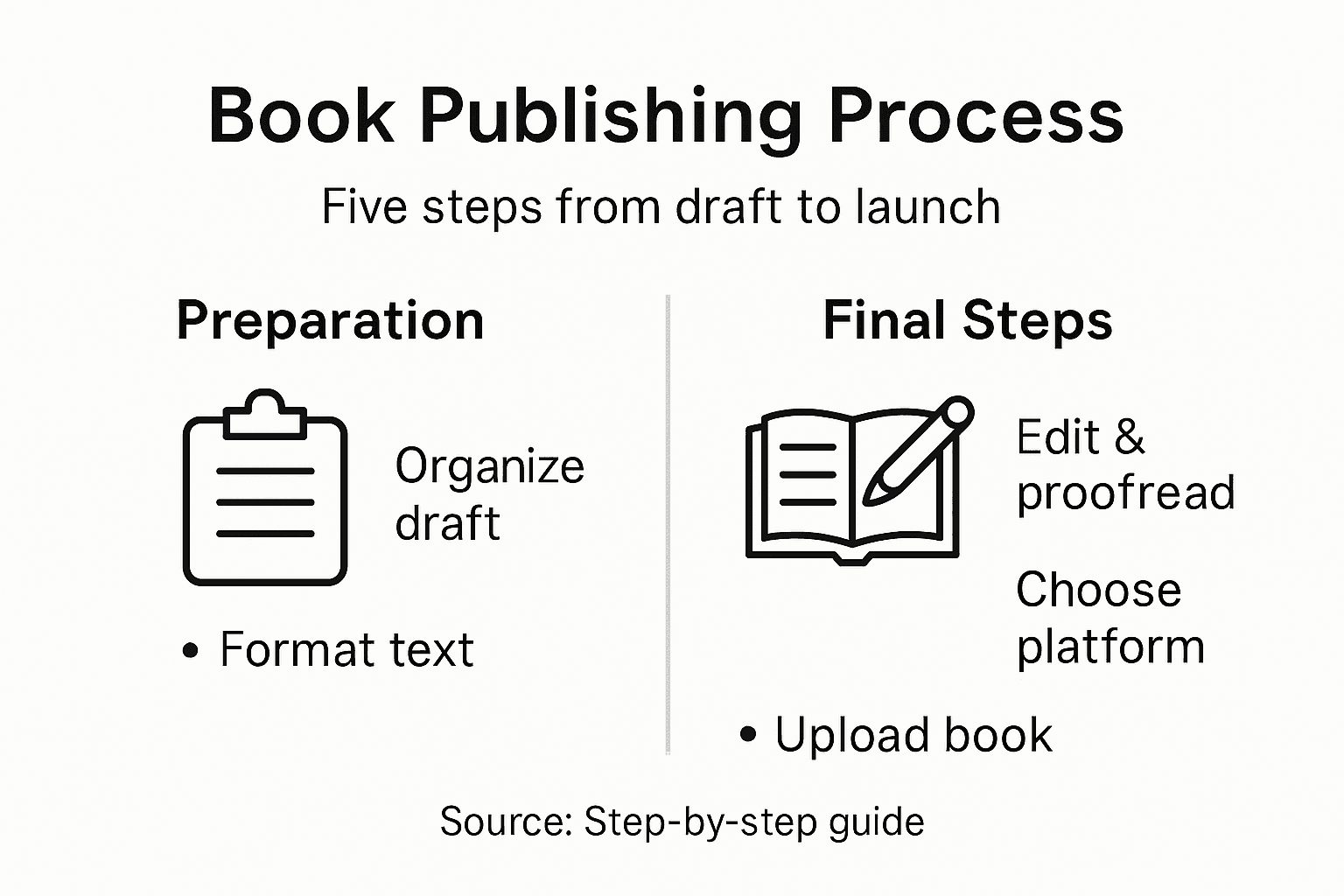
Staring at a draft and wondering how to turn it into a publishable book can feel overwhelming for any new writer. Every aspiring author dreams of seeing their work in the hands of readers worldwide, but organizing and preparing a manuscript often feels confusing. By focusing on a clear structure and taking advantage of powerful AI formatting tools, you can confidently transform raw text into a professional submission that stands out to publishers and self-publishing platforms.
Table of Contents
- Step 1: Organize Your Manuscript For Publishing
- Step 2: Format Your Book Using AI Tools
- Step 3: Edit And Proofread For High Quality
- Step 4: Choose Your Publishing Platform
- Step 5: Upload And Verify Your Published Book
Quick Summary
| Essential Insight | Explanation |
|---|---|
| 1. Organize your manuscript effectively | Structure your draft with a clear flow, including key components like title page, abstract, and chapter layout to facilitate reader understanding. |
| 2. Utilize AI formatting tools | Leverage AI software for seamless and professional document formatting, improving visual presentation and saving time on manual edits. |
| 3. Implement thorough editing and proofreading | Conduct multiple review passes to refine language and reduce errors, ensuring a high-quality final version of your manuscript. |
| 4. Choose the right publishing platform | Evaluate traditional, hybrid, and self-publishing options based on support, distribution, and costs that align with your goals. |
| 5. Ensure meticulous upload process | Carefully prepare and verify all files and metadata during the book upload to ensure a seamless publication process and professional appearance. |
Step 1: Organize your manuscript for publishing
Preparing your manuscript for publication requires strategic planning and meticulous organization. In this step, you'll transform your draft into a professionally structured document that meets publishing standards and attracts potential publishers.
Start by understanding the fundamental structure of a well-organized manuscript. Manuscript preparation involves creating a clear, logical framework that guides readers smoothly through your work. This means developing a coherent flow that makes your writing easy to follow and comprehend.
Here are key components to organize in your manuscript:
- Title page with complete author information
- Abstract summarizing your book's core content
- Table of contents showing chapter breakdown
- Chapter structure with consistent formatting
- Reference list (if applicable)
Preparing manuscript sections methodically helps maintain objectivity and improves overall coherence. Consider creating a style guide for yourself that outlines formatting rules, ensuring consistency across your entire document.
A well-organized manuscript demonstrates professionalism and increases your chances of publication.
Formatting best practices include using standard margins, selecting a readable font like Times New Roman or Arial, and maintaining consistent line spacing. Most publishers prefer double-spacing with 1-inch margins.
Pro tip: Create a separate digital folder with version-controlled drafts to track your manuscript's evolution and prevent accidental file loss.
Step 2: Format your book using AI tools
Using artificial intelligence to format your manuscript can dramatically streamline your book preparation process. In this step, you'll learn how to leverage cutting-edge AI technologies to transform your raw text into a professionally formatted document.
AI document formatting tools can automatically transform unstructured text into polished, publication-ready manuscripts. These intelligent platforms analyze your content and apply consistent formatting, ensuring your book meets professional publishing standards without hours of manual adjustments.
Here are key features of AI formatting tools:
- Automatic template application
- Consistent heading styles
- Uniform paragraph formatting
- Citation management
- Layout optimization
When selecting an AI formatting tool, consider platforms that support long-form content creation and offer natural language processing capabilities. These advanced systems can suggest improvements in readability, structure, and overall document presentation.
This table summarizes common AI formatting features and their direct benefits for authors:
| AI Tool Feature | Benefit for Authors |
|---|---|
| Automatic templates | Ensures consistent, professional look |
| Heading style uniformity | Improves document navigation |
| Citation management | Reduces reference errors |
| Layout optimization | Enhances visual appeal for readers |
AI formatting tools can save authors hours of tedious manual formatting work.
Recommended steps for using AI formatting tools include uploading your manuscript, selecting a professional template, and allowing the system to automatically adjust your document's layout and design.
Pro tip: Always review the AI-generated formatting to ensure it matches your specific publishing requirements and personal aesthetic preferences.
Step 3: Edit and proofread for high quality
Transforming your manuscript from a rough draft into a polished work requires meticulous editing and proofreading. In this critical step, you'll learn how to refine your book's language, structure, and overall quality to ensure a professional final product.

Effective manuscript proofreading focuses on coherence, clarity, and precision. This process goes beyond simple spell-checking, involving multiple layers of review to identify and correct potential issues in grammar, style, and content flow.
Key editing and proofreading strategies include:
- Read your manuscript aloud
- Check for grammatical consistency
- Verify technical accuracy
- Eliminate redundant language
- Ensure logical paragraph transitions
Using AI and human review can significantly improve your manuscript's accuracy and readability. Advanced editing tools can help identify complex grammatical issues, while human review adds nuanced understanding and contextual clarity.
Comprehensive editing transforms a good manuscript into an exceptional book.
Recommended editing workflow involves multiple review passes: first for structural issues, then for language refinement, and finally for detailed proofreading of grammar and punctuation.
Pro tip: Create a dedicated editing checklist with specific criteria to ensure you don't overlook any critical aspects of manuscript refinement.
Step 4: Choose your publishing platform
Selecting the right publishing platform is a crucial decision that can significantly impact your book's success and visibility. In this step, you'll explore different publishing options and learn how to match your manuscript with the most suitable platform for your specific goals and target audience.
Traditional publishing platforms like global academic publishers offer comprehensive support and worldwide distribution networks. These established platforms provide authors with professional editorial services, marketing resources, and credibility that can elevate your book's potential reach.
Key considerations when choosing a publishing platform:
- Distribution reach
- Editorial support
- Royalty structures
- Target audience alignment
- Publishing costs
Your publishing options typically fall into three main categories: traditional publishing, hybrid publishing, and self-publishing. Each approach offers unique advantages and challenges, so understanding the nuances will help you make an informed decision.
Here is a comparison of different publishing approaches to help you select the best fit for your manuscript:
| Publishing Type | Editorial Support | Distribution Scope | Upfront Cost |
|---|---|---|---|
| Traditional | Full editorial team | Global network | Typically none |
| Hybrid | Partial support, some paid | Regional or global | Moderate to high |
| Self-Publishing | Author self-manages | Author-chosen platforms | Low to moderate |
The right publishing platform can transform your manuscript from a personal project into a professional publication.
Recommended evaluation steps include researching platform requirements, understanding their submission guidelines, and assessing their track record in your specific genre or field.
Pro tip: Create a detailed comparison spreadsheet of potential publishing platforms, ranking them according to your specific publication goals and manuscript needs.
Step 5: Upload and verify your published book
Congratulations on reaching the final stage of your publishing journey. This step involves carefully uploading your manuscript and verifying all details to ensure a smooth publication process across digital platforms.
Uploading your book requires precise metadata entry and meticulous file preparation. You'll need to provide accurate book details, select appropriate categories, and upload professionally formatted files that meet platform specifications.
Key steps for successful book upload:
- Prepare digital files (EPUB, PDF)
- Enter comprehensive book metadata
- Set pricing and distribution rights
- Review preview versions
- Confirm publication territories
The upload process involves multiple verification checkpoints where you'll review file compatibility, formatting, and overall presentation. Most publishing platforms provide digital preview tools that allow you to examine how your book will appear to readers before final publication.
Your attention to detail during upload can significantly impact your book's professional presentation.
Recommended upload workflow includes double-checking file formats, reviewing metadata for accuracy, and utilizing platform preview features to ensure a polished final product.
Pro tip: Create backup copies of your final manuscript files in multiple formats before initiating the upload process to prevent potential data loss.
Simplify Your Publishing Journey with Librida
Publishing a book involves a lot of complex steps such as organizing your manuscript, formatting with precision, and selecting the perfect publishing platform. These challenges often leave authors feeling overwhelmed by technical details and worried about maintaining professional quality throughout the process. The key pain points include mastering manuscript structure, achieving consistent formatting, and navigating the final upload with accurate metadata to ensure your work stands out.
Librida is designed to tackle these exact hurdles by combining the power of artificial intelligence with user-friendly tools to guide you from idea to published book seamlessly. Whether you are at the editing phase or ready to format your manuscript professionally, Librida offers intuitive features like AI-assisted formatting, style consistency tools, and structured guidance to streamline each stage. This empowers you to focus on your creative passion without losing time on tedious manual tasks.
Experience the future of book publishing now at Librida.
Take control of your book preparation steps confidently and effectively.
Ready to move faster from manuscript to published book with expert support? Visit Librida and start transforming your ideas today. Explore how AI can simplify editing, enhance formatting, and help you select the ideal publishing platform to bring your story to the world with confidence.
Frequently Asked Questions
How do I organize my manuscript for publishing?
To organize your manuscript, create a clear framework that includes a title page, abstract, table of contents, consistent chapter structure, and a reference list if needed. Begin by developing a style guide that outlines formatting rules to maintain consistency throughout your document.
What AI tools can I use to format my book?
You can use AI document formatting tools that automatically apply templates, manage citations, and optimize layout. Start by selecting a tool that supports long-form content creation and then upload your manuscript for automatic adjustments.
How do I effectively edit and proofread my manuscript?
To edit and proofread your manuscript, read it aloud, check for grammatical consistency, and verify technical accuracy. Use an editing checklist to ensure you address structural issues and language refinement, aiming for a polished final product.
What should I consider when choosing a publishing platform?
When choosing a publishing platform, evaluate the distribution reach, editorial support, royalty structures, and costs. Create a comparison spreadsheet of potential platforms to rank them based on your specific publication goals and manuscript needs.
How do I upload my book after formatting it?
To upload your book, prepare digital files in proper formats, enter accurate metadata, and review your book's preview version. Follow each publishing platform's specific instructions to ensure a smooth publication process and verify all details before finalizing the upload.