

Many writers struggle to balance creative control with the need for professional publishing support. Hybrid publishing offers a real solution, blending author-driven decisions with industry expertise. This model is gaining attention because it delivers higher royalties and quicker publication while allowing you to stay involved every step. If you want to shape your book’s destiny and reach readers globally, understanding hybrid publishing will empower you to make smarter choices for your creative project.
Table of Contents
- Core Concepts of Hybrid Publishing Models
- Types and Variations in Hybrid Publishing
- How Hybrid Publishing Works Step-by-Step
- Costs, Rights, and Choosing a Publisher
- Risks, Common Pitfalls, and Alternatives
Key Takeaways
| Point | Details |
|---|---|
| Hybrid Publishing Defined | It combines elements of traditional and self-publishing, offering authors control while providing professional support. |
| Financial Investment Required | Authors contribute to production costs but retain higher royalty percentages than traditional publishing. |
| Author Control and Support | Authors approve major decisions while receiving professional editing, design, and distribution assistance. |
| Quality Variance in Publishers | Evaluate potential hybrid publishers carefully, considering their services, costs, and author testimonials to ensure alignment with your goals. |
Core Concepts of Hybrid Publishing Models
Hybrid publishing sits between two extremes: traditional publishing and self-publishing. It's where authors gain meaningful control while still accessing professional support.
The core idea is straightforward. You contribute financially to your book's production, but you also keep decision-making power and earn higher royalties. Publishers cover some costs and provide editorial, design, and distribution support—but you're an active partner, not a passive participant.
What Makes Hybrid Different
Traditional publishing puts all power and costs on the publisher. They decide covers, titles, pricing, and timelines. You earn smaller royalties, but they absorb financial risk.
Self-publishing puts all power and costs on you. You control everything but handle editing, design, marketing, and distribution yourself. You keep more royalty percentage but bear all risk.
Hybrid publishing bridges both worlds—you contribute financially and actively participate, while accessing professional resources that would cost thousands if hired independently.
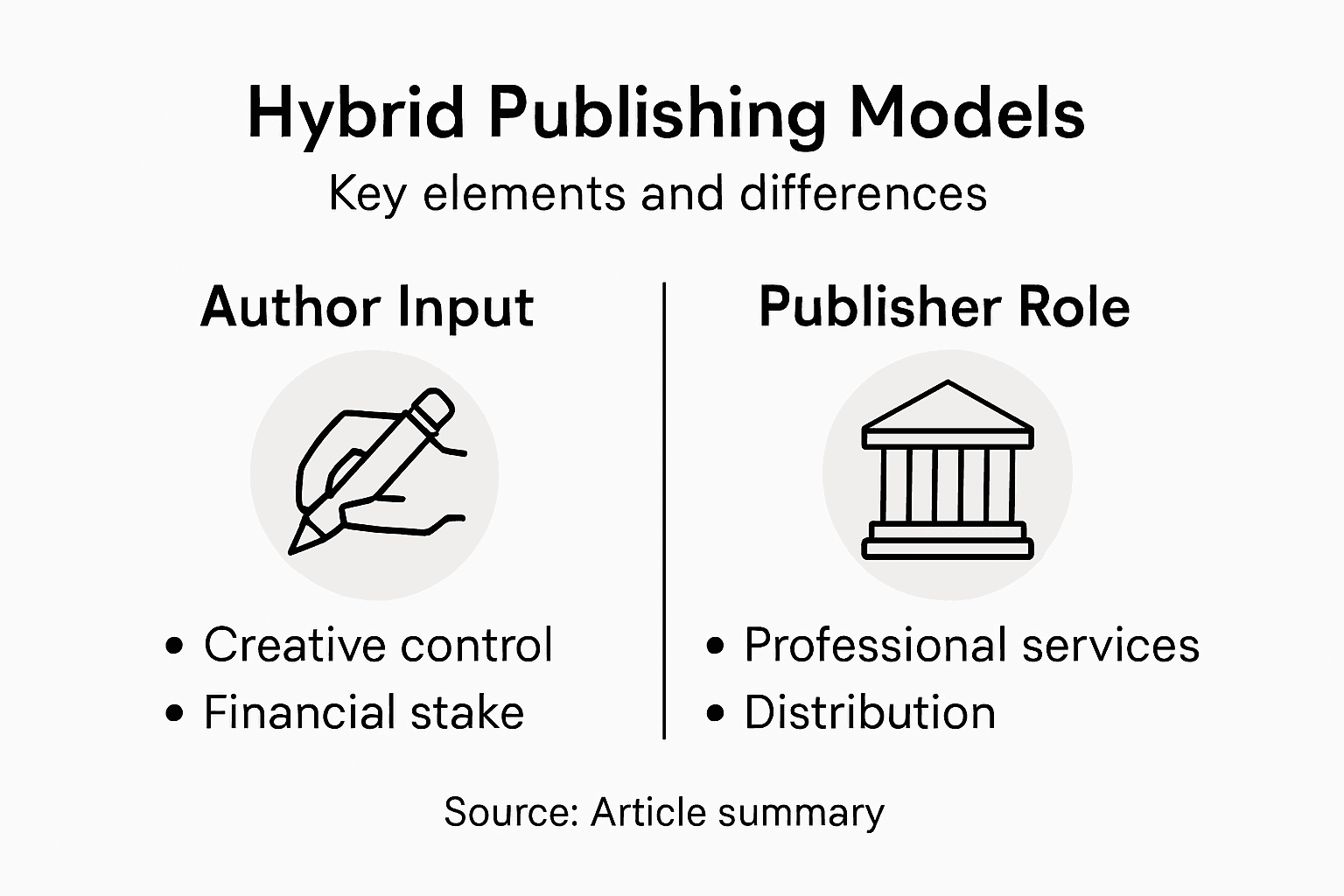
Here's a side-by-side comparison of hybrid, traditional, and self-publishing to clarify their distinctions:
| Aspect | Hybrid Publishing | Traditional Publishing | Self-Publishing |
|---|---|---|---|
| Author Control | Shared, author-driven | Publisher-dominated | Fully author-controlled |
| Upfront Costs | $5,000–$25,000 (varies) | Usually none | $2,000–$8,000 typical |
| Royalties | 50–70% (ebooks), 25–40% (print) | 10–25% (print), 25% (ebooks) | 70%+ (ebooks), 100% (print sales after costs) |
| Speed to Publication | 6–12 months | 1–2 years | 2–6 months, flexible |
| Professional Support | Editing, design, distribution | Full editorial/design team | Must outsource or DIY |
| Creative Decision | Author approves major steps | Publisher decides | Author decides all |
| Risk | Shared financial commitment | Publisher assumes risk | Author assumes all risk |
Key Features of Hybrid Models
- Financial investment: You pay for production costs (editing, design, formatting, ISBN)
- Creative control: You approve covers, titles, pricing, and marketing strategies
- Professional support: Access to editors, designers, and industry expertise
- Higher royalties: Earn 50-70% of sales, compared to 10-25% in traditional publishing
- Faster timelines: Get published in months, not years of agent/editor waiting
- Global distribution: Access to multiple sales channels without negotiating separately
Hybrid publishing offers faster publication, professional quality, and genuine author autonomy—but requires careful evaluation of publishers due to quality variance in the market.
Understanding the Financial Model
You're not paying vanity fees where publishers profit regardless of book performance. Instead, you're investing in quality production that directly serves your book's success.
Typical hybrid costs range from $3,000 to $15,000 depending on book complexity, services included, and publisher reputation. This covers professional editing, cover design, typesetting, and initial distribution setup.
The difference from self-publishing: you're not paying for every service separately or learning complex design and formatting yourself. The difference from traditional publishing: you're not giving away control or waiting years for approval.
Who Benefits Most from Hybrid Publishing
Hybrid works best for authors who want professional quality without surrendering creative decisions. This includes niche authors, memoir writers, entrepreneurs building author platforms, and established writers testing new ideas.
It also appeals to authors seeking global reach without traditional publisher gatekeeping.
Pro tip: Before committing to any hybrid publisher, verify their distribution network includes major retailers (Amazon, Apple Books, Barnes & Noble), check author testimonials on independent sites, and request sample books they've published to assess quality standards.
Types and Variations in Hybrid Publishing
Hybrid publishing isn't one-size-fits-all. Different publishers offer vastly different service packages, costs, and acceptance criteria—creating a spectrum of options for different author needs.
Understanding these variations helps you choose the right fit for your book and budget. Some hybrids are selective and competitive; others accept nearly every manuscript. Some bundle comprehensive marketing; others focus purely on production and distribution.
Selective Versus Open-Acceptance Models
Selective hybrid publishers maintain quality standards and review manuscripts before acceptance. They're pickier about which books they publish, similar to traditional publishers but with author financial involvement.
Open-acceptance hybrids take almost any manuscript. They require less vetting and move faster but may have lower overall quality standards. These work well for niche authors or those wanting to publish quickly without rejection.
Both models exist because different authors have different priorities. Some want the credibility of selectivity; others want guaranteed publication speed.
Service Package Variations
Service package differences create distinct hybrid approaches tailored to author needs and budgets worldwide.
Full-service hybrids offer:
- Professional editing (developmental, line, copy)
- Cover design by experienced designers
- Interior layout and typesetting
- Marketing consultation and promotion
- Global distribution setup
- ISBN and copyright registration
Production-focused hybrids offer:
- Basic editing and proofreading
- Standard cover design templates or simple design
- Print and digital formatting
- Distribution to major retailers
- Limited or no marketing support
Some hybrids excel at author support and marketing; others provide only production services. Know what you're paying for before signing any contract.
Cost-Sharing Models
Hybrid publishers structure costs differently. Some charge flat fees upfront. Others use percentage-based splits where author and publisher share costs proportionally.

A few innovative hybrids only charge if your book sells, recovering costs from revenue sharing. This rare model aligns publisher interests directly with book success.
Understanding cost structures prevents surprises. Ask whether your fee is all-inclusive or if additional costs emerge later.
Here's a summary of common hybrid publishing cost models and what makes them unique:
| Cost Model | Payment Structure | Author Commitment | Typical Publisher Approach |
|---|---|---|---|
| Flat Fee | One upfront payment | Fixed costs, no surprises | Service bundle, clear contract |
| Percentage Split | Services cost split by percent | Ongoing shared expenses | Costs tied to project progress |
| Pay-Only-If-Sold | Fees withdrawn from sales | No upfront expense | Publisher vested in sales |
| Line-Item Charges | Itemized service payments | Flexible but can add up | À la carte, custom packages |
Distribution and Rights Variations
Some hybrids retain distribution rights and handle sales channels. Others give you full rights and simply guide you through self-distribution options.
Distribution scope varies too. Some cover print-on-demand, ebook, and audiobook formats. Others focus only on one or two formats.
Global reach varies significantly. A hybrid publisher in your country may not have strong distribution networks internationally, limiting your book's worldwide visibility.
Pro tip: Before choosing a hybrid publisher, request their complete service list in writing, ask specifically what's included in your quoted price, and verify their distribution extends to markets where your target readers actually shop.
How Hybrid Publishing Works Step-by-Step
The hybrid publishing process feels manageable when you break it down. Most publishers follow a similar workflow, though timing and specifics vary by publisher choice.
Understanding each step prevents surprises and helps you prepare mentally and financially for what's ahead. The journey typically spans 6 to 12 months from submission to published book in readers' hands.
Step 1: Research and Publisher Selection
Start by identifying hybrid publishers that match your book's genre and your budget. Not all hybrids are equal—some specialize in memoir, others in business books or fiction.
Create a comparison list including:
- Service packages and what's included
- Total costs (upfront and ongoing)
- Author royalty percentages
- Distribution reach and retailer access
- Timeline to publication
- Author testimonials and sample books
Read contracts carefully. Look for hidden fees, rights retention clarity, and what happens if your book goes out of print.
Step 2: Manuscript Submission and Evaluation
Submit your manuscript according to publisher guidelines. Some require polished drafts; others accept rougher versions.
The publisher reviews your work to assess market viability (in selective models) or simply confirms it meets basic standards. This step typically takes 2 to 4 weeks.
If accepted, you'll receive a contract outlining services, costs, timeline, and rights agreements. Review this thoroughly before signing.
Step 3: Developmental Editing and Revisions
A developmental editor examines story structure, pacing, character development, and overall flow. They provide detailed feedback identifying what works and what needs fixing.
You'll revise based on their suggestions, typically over 4 to 8 weeks. This back-and-forth refines your manuscript significantly before moving to line editing.
Quality developmental editing transforms decent manuscripts into compelling books—it's where rough ideas become polished stories readers can't put down.
Step 4: Copy Editing and Proofreading
Copy editors fix grammar, consistency, tone, and style issues. They ensure your voice remains intact while polishing technical elements.
Proofreaders catch remaining typos and formatting inconsistencies. Both roles catch errors you've missed after multiple rewrites.
This phase typically takes 3 to 6 weeks depending on manuscript length and complexity.
Step 5: Cover Design and Interior Layout
Your designer creates a cover that attracts your target readers and stands out on retail shelves (physical and digital). Most hybrids provide 2 to 3 revision rounds.
Simultaneously, layout specialists format your interior—choosing fonts, spacing, margins, and page design. Print and digital versions may require different formatting.
This phase takes 4 to 8 weeks from initial concepts to final files.
Step 6: ISBN Assignment and Metadata Setup
Your hybrid publisher assigns an ISBN (International Standard Book Number) identifying your unique book. They create metadata—title, author name, description, keywords, categories—that retailers use for discoverability.
Accurate metadata matters tremendously for findability. Poor metadata means readers searching your topic won't find your book, regardless of quality.
Step 7: Distribution and Launch
Your publisher distributes files to print-on-demand facilities, ebook platforms (Amazon, Apple Books, Google Play), and sometimes audiobook narrators.
Within weeks, your book appears on major retailer websites. You can then launch marketing campaigns, request reviews, and reach readers.
Distribution setup usually completes 2 to 4 weeks before official launch date.
Step 8: Marketing and Ongoing Sales
Hybrid publishers typically provide limited ongoing marketing support. You handle primary promotion through social media, author website, email lists, and outreach.
Some hybrids offer optional paid promotional services. Monitor sales regularly and adjust your marketing based on what generates actual purchases.
This phase continues indefinitely—your book remains "alive" as long as you actively promote it.
Pro tip: Start building your author platform and email list before your book launches; readers who already know you are vastly more likely to purchase and review your work, giving your launch momentum from day one.
Costs, Rights, and Choosing a Publisher
Money and ownership matter enormously in publishing decisions. Understanding what you'll pay and what you'll retain prevents costly mistakes and protects your creative work long-term.
Hybrid publishing isn't free, but it's also not a scam if you choose wisely. The key is knowing what's typical, what's fair, and which publishers deserve your investment.
Understanding Hybrid Publishing Costs
Hybrid publishing typically requires upfront costs from $5,000 to $25,000 depending on services included. This range covers different service levels and book types.
What determines your exact cost?
- Book length (longer books need more editing and design time)
- Service level (basic versus comprehensive packages)
- Professional experience (established designers charge more than new ones)
- Genre (complex books like textbooks cost more than simple memoirs)
- Marketing add-ons (these escalate costs significantly)
Break down any quote into line items. Know exactly what $8,000 covers versus what $15,000 includes. Some publishers bundle everything; others charge separately for each service.
Decoding What's Included
Don't assume all hybrid publishers offer identical services. A $6,000 package might include only editing and basic cover design, while a $12,000 package adds marketing consultation, audiobook narration, and wide distribution.
Ask publishers these specific questions:
- How many revision rounds for editing and cover design?
- Who owns the cover design files after publication?
- Does your fee cover distribution setup or just production?
- Are there ongoing fees after publication?
- What marketing support is included versus optional?
Hidden fees emerge when you ask for extras. Clarify everything upfront.
Rights Ownership and Royalties
Copyright ownership is non-negotiable. You must retain full copyright of your manuscript and published work. Never transfer copyright to a publisher—this is a red flag indicating a predatory hybrid.
Royalty percentages vary by hybrid. Standard royalties range from 50% to 70% on ebook sales and 25% to 40% on print sales. Traditional publishers offer 10% to 15% on print and 25% on ebooks, so hybrids should beat those numbers significantly.
Understand the difference between net royalties (calculated from publisher's revenue after retailer cuts) and gross royalties (calculated from cover price). Gross royalties benefit you far more.
Retaining copyright means you control your book's future—you can change publishers, create adaptations, or license translations without negotiating with anyone else.
Red Flags When Evaluating Publishers
Avoid publishers that:
- Demand copyright ownership or "exclusive" rights
- Require you buy minimum copies of your own book
- Charge excessive upfront fees (beyond $25,000 without clear justification)
- Offer vague contract language about rights or royalties
- Have no verifiable track record or author testimonials
- Pressure you to decide quickly
- Refuse to provide sample books they've published
- Use outdated websites or unprofessional communication
Evaluating Publisher Reputation
Research publishers thoroughly before signing:
- Search for author reviews on independent sites (not just the publisher's website)
- Ask for references and contact recent authors directly
- Examine sample books they've published for quality
- Check Better Business Bureau ratings and complaint histories
- Verify they have actual distribution agreements with major retailers
- Confirm they employ professional editors and designers
A reputable hybrid publisher invites scrutiny and provides proof of their legitimacy.
Making Your Final Decision
Create a comparison spreadsheet listing:
- Total cost and what's included
- Royalty percentages (ebook and print separately)
- Rights retention clarity
- Distribution reach and retailer access
- Timeline to publication
- Author support and marketing inclusions
- Publisher reputation score (based on research)
Score each publisher and compare totals. The cheapest isn't always best if they skimp on quality. The most expensive isn't automatically superior either.
Choose the publisher offering the best value—quality services at fair pricing with genuine author support.
Pro tip: Request sample contracts from multiple publishers and have a publishing lawyer review them (expect $300-500 for contract review); this investment prevents thousands in regret later when you discover unfavorable terms.
Risks, Common Pitfalls, and Alternatives
Hybrid publishing isn't perfect. It attracts both legitimate publishers and predatory operators who exploit authors' dreams. Understanding risks protects you from expensive mistakes.
Not every publishing path works for every author either. Sometimes alternatives better match your goals, timeline, or budget.
The Vanity Press Trap
Vanity presses disguised as hybrid publishers charge high fees but offer limited editorial and distribution support. They profit from author payments regardless of book success.
Here's how to spot them:
- They accept virtually every submission without evaluation
- They emphasize author payment over manuscript quality
- They offer minimal editing or use generic templates
- They lack verifiable distribution agreements
- They pressure you to buy bulk copies of your own book
- They provide no marketing support whatsoever
- They have no author testimonials or verifiable track record
Legitimate hybrids make money when your book sells. Vanity presses make money when you sign the contract.
Contract Pitfalls to Avoid
Problematic contract terms can lock you into unfavorable arrangements for years. Watch for:
- Requests for copyright transfer (run away immediately)
- Exclusive rights preventing you from republishing elsewhere
- Automatic contract renewal without your approval
- Vague definitions of "out of print" (books stay in print indefinitely)
- Clauses requiring you to purchase inventory
- High termination fees or impossible exit conditions
- Non-transparent royalty calculations
Have a publishing attorney review contracts before signing. This $300-500 investment prevents thousands in regret.
Quality Control Issues
Predatory practices and lack of quality control plague some hybrid operations. Poor editing, amateurish covers, and sloppy formatting damage your author credibility.
Authors report:
- Editors with minimal publishing experience
- Cover designs that look homemade or dated
- Interior formatting that reads unprofessionally
- Books rejected by major retailers due to quality issues
- No actual distribution despite claims of "global reach"
Quality matters because readers judge your professionalism by your book's appearance.
Marketing Expectations
Many hybrids promise marketing support then deliver nothing meaningful. They expect you to handle all promotion while taking royalty cuts.
Be realistic: most publishers provide minimal marketing. You'll do most promotion yourself regardless of publishing model. Factor this into your decision.
Predatory publishers destroy authors' credibility and wallets simultaneously. Vetting thoroughly before committing prevents both outcomes.
Exploring Alternative Publishing Paths
Traditional publishing remains viable if you're patient. Publishers cover all costs, provide professional teams, and offer prestige. Trade-offs: slow timelines (1-2 years), loss of control, lower royalties, and agent gatekeeping.
Self-publishing gives you complete control and higher royalties (70%+ on ebooks). You handle editing, design, and marketing. Trade-offs: substantial upfront costs ($2,000-8,000), steeper learning curve, and no built-in distribution.
Open access publishing removes paywalls and reaches broader audiences. Many provide free publication. Trade-offs: limited commercial potential, smaller print runs, and less author support.
Small independent presses offer middle ground between traditional and self-publishing. They're selective, provide professional support, and retain author rights. Trade-offs: slower timelines and smaller marketing budgets than major houses.
Choosing Your Path
Consider these factors:
- Timeline: How urgently do you need your book published?
- Budget: What can you realistically invest?
- Control: How important is creative decision-making to you?
- Credibility: Are you building an author platform or one-off publication?
- Genre: Do readers in your category expect traditionally published books?
Hybrid works best for authors wanting professional quality, reasonable speed, creative control, and genuine author partnerships. If other factors matter more, alternatives might serve you better.
Pro tip: Join author communities on Reddit, Facebook, and specialized forums where real authors share hybrid publisher experiences; their firsthand accounts reveal which publishers deliver and which disappoint.
Take Control of Your Publishing Journey with Librida
Navigating the complexities of hybrid publishing can feel overwhelming with questions about creative control, upfront costs, and finding the right professional support. This article highlights how authors like you seek genuine autonomy, faster publication timelines, and access to expert resources without sacrificing quality or royalty potential. If you are ready to move beyond traditional barriers and avoid costly pitfalls while bringing your story to life, Librida offers a powerful solution.
Empower your writing process with Librida’s AI-powered platform designed to simplify manuscript development, enhance productivity, and guide you through every stage of creating a polished book. Whether you want to take charge of your creative decisions or streamline complex steps like editing and formatting, Librida helps you build a professional-quality manuscript that can confidently enter the hybrid publishing world. Don’t wait for years to see your vision realized. Visit Librida today and discover how technology can turn your ideas into published works faster and smarter. Start your journey now at https://librida.com and experience the future of author empowerment.
Frequently Asked Questions
What is hybrid publishing?
Hybrid publishing is a model that combines elements of traditional publishing and self-publishing, allowing authors to maintain creative control while still receiving professional support and resources from a publisher. This model typically requires authors to contribute financially to the production of their books.
How does hybrid publishing differ from traditional and self-publishing?
In traditional publishing, the publisher bears all costs and makes key decisions, resulting in lower royalties for the author. Self-publishing grants full control to the author, who also assumes all costs and risks. Hybrid publishing strikes a balance, providing professional support while allowing authors to maintain some level of control and earn higher royalties.
What are the financial implications of hybrid publishing?
Authors typically invest between $5,000 and $25,000 in hybrid publishing, covering costs for editing, design, and distribution. However, they also earn higher royalties, ranging from 50% to 70% for ebooks and 25% to 40% for print sales, compared to lower percentages offered by traditional publishers.
Who is the ideal author for hybrid publishing?
Hybrid publishing is particularly suitable for authors who want professional quality and global reach while retaining creative control. This includes niche authors, memoir writers, entrepreneurs, and established writers looking to experiment with new ideas.