

Many first-time authors expect a straight path from finished manuscript to printed book, only to discover the journey is full of unexpected complexity. Understanding the publishing workflow is crucial because each phase—writing, editing, design, and marketing—directly shapes your book's success. Learn how the right workflow, combined with smart use of AI tools, gives you control, saves time, and ensures your story reaches readers in its best possible form.
Table of Contents
- Publishing Workflow Defined And Misconceptions
- Types Of Publishing Workflows Explained
- Key Stages And Role Assignments
- AI Tools And Automation Benefits
- Risks, Challenges, And Common Mistakes
Key Takeaways
| Point | Details |
|---|---|
| Understanding the Publishing Workflow | The publishing workflow is a structured process that a manuscript goes through, from submission to distribution, and includes multiple stages and stakeholders. Each stage is crucial to ensure quality and success. |
| Importance of Professional Editing | Many authors mistakenly view editing as optional; however, professional editing enhances clarity and structure, critical for a book's reception. Skipping this step can lead to negative reviews. |
| Effective Marketing Begins Early | Marketing should start well in advance of publication, ideally 3-6 months prior, to build an audience and generate buzz, rather than waiting until launch day. |
| Choose the Right Workflow Model | Selecting a publishing workflow that matches your needs—linear for simplicity, task-based for teamwork, or status-based for transparency—is essential for efficiency and success. |
Publishing Workflow Defined and Misconceptions
Most aspiring authors imagine a simple path: finish manuscript, send to publisher, watch it appear on shelves. Reality looks different. A publishing workflow is the entire structured process a manuscript moves through from submission to reader's hands, involving multiple stages, stakeholders, and quality checks.
The actual journey includes planning, writing, editing, formatting, cover design, marketing setup, and distribution. Each step matters. Skip one, and your book stumbles at the finish line.
What the Publishing Workflow Actually Is
Think of a publishing workflow as an assembly line with intelligence. Your manuscript enters at one end and undergoes transformation through specialized stages.
Here's what typically happens:
- Manuscript preparation: You finalize content, fix obvious errors, and organize chapters
- Professional editing: Developmental editors shape structure; copy editors polish language
- Cover and layout design: Visual elements take form alongside interior formatting
- Proofing and quality review: Multiple eyes catch remaining issues
- ISBN and metadata setup: Technical details enable discoverability
- Distribution setup: Files route to retailers, distributors, and marketing channels
- Launch coordination: Release timing, marketing push, and audience outreach align
The editorial workflow in academic publishing reveals that even formal systems involve detailed phases including evaluation, review, and revisions. Your self-publishing journey mirrors this complexity, though you control most decisions.
Common Misconceptions That Slow Authors Down
Misconception 1: Editing is optional or a quick pass
Many first-time authors skip professional editing to save money. Your friends spotting typos isn't editing. Real editing transforms clarity, structure, and reader experience. Readers notice sloppy books immediately and leave brutal reviews.
Misconception 2: Cover design doesn't matter much
Covers are your first sales pitch. A weak cover tanks sales, regardless of content quality. Readers judge books by appearance within seconds before reading any synopsis.
Misconception 3: Finishing the manuscript means you're done writing
Most authors don't realize their first draft is truly a first draft. Multiple revision rounds typically happen during professional editing and layout stages. Expect to revise substantially.
Misconception 4: You should publish immediately after completing the draft
Rushing publication leads to errors that damage your author reputation. A proper workflow takes weeks or months depending on your chosen path.
Misconception 5: Marketing starts after publication
The most effective marketing happens before and during publication. Building an audience, creating launch buzz, and preparing promotional materials should begin months earlier.
Your publishing workflow isn't a race—it's a sequence of connected steps that each affect the final result. Skipping or rushing any stage shows up in your finished book.
Pro tip: Map your entire workflow before writing or immediately after finishing your draft. Knowing exactly which steps come next prevents costly mistakes and keeps you moving steadily toward publication rather than floundering at unexpected obstacles.
Types of Publishing Workflows Explained
Not all publishing workflows look the same. Your ideal workflow depends on your timeline, budget, team size, and publishing method. Understanding your options prevents choosing a system that works against you.
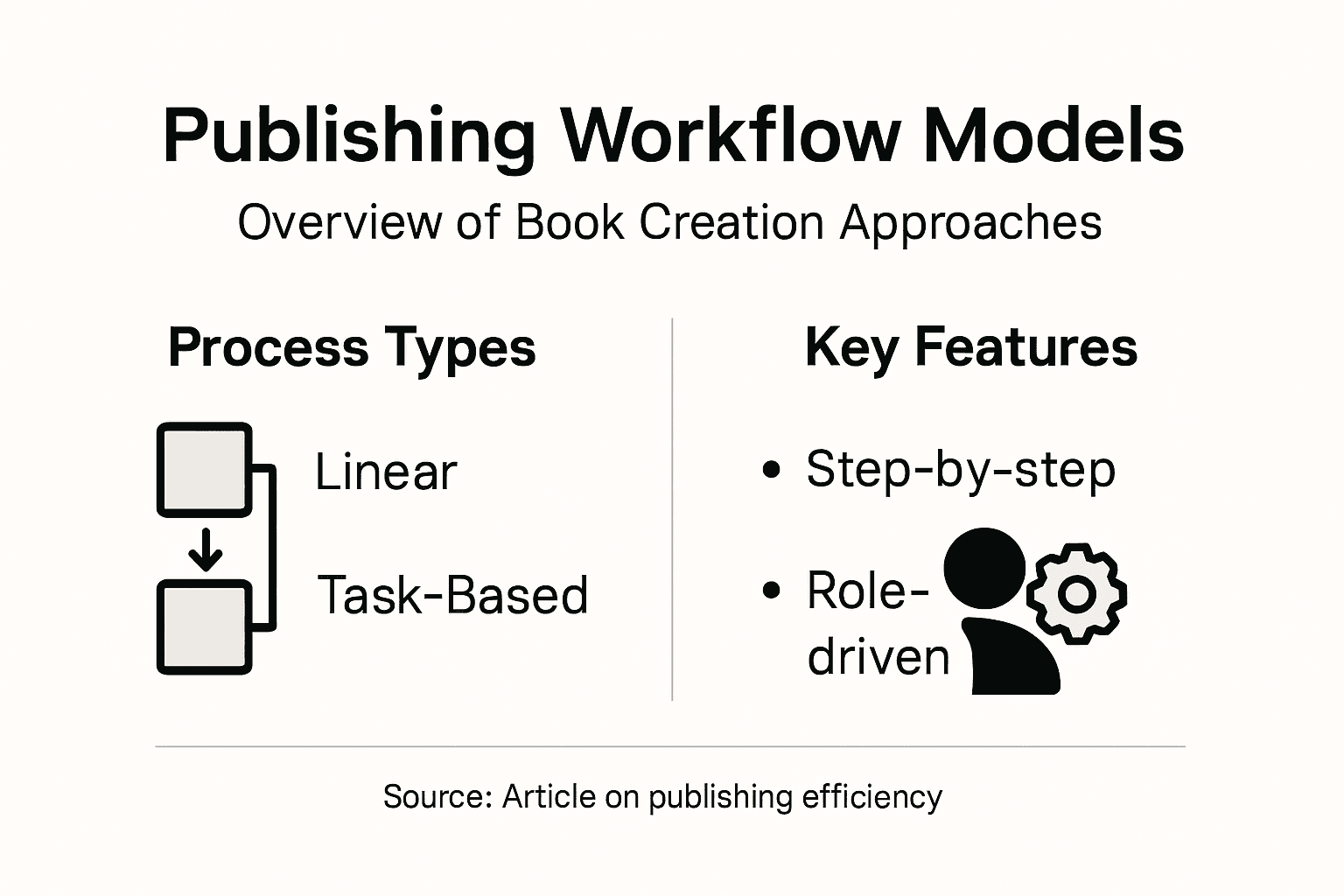
There are three main workflow models, though most authors blend them. Each has distinct strengths for different situations.
Linear Workflows: Step-by-Step Progression
A linear workflow moves your manuscript through stages sequentially. Each phase completes before the next begins. First comes editing, then design, then distribution setup.
This approach works well when:
- You have a clear timeline and can't skip steps
- You're working alone or with a small team
- You prefer predictability and straightforward progression
- Each stage depends on the previous one finishing
Linear workflows suit first-time self-publishers. You move forward steadily without juggling multiple concurrent tasks. The downside: waiting for one person to finish their work before you can proceed slows everything down.
Task-Based Workflows: Roles and Deadlines
Task-based workflows assign specific responsibilities with clear deadlines. An editor gets the manuscript with a due date. A designer starts cover work on a separate timeline. A marketer begins preparing campaigns simultaneously.
Key features include:
- Clear role definitions for each contributor
- Assigned deadlines for specific deliverables
- Ability to work on multiple elements in parallel
- Accountability and measurable progress
Task-based workflows accelerate publication. Multiple people work simultaneously on different elements. This model requires good communication and coordination, making it ideal for authors working with publishing professionals or larger teams.
Status-Based Workflows: Tracking Progress Through Stages
Status-based workflows track your manuscript's location in the publishing pipeline. Think of stages like "In Writing," "Under Edit," "Design Phase," "Quality Review," and "Published." Content moves from one status to the next, giving everyone visibility.
Status-based systems shine when:
- You need transparency across multiple contributors
- You want to see exactly where everything stands
- You're managing complex projects with interdependencies
- You need historical records of what happened when
These workflows work beautifully with project management software. Everyone checks the same dashboard and knows current status instantly.
How Publishing Methods Influence Your Workflow Choice
Publishing workflows vary across commercial and digital contexts based on unique needs. Traditional publishers use rigid linear workflows with gatekeepers. Self-publishers have flexibility to choose.
Self-publishing with Librida typically blends task-based and status-based models. You control pacing while tracking progress through clear stages.
Here's a side-by-side look at the main publishing workflow models:
| Workflow Model | Best For | Key Strength | Primary Limitation |
|---|---|---|---|
| Linear | First-time solo authors | Simple step-by-step process | Slowest overall speed |
| Task-Based | Teams, professionals | Parallel work, faster pace | Needs strong coordination |
| Status-Based | Complex, multi-person projects | High transparency, progress tracking | Can be overwhelming for beginners |
The best workflow matches how you actually work, not how you think you should work. Choose based on your personality, team size, and timeline.
Pro tip: Start with a linear workflow for your first book to keep things simple, then upgrade to task-based or status-based systems once you understand the publishing process and want to work faster.
Key Stages and Role Assignments
Your publishing workflow only works if everyone knows their job. Each stage requires specific expertise and decision-making authority. Without clear role assignments, manuscripts stall and timelines slip.
Understanding who does what at each point prevents confusion and keeps momentum going.
Stage 1: Development and Planning
This is where your book concept becomes real. You outline chapters, develop your story premise, and decide your target audience.
Roles in this stage:
- You (the author): Create the core content and vision
- Developmental consultant (optional): Helps structure your book and identify weak areas
- Subject matter expert (if needed): Validates technical or specialized content
During development, you're gathering feedback and refining direction. This stage sets up everything that follows.
Stage 2: Writing and Manuscript Preparation
You complete your manuscript during this phase. Most authors work alone here, though some hire writing coaches or beta readers for feedback.
This stage involves:
- Writing your manuscript draft
- Self-editing for clarity and flow
- Gathering beta reader feedback
- Making substantial revisions based on input
Roles are simple: you write. Others may review and suggest improvements, but you control the revisions.
Stage 3: Professional Editing
The publishing process involves distinct roles including project editors who manage manuscripts through production and ensure quality standards are met. Your developmental editor shapes overall structure and pacing. Your copy editor polishes grammar, consistency, and language clarity.

Some authors hire both; others choose one based on budget. Developmental editing costs more but transforms weak manuscripts into strong ones.
Stage 4: Design and Production
Once editing finishes, your cover designer and layout specialist take over. The cover designer creates your book's exterior. The layout specialist formats your interior, chooses fonts, and handles spacing.
Your role here: Approve designs and provide feedback. Designers need your vision to guide their work.
Stage 5: Proofing and Quality Assurance
A fresh set of eyes catches remaining errors. Your proofreader reviews the final formatted pages line by line. They catch typos, formatting inconsistencies, and printing issues.
This is your last chance to fix problems before publication.
Stage 6: Distribution and Marketing Setup
Marketing specialists prepare your book for launch. Distribution coordinators handle ISBN assignment, retailer setup, and distribution channels. You guide marketing strategy while professionals execute details.
Compare the publishing workflow stages and who leads each function:
| Stage | Main Responsible Role | Core Decision Focus |
|---|---|---|
| Development & Planning | Author (sometimes consultant) | Book vision and structure |
| Manuscript Writing & Prep | Author | Draft and self-editing |
| Professional Editing | Editor(s) | Content quality and clarity |
| Design & Production | Designer/Layout Specialist | Visual appeal and formatting |
| Proofing & Quality Assurance | Proofreader | Final error correction |
| Distribution & Marketing Setup | Marketing/Distribution Specialist | Launch strategy and reach |
Clear role assignments prevent work from falling through cracks and ensure every task gets proper attention from someone qualified to do it.
Pro tip: Document who owns each stage and what decisions they make before your manuscript enters any workflow, then share this clarity with everyone involved.
AI Tools and Automation Benefits
AI is reshaping how authors publish. Instead of drowning in repetitive tasks, you focus on your story while AI handles the grunt work. For first-time self-publishers, this changes everything.
The real power isn't replacement. It's leverage.
Manuscript Screening and Quality Enhancement
AI tools analyze your manuscript before expensive human editing begins. They identify structural weaknesses, inconsistent pacing, and clarity issues automatically.
Benefits include:
- Catching obvious grammar and spelling errors instantly
- Flagging repetitive phrasing and awkward sentence structure
- Identifying plot holes or character inconsistencies
- Suggesting improvements without changing your voice
- Saving money by catching issues before hiring a professional editor
This preliminary screening means your editor focuses on bigger-picture improvements rather than basic cleanup. Your editing investment goes further.
Content Organization and Formatting
AI tools assist with multi-format content structuring, automatically handling different book formats and chapter organization. AI can extract metadata automatically—book description, keywords, chapter headings—without manual entry.
This automation saves hours on administrative work. You skip tedious data entry and move directly to creative decisions.
Marketing Analytics and Metadata Optimization
AI analyzes what makes books discoverable. It suggests keywords your target readers actually search for, not generic terms everyone uses.
AI-powered systems help with:
- Identifying high-performing keywords in your genre
- Analyzing competitor book positioning
- Suggesting optimal book categories and subcategories
- Creating metadata that improves visibility across retailers
Better metadata means better discoverability. Readers who want your book actually find it.
Speed and Accuracy Improvements
Intelligent workflows powered by AI enable faster manuscript processing and quality checks, dramatically reducing production timelines while maintaining standards. What took weeks now takes days. Accuracy improves because machines don't get tired or miss patterns humans overlook.
For authors on tight timelines, this acceleration is invaluable.
The Human Element Remains Crucial
Here's what matters: AI enhances your work, but doesn't replace critical decisions. You choose which AI suggestions to accept. Your editor still shapes your narrative voice. Your designer still makes aesthetic choices.
AI handles repetitive work. You handle creative decisions.
AI is most powerful when paired with human judgment—automation accelerates the boring parts so you can focus on what makes your book uniquely yours.
Pro tip: Start with AI manuscript screening to identify problem areas, then hire your professional editor with a focused task list instead of asking them to start from scratch.
Risks, Challenges, and Common Mistakes
Publishing dreams derail when authors overlook critical pitfalls. Some mistakes cost money. Others damage your reputation permanently. Knowing what goes wrong helps you avoid it.
The good news: most problems are preventable.
Poor Manuscript Preparation
Many authors submit drafts thinking editors will fix everything. That's not how it works. Submitting sloppy work wastes everyone's time and money.
Common preparation mistakes:
- Inconsistent formatting and chapter structure
- Unresolved plot holes or timeline issues
- Overuse of clichés or weak dialogue
- Failure to proofread basic errors
- Unclear target audience or purpose
Your manuscript should be polished before professional editing begins. Self-edit ruthlessly first. Your editor's job is refinement, not salvage.
Ignoring Submission Guidelines and Scope
Common mistakes include misunderstanding journal scopes and failure to comply with submission guidelines, which wastes time and damages credibility with professionals. Each editor, agent, or platform has specific requirements. Ignoring them signals carelessness.
Always read guidelines completely before submitting anything.
Underestimating Timeline and Budget
Authors consistently underestimate how long publishing takes and how much it costs. Quality editing runs $1,000 to $5,000+. Professional cover design costs $500 to $2,000. Marketing requires months of preparation.
Rushing these phases destroys your book's potential. Plan for 6-12 months and budget accordingly.
Trusting Predatory Services
Watchdog for scams. Predatory publishers charge excessive fees, offer unrealistic promises, or demand rights to your work permanently.
Red flags include:
- Demands for upfront payment before any services
- Guaranteed bestseller promises
- Pressure to sign long-term contracts quickly
- Unwillingness to explain their process transparently
- Poor online reviews from other authors
Research any service thoroughly before paying. Check author testimonials on independent sites.
Failing to Plan Your Workflow
Without a clear workflow, tasks pile up randomly. You don't know who's responsible for what. Deadlines slip. Quality suffers.
Publishing challenges highlight risks to the integrity and efficacy of the publishing process, with transparency in decision-making proving essential. Document your entire workflow before starting. Assign clear ownership for each stage. Set realistic deadlines.
Neglecting Marketing Until Launch
Authors finish books and then wonder why nobody buys them. Marketing works when you start months early. Building an audience takes time.
Start marketing 3-6 months before publication. Build your email list. Create author visibility. Develop launch strategies with professionals.
Publishing failures usually aren't about bad writing—they're about bad planning. The authors who succeed plan backward from their launch date.
Pro tip: Create a written publishing timeline working backward from your target launch date, assigning specific responsibilities and deadlines to each role, then share it with everyone involved so nothing falls through the cracks.
Streamline Your Publishing Workflow with Librida
The article highlights common challenges authors face in managing a complex publishing workflow from manuscript preparation through editing, design, and marketing. If you feel overwhelmed by coordinating multiple stages or unsure how to implement task-based and status-based workflows effectively, Librida offers an intuitive platform tailored to simplify these processes. By leveraging advanced AI tools, Librida helps you identify structural issues early, organize content seamlessly, and optimize metadata for better discoverability—all critical steps to avoid costly mistakes and wasted time.

Take control of your publishing journey today at Librida. Whether you are navigating professional editing, managing design approvals, or building your marketing plan, Librida supports you with personalized automation and clear progress tracking. Visit Librida now to unlock powerful tools that turn your ideas into a polished, market-ready book efficiently and confidently.
Frequently Asked Questions
What is a publishing workflow?
A publishing workflow is the structured process that a manuscript goes through from submission to being available to readers. It includes stages like writing, editing, design, quality checks, and distribution.
Why is professional editing important in the publishing process?
Professional editing is crucial as it transforms clarity and structure, improves the reader experience, and helps avoid negative reviews. Skipping this step can result in a subpar final product.
How can I effectively plan my publishing workflow?
To effectively plan your publishing workflow, outline each stage of the process, assign clear roles and responsibilities, and set realistic deadlines. Mapping your workflow before or immediately after finishing your draft can help prevent mistakes.
What are common misconceptions about the publishing process?
Common misconceptions include believing that editing is optional, that cover design doesn't matter, and that marketing starts only after publication. Understanding these can save time and improve the quality of your book.
Recommended
- The Unfinished Frontier: A Launch into the Unknown (Community Edition) by Mikael Löwgren | Librida
- The Unfinished Frontier: A Launch into the Unknown by Mikael Löwgren | Librida
- The Orchard of Epiphanies by Mikael Löwgren | Librida
- The Silent Quarry by Mikael Löwgren | Librida
- Understanding the SEO Content Workflow for Businesses - Paul Baguley
- Luxury Business Card Workflow: From First Brief to Final Proof – BcardsCreation