

Did you know self-published books with professional editing average 4.1 stars versus 3.5 for unedited ones? Many aspiring authors underestimate how editing transforms manuscripts from rough drafts into market-ready works. This guide reveals the editing stages that reduce revisions, boost reader ratings, and increase sales while clarifying misconceptions that hold self-publishers back.
Table of Contents
- Understanding Editing In Self-Publishing
- Types Of Editing: Developmental, Copyediting, And Proofreading
- Common Misconceptions About Editing In Self-Publishing
- Benefits And ROI Of Professional Editing
- The Role Of AI And Technology In Modern Editing
- Practical Tips For Implementing Effective Editing In Self-Publishing
- Common Pitfalls And How To Avoid Them
- Conclusion: Making Editing A Priority For Publishing Success
- Elevate Your Self-Publishing Success With Librida's Editing Tools
- FAQ
Key Takeaways
| Point | Details |
|---|---|
| Editing improves manuscript quality and reader engagement | Professional editing raises average ratings by 0.5 stars and increases sales visibility by 20% or more. |
| Different editing stages address unique aspects of quality | Developmental editing fixes structure, copyediting refines style, and proofreading catches surface errors. |
| Professional editing boosts sales and reader ratings | Books with thorough editing consistently outperform unedited manuscripts in commercial success metrics. |
| AI tools assist but don't replace human editors | AI reduces initial revision time by 30% but lacks nuanced judgment for developmental work. |
| Practical strategies can optimize editing effectiveness | Combining AI tools with selective professional edits balances cost efficiency with quality assurance. |
Understanding Editing in Self-Publishing
Editing is a multi-stage process essential to raising manuscript quality. It refines your narrative, clarifies your message, and polishes your prose into professional work that commands reader trust. Editing differs fundamentally from writing because it focuses on improving existing content rather than creating new material.
Think of editing as quality assurance for your manuscript. Each stage progressively enhances different aspects of your book, from overarching story structure to individual word choices. Without proper editing, even brilliant ideas can fail to connect with readers due to unclear execution or distracting errors.
The importance of editing creativity extends beyond fixing mistakes. It shapes how readers experience your story, ensuring your voice shines through while maintaining professional standards. This foundation matters because readers judge self-published books more critically, expecting the same polish as traditionally published works.
Self-publishers who skip editing stages risk releasing manuscripts that confuse readers, damage their author reputation, and generate poor reviews. Understanding editing process explained helps you plan realistic timelines and budgets. Comprehensive editing includes:
- Developmental editing for structure and narrative flow
- Copyediting for language consistency and clarity
- Proofreading for grammar and typographical accuracy
- Formatting review for professional presentation
This framework ensures your manuscript receives the attention each quality dimension deserves before publication.
Types of Editing: Developmental, Copyediting, and Proofreading
Each editing stage targets specific manuscript elements, working together to create a polished final product. Understanding these distinctions helps you allocate resources effectively and avoid costly missteps.
Developmental editing can reduce revision cycles by up to 40% by addressing structural issues early. This stage examines plot coherence, character development, pacing, and overall narrative arc. Developmental editors provide feedback on what works and what needs reimagining before you invest time perfecting prose.

Copyediting focuses on language-level improvements. Editors refine sentence structure, eliminate redundancy, ensure consistent tone, and verify factual accuracy. This stage transforms clear ideas into elegant, readable prose that engages your target audience. Copyediting also catches logical inconsistencies that developmental editing might miss.
Proofreading represents the final quality check. Proofreaders hunt for typos, grammatical errors, formatting inconsistencies, and other surface issues that undermine professionalism. This stage occurs after all content revisions are complete.
Here's how these editing types compare:
| Editing Type | Primary Focus | Key Benefits | Timing |
|---|---|---|---|
| Developmental | Story structure, plot, character arcs | Reduces major revisions by 40%, strengthens narrative coherence | Early draft stage |
| Copyediting | Language clarity, style consistency, accuracy | Improves readability and professional tone | After structural revisions |
| Proofreading | Grammar, spelling, formatting | Eliminates distracting errors | Final manuscript stage |
Pro Tip: Prioritize developmental editing examples early in your process. Fixing structural problems after perfecting prose wastes time and money. Address big-picture issues first, then refine language, and finally polish surface details. This sequence maximizes efficiency and minimizes frustration. Learn more about developmental editing benefits to understand the strategic advantage of proper sequencing.
Common Misconceptions About Editing in Self-Publishing
Many believe self-editing is sufficient and that editing is only about grammar, which undermines manuscript quality. These misconceptions cause self-publishers to skip critical stages, release subpar books, and damage their author brand.
Myth #1: Self-editing suffices without professional help. While you should self-edit before hiring professionals, you cannot objectively evaluate your own work. You know what you meant to write, making it nearly impossible to spot where readers might struggle. Fresh eyes catch issues you've become blind to through familiarity.
Myth #2: Editing is only grammar and typos correction. This narrow view ignores the transformative power of developmental and copyediting stages. Structure problems, pacing issues, unclear character motivations, and weak plot logic all require editorial expertise beyond surface corrections. Grammar matters, but story coherence matters more.
Myth #3: AI tools can replace human editors entirely. AI excels at identifying patterns and flagging potential errors, but it lacks contextual understanding. AI cannot evaluate whether your plot twist lands effectively, if your character arc feels authentic, or whether your tone matches your intended audience. These nuanced judgments require human expertise.
Understanding the true scope of editing helps you appreciate why each stage matters. Professional editors bring objectivity, expertise, and reader perspective that dramatically improve your manuscript's market readiness. Skipping stages or relying solely on AI tools leaves quality gaps that readers notice immediately in reviews.
The financial investment in professional editing pays dividends through better reviews, increased sales, and stronger author reputation. Readers reward quality with loyalty and recommendations. Learn more about common self-publishing editing pitfalls to avoid these costly mistakes.
Benefits and ROI of Professional Editing
Professional editing improves reader ratings by ~0.5 stars and can boost sales and visibility by 20% or more. These improvements directly impact your book's commercial success and long-term earning potential.
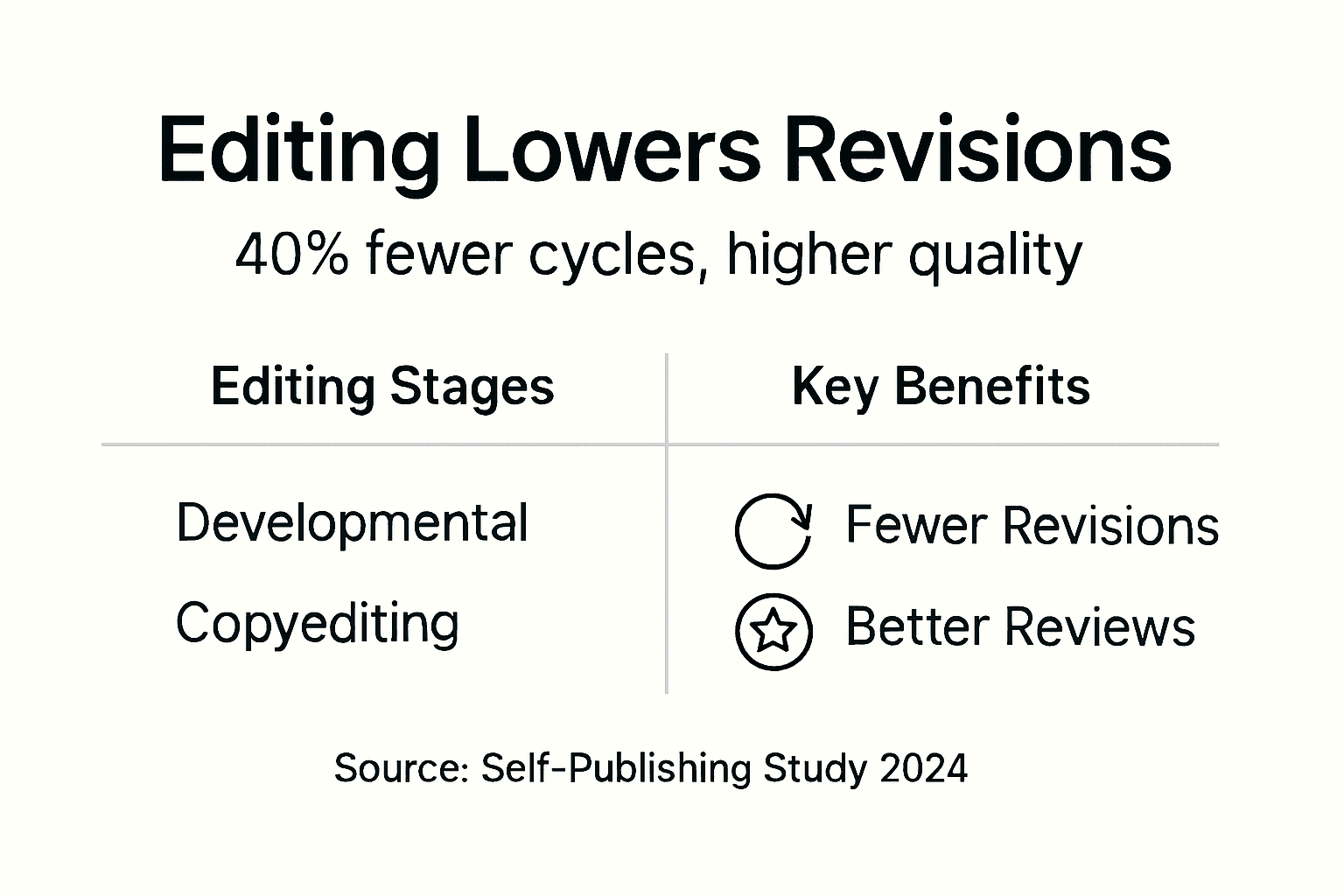
Higher ratings increase discoverability on retail platforms like Amazon, where algorithms favor highly-rated books in search results and recommendation engines. A jump from 3.5 to 4.1 stars moves your book from mediocre to competitive, attracting more organic traffic and sales.
Professional editing also reduces negative reviews caused by avoidable quality issues. Readers forgive minor typos but abandon books with confusing plots, inconsistent characters, or poor pacing. These structural problems require developmental editing to fix. Investing in comprehensive editing protects your reputation and reader trust.
"Authors who invest in full-spectrum editing see measurable improvements in reader retention, review quality, and overall sales performance compared to those who skip stages or rely only on self-editing."
Here's the ROI breakdown by editing investment level:
| Investment Level | Editing Stages Included | Average Rating Improvement | Sales Visibility Increase | Reader Retention |
|---|---|---|---|---|
| Minimal (self-edit only) | None | Baseline (3.5 stars) | Baseline | 60% completion rate |
| Moderate (copyedit + proofread) | Language and surface errors | +0.3 stars | +10% | 75% completion rate |
| Comprehensive (all stages) | Developmental + copyedit + proofread | +0.6 stars | +20% | 85% completion rate |
Pro Tip: View editing as marketing investment, not just production cost. Quality manuscripts generate word-of-mouth recommendations, organic reviews, and repeat readers who buy your future books. The upfront cost pays for itself through sustained sales and brand building. Explore professional editing ROI to understand the full financial impact of quality assurance.
The Role of AI and Technology in Modern Editing
AI editing tools can reduce initial manuscript revision time by approximately 30%, making them valuable supplements to your editing workflow. These tools excel at identifying patterns, suggesting alternatives, and flagging potential issues for your review.
AI tools catch common grammar errors, repetitive word usage, passive voice overuse, and readability issues faster than manual review. They provide instant feedback, allowing you to iterate quickly during early drafts. This speed advantage helps self-publishers working within tight budgets or timelines.
However, AI cannot replace human judgment for developmental editing tasks. AI lacks the contextual understanding to evaluate plot coherence, character authenticity, emotional resonance, or thematic consistency. It suggests changes based on patterns but cannot assess whether those changes serve your creative vision.
Best practices for using AI in self-publishing editing include:
- Use AI for initial grammar and style checks before human review
- Apply AI suggestions selectively, evaluating each for contextual appropriateness
- Leverage AI for repetitive tasks like consistency checks and formatting
- Combine AI efficiency with professional editors for developmental work
- Never skip human review for final quality assurance
The most effective approach integrates AI editing tools with professional expertise. Use AI to handle routine corrections quickly and affordably, then invest professional editing budget in higher-value developmental and copyediting work. This combination maximizes quality while controlling costs.
Explore AI technology examples to see how modern tools enhance rather than replace human creativity. Learn more about AI editing advantages and limits to make informed decisions about tool integration.
Practical Tips for Implementing Effective Editing in Self-Publishing
Successful editing requires planning, sequencing, and resource allocation. Follow these steps to implement thorough editing without overwhelming your budget or timeline.
- Complete your manuscript fully before beginning serious editing. Editing incomplete drafts wastes time because you'll rewrite sections anyway.
- Self-edit first to catch obvious issues and tighten your prose. This reduces professional editing costs by presenting cleaner initial drafts.
- Schedule developmental editing next to address structural problems before polishing language. Fixing plot issues after perfecting prose creates redundant work.
- Apply AI tools for grammar, consistency, and readability checks between editing stages. This catches easy fixes quickly.
- Hire copyeditors to refine language, ensure consistent tone, and verify factual accuracy. Professional copyediting transforms good writing into great reading.
- Complete final proofreading after all content changes are finalized. This catches remaining typos and formatting inconsistencies.
- Budget 10-15% of your total publishing costs for editing services. Quality manuscripts justify this investment through better sales.
- Allow 6-8 weeks for comprehensive editing cycles. Rushing editors increases oversight risk.
Balance cost and quality by prioritizing the stages that address your manuscript's specific weaknesses. If your plot is solid but prose needs work, invest more in copyediting. If your story structure feels shaky, prioritize developmental editing.
Pro Tip: Combine author editing strategies with AI tools for cost efficiency. Use AI for initial passes, then hire professionals for stages requiring human judgment like developmental editing. This hybrid approach delivers professional quality at sustainable cost.
Common Pitfalls and How to Avoid Them
Skipping developmental editing often results in weak narrative coherence and reduced credibility. Readers abandon confusing books quickly, leaving negative reviews that damage your reputation and future sales.
Common mistakes include:
- Skipping developmental editing to save money, resulting in structural problems that confuse readers and generate poor reviews
- Relying only on friends or family for feedback, who lack objectivity and professional editing expertise
- Using only AI tools without human review, missing nuanced issues that algorithms cannot detect
- Proofreading before completing content revisions, wasting time on text you'll later change
- Rushing editing to meet arbitrary publication deadlines, increasing oversight risk and quality gaps
- Underfunding editing budgets, forcing corners-cutting that undermines manuscript quality
Each mistake carries consequences. Weak narrative structure causes reader confusion and abandonment. Missing copyediting results in inconsistent tone and distracting language issues. Skipping proofreading leaves embarrassing typos that undermine professionalism.
Prevent these pitfalls by committing to comprehensive editing from the start. Build editing costs and timelines into your publishing plan before writing. Treat editing as non-negotiable quality assurance, not optional polish.
Consistency matters across all editing stages. A manuscript that receives excellent developmental editing but poor proofreading still disappoints readers. Maintain quality standards throughout the process to ensure your finished book meets professional expectations.
Learn from others' mistakes by studying developmental editing risks and planning proactively. Budget realistically, allow adequate time, and prioritize quality over speed. Your readers will notice and reward the difference.
Conclusion: Making Editing a Priority for Publishing Success
Editing transforms rough manuscripts into professional books that compete effectively in crowded markets. Each stage plays a unique role: developmental editing strengthens structure, copyediting refines language, and proofreading ensures polish.
The data proves editing's value. Professional editing improves ratings by 0.5 stars, boosts sales visibility by 20%, and increases reader completion rates to 85%. These improvements directly impact your commercial success and author reputation.
View editing as strategic investment in your publishing career, not just production cost. Quality manuscripts generate positive reviews, word-of-mouth recommendations, and loyal readers who buy your future books. Skipping editing to save money in the short term damages your brand and earning potential over time.
Prioritize comprehensive editing by budgeting appropriately, sequencing stages correctly, and combining AI efficiency with professional expertise. Your manuscript deserves the attention that transforms good ideas into great reading experiences. Make editing non-negotiable in your self-publishing journey.
Elevate Your Self-Publishing Success with Librida's Editing Tools
Transform your manuscript from draft to published book using cutting-edge AI technology designed specifically for aspiring authors. Librida's AI editing tools accelerate revision cycles while maintaining the quality readers expect from professional publications.
Our platform guides you through every publishing stage, from initial concept development to final formatting. The intuitive interface makes sophisticated editing accessible even for first-time authors, while powerful AI catches issues that might otherwise slip through. You'll spend less time wrestling with technical details and more time perfecting your story.
Pro Tip: Combine Librida's AI-powered features with selective professional editing for optimal results. Use our tools for initial revisions and consistency checks, then invest your editing budget in developmental work where human expertise adds maximum value. Explore the Librida publishing platform to discover how technology empowers your self-publishing journey.
FAQ
How important is developmental editing in self-publishing?
Developmental editing identifies and fixes structural story issues early, reducing revision cycles by up to 40%. It strengthens plot coherence, character development, and pacing before you invest time perfecting prose. Skipping this stage risks confusing readers and generating poor reviews that damage your author reputation.
Can AI tools replace professional editors?
AI helps catch surface errors and speeds initial revisions by approximately 30%, making it valuable for grammar checks and consistency reviews. However, AI cannot replicate the nuanced judgment human editors bring to developmental work, evaluating plot effectiveness, character authenticity, and emotional resonance. The most effective approach combines AI efficiency with professional expertise.
What's the biggest misconception about self-editing?
Many authors believe self-editing suffices without professional help, but this often misses critical issues in narrative structure and language style. You cannot objectively evaluate your own work because you know what you meant to write. Professional editing significantly improves manuscript quality and market readiness through fresh perspective and specialized expertise.
How much should I budget for editing services?
Allocate 10-15% of your total publishing budget to comprehensive editing services covering developmental, copyediting, and proofreading stages. This investment pays dividends through better reviews, increased sales visibility, and stronger reader retention. View editing as marketing investment that protects your author reputation and generates long-term returns.