

Self-publishing your first book feels overwhelming. Between manuscript preparation, formatting, legal registrations, and marketing, many aspiring authors abandon their dreams before reaching publication. AI-powered tools now streamline this journey, cutting writing and editing time by nearly half while maintaining creative control. This guide walks you through every step from manuscript to market launch using proven AI-enhanced workflows.
Table of Contents
- Prerequisites: What You Need Before Starting Your Self-Publishing Journey
- Step 1: Manuscript Preparation and AI Integration
- Step 2: Book Formatting, Design, and Publishing Setup
- Step 3: Distribution and Marketing Fundamentals
- Common Mistakes and Troubleshooting
- Expected Timelines, Costs, and Success Benchmarks
- Publish Smarter With Librida's AI-Driven Platform
- FAQ
Key Takeaways
| Point | Details |
|---|---|
| AI efficiency gains | AI writing assistants reduce manuscript preparation time by up to 40% compared to traditional methods. |
| Professional editing matters | Poor editing causes 62% of self-publishing failures, making quality review essential for success. |
| Global distribution advantage | AI-enabled platforms increase market exposure by over 50% through automated multi-marketplace distribution. |
| Legal protection | Proper ISBN and copyright registration prevent 28% of legal disputes among self-publishers. |
| Marketing impact | AI-guided marketing campaigns can boost launch sales by 35% through data-driven targeting. |
Prerequisites: What You Need Before Starting Your Self-Publishing Journey
Successful self-publishing starts with proper preparation. You need a completed story concept and basic writing skills to give AI tools meaningful content to enhance. Raw creativity matters more than perfect grammar at this stage.
Access to AI-driven writing and editing software forms your technical foundation. These platforms handle grammar checks, style suggestions, and structural improvements while you maintain creative direction. Most authors see productivity gains within the first week of adoption.
Budget planning prevents mid-project surprises. Self-publishing typically requires $2,000 to $5,000 covering professional editing, cover design, formatting, ISBN registration, and initial marketing. AI tools reduce some costs but cannot eliminate them entirely.
Pro Tip: Start with free trials of multiple AI writing platforms to find which interface matches your workflow before committing to paid subscriptions.
Legal knowledge protects your work and revenue. Understanding ISBN requirements, copyright registration processes, and publishing rights prevents costly mistakes that trap 28% of novice authors in disputes. Spend two hours researching your country's specific requirements before writing a single page.
| Prerequisite | Purpose | Estimated Cost |
|---|---|---|
| Completed story concept | Provides foundation for AI enhancement | $0 |
| AI writing software | Accelerates drafting and editing | $10-50/month |
| Professional editing budget | Ensures publication quality | $500-2,000 |
| ISBN and copyright | Legal protection and distribution | $125-300 |
| Marketing funds | Launch promotion and advertising | $500-1,500 |
Step 1: Manuscript Preparation and AI Integration
Drafting your manuscript becomes faster when you combine human creativity with AI writing assistants. These tools suggest phrasing alternatives, identify plot inconsistencies, and maintain character voice consistency across chapters. Using AI writing assistants reduces manuscript drafting time by up to 40% compared to writing without technological support.
Start each writing session by reviewing AI-generated suggestions from your previous day's work. Accept improvements that strengthen clarity while rejecting changes that dilute your unique voice. This iterative approach builds momentum without sacrificing authenticity.
Editing requires layered review combining AI editing tools with human feedback. Run your completed draft through grammar checkers first, then send polished chapters to beta readers for emotional resonance testing. AI catches technical errors humans miss; humans catch emotional flatness AI cannot detect.
Pro Tip: Schedule editing in three passes focusing separately on plot, prose, and polish rather than attempting comprehensive review in one exhausting session.
Maintain creative control throughout AI integration. These tools enhance productivity and catch errors but cannot replace your storytelling instincts. Review every AI suggestion critically, accepting only changes that genuinely improve reader experience.
- Complete first draft using AI writing suggestions for efficiency
- Run full manuscript through AI grammar and style analysis
- Incorporate AI recommendations that strengthen clarity and flow
- Send revised chapters to human beta readers for feedback
- Perform final polish combining both AI and human input
Step 2: Book Formatting, Design, and Publishing Setup
Professional formatting transforms your manuscript into a marketable product. Professional book formatting tools handle interior layout, chapter breaks, page numbering, and typography according to industry standards. Readers subconsciously judge book quality by formatting consistency before evaluating content.

AI-powered design software creates compelling book covers without expensive graphic designers. These platforms analyze genre conventions, suggest color palettes, and generate multiple design variations for testing. Books with professionally designed covers sell 25% more copies than amateur designs in competitive markets.
ISBN registration and copyright metadata setup protect your intellectual property. Purchase ISBNs through official channels in your country, never through third-party resellers charging premium fees. Register copyright before publication to establish legal ownership and distribution rights.
- Use AI layout tools to format interior pages meeting print and digital standards
- Generate multiple cover designs testing different concepts with target readers
- Register ISBN numbers for each format (paperback, hardcover, ebook) you plan to sell
- Complete copyright registration forms including accurate metadata and publication dates
- Verify all legal documents before uploading to distribution platforms
| Format Type | Professional Standard | AI Tool Capability |
|---|---|---|
| Interior layout | Consistent margins, headers, page numbers | Automated template application |
| Typography | Genre-appropriate fonts, proper hierarchy | Smart font pairing suggestions |
| Cover design | High-resolution images, compelling composition | AI-generated concepts and variations |
| Metadata | Accurate ISBN, copyright, keywords | Automated field completion |
Step 3: Distribution and Marketing Fundamentals
Global distribution through AI distribution platforms multiplies your potential readership exponentially. AI-based distribution platforms increase market exposure by over 50% by distributing to 10+ marketplaces including Amazon, Apple Books, Barnes & Noble, and international retailers simultaneously. Manual distribution to this many channels would require months of individual account setup.
Leverage AI analytics to plan targeted marketing campaigns that reach readers most likely to enjoy your genre. These tools analyze reader behavior patterns, identify optimal pricing strategies, and suggest promotional timing for maximum impact. Authors using data-driven marketing see 35% higher launch week sales than those relying on intuition alone.
Schedule your launch strategically around holidays, competing releases, and seasonal reading patterns. Spring and fall offer peak book buying periods, while summer sees decreased sales in most genres except beach reads and thrillers.
- Upload your formatted manuscript and cover to AI-enabled distribution platforms
- Select all relevant marketplaces for maximum geographic reach
- Set competitive pricing based on AI analysis of similar successful titles
- Schedule pre-launch marketing campaigns targeting genre-specific reader communities
- Plan launch week promotions including limited-time discounts and social media engagement
- Monitor real-time sales data to adjust marketing strategy during critical first month
Common Mistakes and Troubleshooting
Poor editing accounts for 62% of self-publishing failures according to industry analysis. Never skip professional review or comprehensive AI-assisted editing regardless of budget constraints. Readers forgive weak plots faster than persistent typos and grammatical errors that signal unprofessionalism.
Skipping ISBN and copyright registrations causes 28% of legal disputes among self-publishers. These foundational steps cost a few hundred dollars but prevent thousands in legal fees when distribution or rights issues arise. Complete all registrations before uploading to any platform.
Rushing to publication often produces negative reviews that permanently damage sales potential. First impressions matter enormously in book marketing where algorithms prioritize highly-rated titles. Allow adequate time for iterative editing and marketing preparation even when excitement tempts premature launch.
"The difference between successful and failed self-publishing projects rarely involves writing talent. It almost always comes down to patience during editing and attention to legal details that seem boring but prove essential." — Publishing industry consultant analysis, 2026
- Invest in professional editing even when using AI editing tools to catch what algorithms miss
- Complete ISBN and copyright registration before uploading manuscripts anywhere
- Build pre-launch audience through social media and email lists rather than publishing to silence
- Test pricing strategies and cover designs with small focus groups before finalizing
- Budget conservatively, assuming higher costs than initial estimates to avoid mid-project funding gaps
Expected Timelines, Costs, and Success Benchmarks
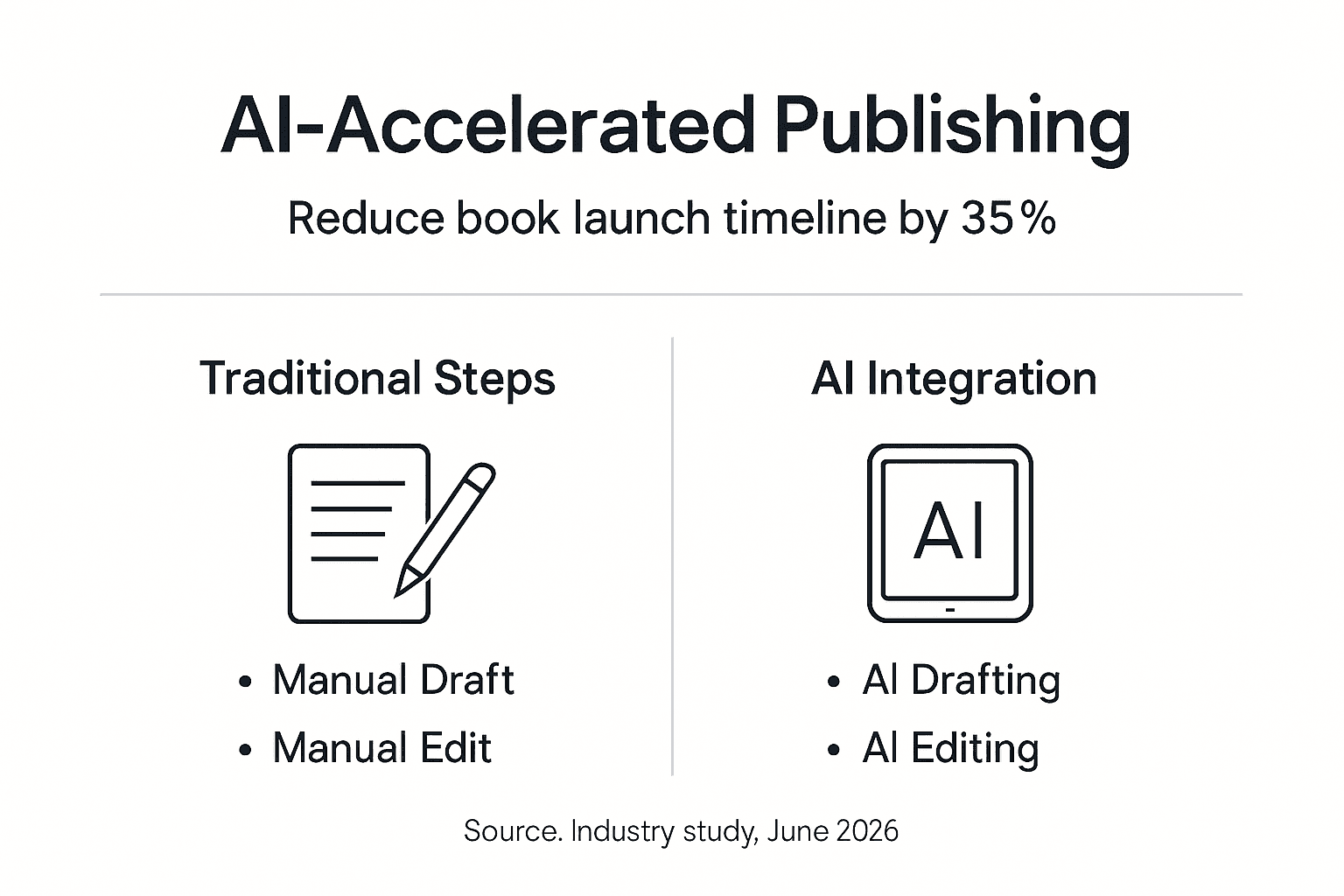
Typical self-publishing timelines range from 3 to 6 months for authors working part-time. AI tools reduce this by 25% to 35% through faster drafting, automated formatting, and streamlined distribution setup. Expect 2 to 4 months from completed first draft to marketplace availability when using AI-enhanced workflows.
Total costs typically fall between $2,000 and $5,000 including editing, design, legal registrations, and initial marketing. AI tools cut expenses on formatting and basic editing but cannot eliminate costs for professional review, ISBN registration, and effective promotion.
Success rates reach approximately 70% among authors following structured AI-guided processes compared to 40% for those attempting traditional solo publishing. Success means publishing a professionally formatted, properly marketed book that generates positive reviews and meaningful sales, not necessarily bestseller status.
Track your progress against clear milestones to maintain momentum and identify problems early. Authors who set specific weekly goals complete projects faster and with higher quality than those working without defined benchmarks.
| Milestone | Traditional Timeline | AI-Enhanced Timeline | Key Success Indicator |
|---|---|---|---|
| First draft completion | 2-4 months | 1-2.5 months | 60,000+ words, coherent plot |
| Editing and revision | 1-2 months | 2-4 weeks | Zero grammar errors, positive beta feedback |
| Formatting and design | 2-3 weeks | 1 week | Professional appearance matching genre standards |
| Distribution setup | 1-2 weeks | 3-5 days | Live on 8+ major marketplaces |
| Launch marketing | Ongoing | Ongoing | 50+ pre-launch email subscribers, 20+ reviews first month |
Publish Smarter with Librida's AI-Driven Platform
Your publishing journey deserves tools that work as hard as you do. Librida transforms the complex self-publishing process into a streamlined workflow powered by integrated AI-powered writing and editing tools designed specifically for aspiring authors. Our platform reduces timelines and costs while boosting the quality of your final product.
Access professional book formatting and design services that make your manuscript marketplace-ready within days, not weeks. Our AI assistants handle technical details while you focus on storytelling. Join thousands of authors who have successfully published using our structured approach.
Explore expert resources, step-by-step tutorials, and supportive community features that empower your author journey. Visit our insider publishing insights to learn advanced strategies from experienced self-publishers who have navigated this path successfully.
FAQ
How long does it take to self-publish a book using AI tools?
AI tools typically reduce the self-publishing timeline to about 2 to 4 months, compared to the traditional 3 to 6 month range. This acceleration comes from faster drafting, automated editing suggestions, streamlined formatting, and simplified multi-platform distribution setup.
What are the most critical legal steps before publishing?
Registering your ISBN and securing your copyright metadata before publication are vital to protect rights and avoid legal disputes. Failure to complete these steps causes up to 28% of legal problems among self-publishers, resulting in expensive resolution processes.
How do AI tools improve the quality of a self-published book?
AI tools assist with grammar checking, style consistency, professional formatting, and cover design, reducing errors and boosting polish significantly. Authors retain complete creative control while benefiting from AI's efficiency in catching technical mistakes that human eyes often miss during review.
What common mistakes should self-publishers avoid?
Neglecting professional editing, rushing the launch without adequate preparation, and skipping legal registrations are top mistakes causing most self-publishing failures. Using AI-assisted editing combined with human review and planning your timeline carefully can prevent these pitfalls effectively.