

Many believe strong plots alone create compelling stories, but character development drives true engagement. This guide reveals the essential story components, proven frameworks, common missteps, and AI integration strategies that empower aspiring authors to systematically develop narratives. You'll discover how to structure coherent plots, craft authentic character arcs, and leverage AI tools to boost creativity while reducing planning time by up to 40%.
Table of Contents
- Fundamentals Of Story Development
- Common Misconceptions In Storytelling
- Frameworks For Organizing Story Ideas
- Character Development Processes
- Using AI To Enhance Story Development
- Practical Steps In Story Development
- Discover Librida's Storytelling Tools
- Frequently Asked Questions About Story Development
Key takeaways
| Point | Details |
|---|---|
| Story structure matters | Combining narrative elements like inciting incidents, climax, and resolution with character arcs creates engaging, coherent stories. |
| Frameworks guide clarity | Proven structures like Hero's Journey and Save the Cat provide clear roadmaps for pacing and emotional impact. |
| Avoid common pitfalls | Novice authors often neglect character depth, assume linear writing processes, and overlook iterative revision needs. |
| AI accelerates creativity | Modern tools reduce planning time by up to 40%, overcome writer's block, and support faster iterative drafting without replacing author vision. |
| Iteration improves quality | Multiple revision cycles incorporating feedback enhance story coherence, character consistency, and overall narrative depth. |
Fundamentals of story development
Every compelling narrative relies on core structural elements that guide readers through an emotional journey. The inciting incident kicks off your story by disrupting your character's normal world. Rising action builds tension through escalating challenges that test your protagonist's resolve. The climax delivers the story's peak confrontation where everything hangs in balance. Resolution ties up plot threads and shows how characters have transformed.
The three-act structure organizes these elements into setup, confrontation, and resolution. Act one introduces your world and characters while establishing the central conflict. Act two intensifies obstacles and forces characters to make difficult choices. Act three brings consequences to a head and delivers satisfying closure. This framework keeps readers engaged because it mirrors how we naturally process dramatic events.
Foundational story elements like inciting incident, climax, and resolution shape narrative flow and reader immersion. When you structure stories deliberately, you create clear cause and effect relationships that feel inevitable yet surprising. Think of structure as your story's skeleton. Without it, even brilliant prose collapses into confusion.
Consider how these elements work together:
- Inciting incident creates urgency that pulls readers into the story world
- Rising action maintains momentum through escalating stakes and complications
- Climax delivers emotional payoff by testing characters at their breaking point
- Resolution provides closure while leaving readers satisfied yet contemplative
Modern AI swarm autonomous storytelling tools help you map these structural elements efficiently. They suggest logical plot progressions based on your story's unique setup, saving hours of manual outlining while maintaining your creative vision.
Common misconceptions in storytelling
The biggest myth plaguing novice authors is that stories flow linearly from first draft to finished manuscript. Reality looks messier. Story development is iterative; authors revise key elements 4-6 times per project. You'll circle back to earlier chapters, rework character motivations, and restructure entire plot threads as your understanding deepens.
Another dangerous misconception centers on plot supremacy. Many beginners obsess over intricate plot twists while neglecting the characters experiencing those events. Readers connect emotionally through character struggles and growth, not clever plot mechanics. A simple story with authentic characters always outperforms a complex plot with cardboard cutouts.
"Plot is what happens to characters. Character is what happens inside them. Readers remember characters long after forgetting plot details."
Common errors stem from these misconceptions:
- Prioritizing plot complexity over character authenticity and emotional depth
- Ignoring beta reader feedback because it challenges your original vision
- Assuming first drafts capture your story's best version
- Treating revision as punishment rather than essential creative refinement
The solution involves embracing iterative story development as your creative process. Each revision cycle reveals deeper truths about your characters and themes. Your third draft might completely reimagine a subplot you considered finished. This flexibility separates published authors from perpetual beginners.
Tools that support characters with voices interactive fiction help you test character consistency across revision cycles. They flag moments where character behavior contradicts established traits, ensuring your revisions strengthen rather than dilute character authenticity.
Frameworks for organizing story ideas
The Hero's Journey provides a mythic template tracking a protagonist's transformation through adventure. Your hero starts in the ordinary world, receives a call to adventure, faces trials that forge new abilities, and returns home transformed. This framework resonates because it mirrors universal human growth experiences. Use it when your story emphasizes personal transformation and overcoming internal obstacles.
Save the Cat breaks stories into fifteen precise beats that ensure proper pacing. It specifies exactly when your protagonist should face setbacks, make discoveries, and experience breakthroughs. This structure excels at commercial storytelling where clear momentum and satisfying payoffs matter most. Choose it when you want foolproof story architecture that keeps readers turning pages.
| Framework | Best For | Emotional Focus | Learning Curve |
|---|---|---|---|
| Hero's Journey | Character transformation | Internal growth and self-discovery | Moderate |
| Save the Cat | Commercial fiction | Clear beats and satisfying payoffs | Easy |
| Three-Act Structure | Universal application | Balanced plot and character | Easy |
| Five-Act Structure | Complex narratives | Layered conflict development | Advanced |
Your framework choice depends on story goals. Hero's Journey suits fantasy and coming-of-age tales where internal change drives external action. Save the Cat works brilliantly for thrillers and romance where readers expect specific emotional beats. Three-act structure offers flexibility for any genre while maintaining clear narrative direction.
Pro Tip: Start with three-act structure for your first manuscript. Master basic setup, confrontation, and resolution before attempting more complex frameworks. You can always layer Hero's Journey or Save the Cat elements into subsequent drafts once you understand fundamental story mechanics.
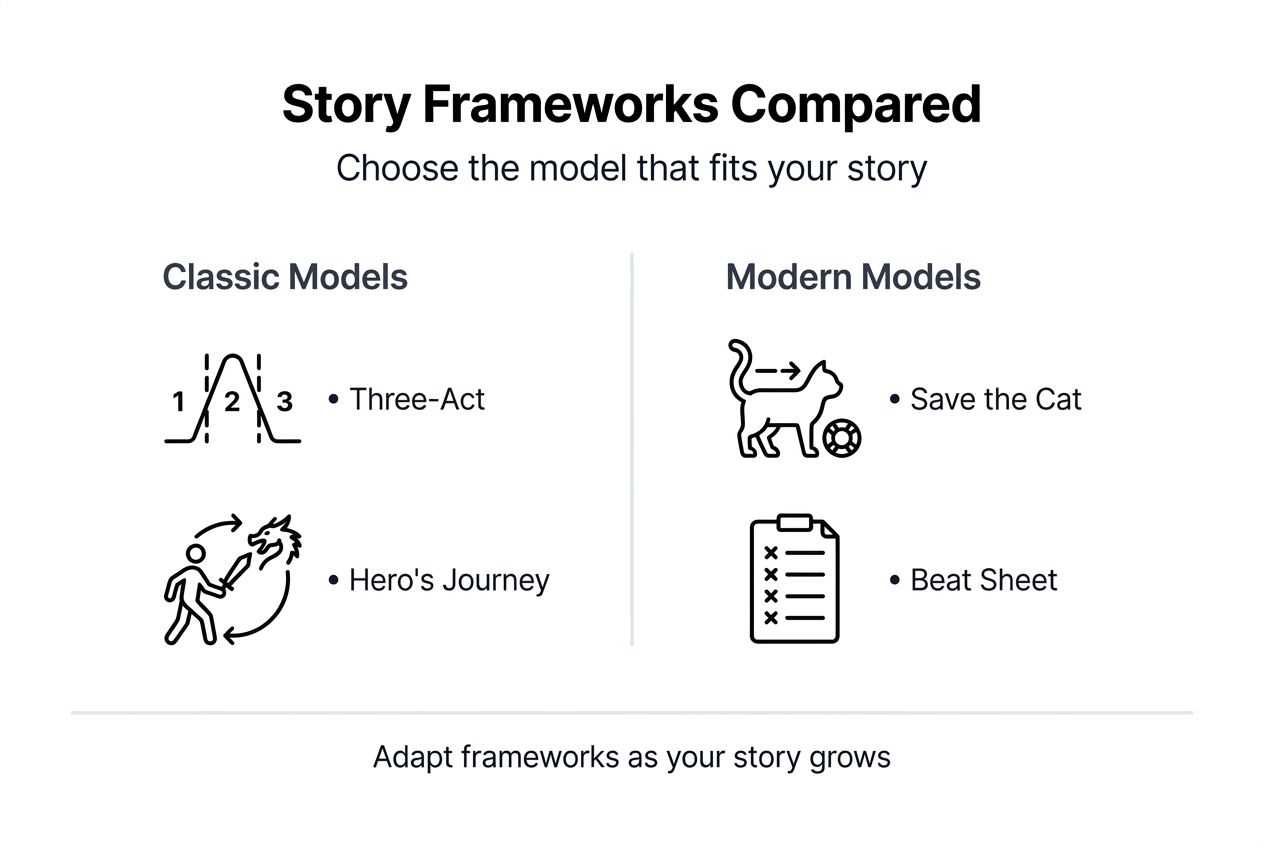
Frameworks provide guardrails, not prisons. Adapt them to serve your unique story rather than forcing your narrative into rigid templates. The best framework is whichever helps you complete a coherent first draft you can then revise into excellence.
Character development processes
Character transformation separates forgettable stories from memorable ones. Your protagonist must change fundamentally between opening and closing pages. Map this arc by identifying your character's internal flaw, the belief system protecting that flaw, and the experiences that will shatter those false beliefs. Physical plot events exist to facilitate this internal journey.
Growth arcs follow predictable patterns. Your character starts with a flawed worldview, encounters challenges that expose those flaws, resists change while clinging to familiar patterns, hits rock bottom when old methods catastrophically fail, and finally embraces new understanding that enables victory. Readers recognize this pattern subconsciously and feel satisfied when you deliver it authentically.
Aligning character development with plot requires deliberate planning:
- Define your character's starting emotional state and limiting beliefs
- Design plot events that specifically challenge those beliefs
- Show incremental attitude shifts through actions rather than exposition
- Ensure the climax forces a choice that proves transformation
- Demonstrate new capabilities in the resolution that were impossible at story start
Consistent character arcs dramatically increase reader engagement and story satisfaction. When characters behave unpredictably without motivation, readers disconnect. When every action flows logically from established personality and current emotional state, readers trust your storytelling and invest deeper emotionally.
Tools for characters with voices interactive fiction help maintain consistency across long manuscripts. They track character traits, speech patterns, and relationship dynamics, alerting you when a scene contradicts established characterization. This consistency checking saves countless revision hours.
Pro Tip: Write a one-page biography for each major character covering childhood trauma, core beliefs, greatest fear, and ultimate desire. Reference this document before writing any scene featuring that character. Consistency stems from knowing your characters deeper than the page reveals.
Using AI to enhance story development
AI tools reduce planning time by up to 40% for novice authors while amplifying creative possibilities. They excel at generating alternative plot directions when you feel stuck, suggesting character motivations you hadn't considered, and identifying structural weaknesses in your outline. This acceleration matters because faster iteration cycles mean more learning opportunities per project.

Writer's block often stems from perfectionism or fear of choosing wrong directions. AI in creative process provides adaptive suggestions that break paralysis. When you can't decide between two plot paths, AI generates pros and cons for each option based on your story's established elements. This analytical support frees your creativity to focus on emotional authenticity rather than mechanical problem solving.
AI accelerates iterative drafting by automating tedious revision tasks. It flags passive voice, identifies repetitive phrasing, and suggests stronger word choices while you focus on deeper story issues. Feedback incorporation becomes faster when AI helps you locate every instance of a plot thread that needs revision. These efficiency gains compound across multiple draft cycles.
Critical understanding: AI enhances rather than replaces author creativity. It handles pattern recognition and option generation at superhuman speed, but cannot judge emotional authenticity or thematic resonance. You remain the creative decision maker who shapes raw suggestions into coherent vision.
Key AI applications in story development:
- Generating diverse character backstory options that fit your story world
- Suggesting plot complications when your outline feels predictable
- Identifying pacing issues where scenes drag or rush too quickly
- Offering alternative dialogue that better matches character voice
- Mapping complex plot threads to ensure no loose ends
Platforms supporting AI generated audiobooks changing reading and multi language stories breaking borders demonstrate AI's expanding role in publishing. The same technology powering those innovations now helps authors develop stronger manuscripts before publication.
Responsible AI use requires maintaining AI content safety creative spaces standards. Verify AI suggestions align with your artistic vision rather than blindly accepting them. Your unique voice and perspective create value that no algorithm can replicate.
Practical steps in story development
Systematic story development transforms vague ideas into polished manuscripts through deliberate stages. Start with idea generation where you explore multiple concepts without commitment. Capture premises, character sketches, and thematic questions in brief notes. Quantity matters more than quality here as you search for ideas that genuinely excite you.
Next, apply your chosen framework to impose structure on selected ideas. Map major plot points to Hero's Journey stages or Save the Cat beats. This outlining phase prevents middle-of-manuscript crises where you realize your plot has no destination. Detailed outlines save exponentially more writing time than they consume.
Your practical workflow:
- Generate and evaluate 5 to 10 story concepts through brief premise descriptions
- Select the most compelling idea and apply a structural framework
- Develop character profiles with clear transformation arcs aligned to plot
- Write a messy first draft prioritizing completion over perfection
- Revise systematically using AI tools to accelerate feedback incorporation
- Seek beta reader input and iterate based on patterns in their responses
AI integration shortens timelines at every stage. During idea generation, it suggests premises based on genre trends and thematic combinations. In outlining, it identifies structural gaps and pacing issues. First draft writing accelerates when AI handles research and fact checking. Revision becomes surgical when AI pinpoints specific improvement opportunities.
Consider how AI swarm autonomous storytelling approaches manuscript progression. Multiple AI agents analyze different story aspects simultaneously, providing comprehensive feedback that would take human editors days to compile. This parallel processing reveals improvement opportunities invisible to single-perspective analysis.
Simple case example: An author outlining a mystery novel uses AI to generate ten possible killer identities. Each option comes with motivation analysis and clue placement suggestions. The author selects the most surprising yet logical option, then requests AI help ensuring clues appear at proper intervals. This collaboration produces a tighter mystery outline in hours versus weeks.
Your iterative input remains essential throughout AI-assisted development. Technology handles mechanical heavy lifting while you make creative decisions about tone, theme, and emotional authenticity. The author who best combines human intuition with AI efficiency gains competitive advantage in today's publishing landscape.
Modern tools like book trailers AI video extend beyond manuscript creation into marketing. The same platforms helping you write can later help you promote, creating seamless workflows from conception through reader acquisition.
Discover Librida's storytelling tools
Your journey from aspiring author to published storyteller requires more than knowledge. It demands practical tools that translate theory into finished manuscripts. Librida integrates the story development frameworks, AI-assisted writing, and iterative revision workflows discussed throughout this guide into one comprehensive platform.

Our AI-powered features accelerate every development stage while preserving your unique creative voice. From initial concept generation through final manuscript polish, Librida provides the structured support that transforms incomplete drafts into compelling narratives. Explore our roadmap to see upcoming features designed specifically for emerging authors. Discover inspiring examples like Notes from a Slightly Unstable Life that showcase what's possible when you combine solid storytelling fundamentals with modern technology. Check our changelog for the latest platform improvements helping authors like you achieve publishing success.
Frequently asked questions about story development
What is the best storytelling framework for beginners?
Three-act structure offers the easiest entry point for novice authors. It provides clear beginning, middle, and end guidance without overwhelming complexity. Once you master basic setup, confrontation, and resolution, you can explore Hero's Journey or Save the Cat for more nuanced story architecture.
How can AI help with writer's block without replacing creativity?
AI generates multiple options when you feel stuck, breaking decision paralysis without making choices for you. It suggests plot directions, character motivations, and scene possibilities that you evaluate and adapt. You remain the creative decision maker while AI handles the mechanical work of option generation and pattern analysis.
How many drafts does a typical manuscript require?
Most published novels go through four to six major revision cycles before reaching publication quality. Your first draft establishes basic story and characters. Subsequent drafts deepen characterization, tighten pacing, strengthen themes, and polish prose. Each cycle reveals new improvement opportunities invisible in earlier versions.
Why is character development often more important than plot?
Readers remember characters long after forgetting specific plot events. Emotional connection happens through character struggles, growth, and authentic reactions to circumstances. A simple plot with compelling characters always outperforms a complex plot with shallow characters because humans naturally invest in other humans, not abstract events.
Can novice authors benefit from using AI-powered writing tools?
Absolutely. AI tools reduce planning time by up to 40% while helping beginners learn story structure through real-time feedback. They identify common mistakes like inconsistent characterization or pacing problems that novices often miss. This accelerated learning curve means faster progression from incomplete drafts to publishable manuscripts.