

Aspiring authors often struggle to transform creative ideas into publishable manuscripts because they lack structured guidance. Without clear steps, many abandon promising stories halfway through development. This guide delivers actionable strategies to carry your concept from brainstorming through final polishing, using modern tools and proven techniques that help you complete your manuscript confidently.
Table of Contents
- Prerequisites For Story Development
- Step-By-Step Story Development Process
- Using Tools To Enhance Story Development
- Common Mistakes And Troubleshooting In Story Development
- Measuring Success And Story Development Timeline
- Warnings And Best Practices Using AI In Story Development
- Explore Librida's AI Tools To Support Your Story Development Journey
- Frequently Asked Questions
Key takeaways
| Point | Details |
|---|---|
| Structured process | Follow clear stages from ideation through revision to maintain momentum and coherence. |
| Strategic tool use | AI and digital platforms enhance productivity when balanced with personal creativity. |
| Avoid common pitfalls | Neglecting character arcs and overusing AI diminishes quality; use worksheets and maintain voice. |
| Measurable milestones | Track word counts and chapter completion to stay on schedule and gauge progress. |
| Balance AI assistance | Preserve originality by revising AI suggestions to inject your unique style. |
Prerequisites for story development
Before diving into writing, establish a solid foundation to guide your creative decisions. Start by identifying your story's genre and target audience, as these choices shape tone, pacing, and themes. A mystery novel requires different structuring than a fantasy epic, and knowing your readers helps you craft resonant narratives.
Equip yourself with essential writing tools. A reliable word processor and note-taking apps let you capture ideas and organize drafts efficiently. Digital tools streamline manuscript management, making revisions less daunting.
Understand core storytelling elements:
- Plot basics: beginning, middle, end with rising action and climax
- Character roles: protagonists, antagonists, supporting cast with distinct motivations
- Setting importance: world-building that grounds your narrative authentically
- Theme clarity: underlying messages that give your story depth
Cultivate a disciplined mindset ready for iterative work. Story development involves multiple drafts and revisions. Embrace feedback and view editing as refinement, not failure. Writers who prepare mentally for this cyclical process complete manuscripts more consistently.
Knowing these prerequisites sets a strong foundation. You'll approach development with clear direction rather than wandering aimlessly through your story.
Step-by-step story development process
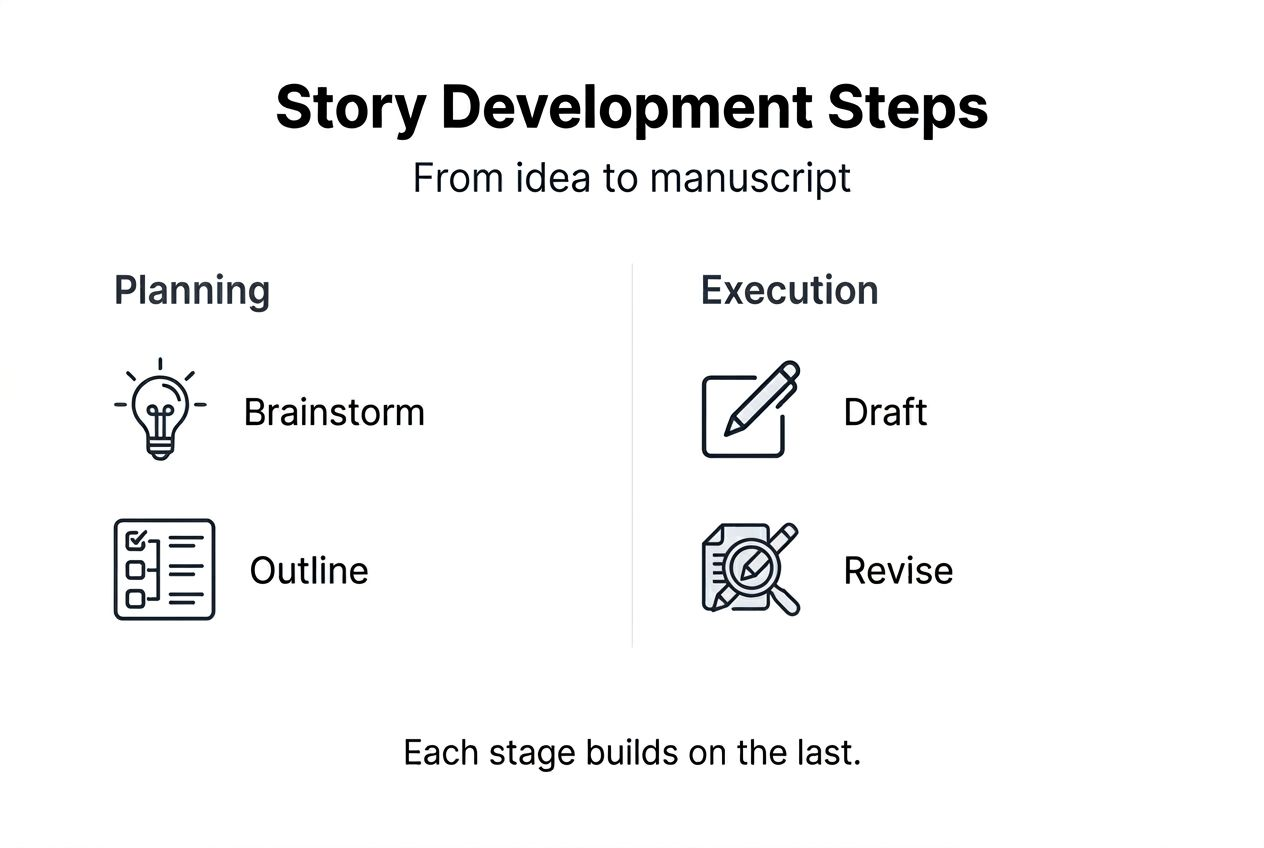
Transform your idea into a polished manuscript by following these ordered stages. Each step builds on the previous, creating a structured path from concept to completion.
-
Idea generation and brainstorming: Establish your core concept, themes, and central conflict. Write freely without judging ideas, exploring what excites you most. Capture multiple angles and choose the most compelling direction.
-
Character creation: Develop protagonists and supporting characters with clear goals, flaws, and growth arcs. Compelling characters drive reader engagement, so invest time crafting backstories and motivations that feel authentic.
-
Plot outlining: Structure your narrative using frameworks like the three-act structure or hero's journey. Detailed story outlines improve completion rates by 45%, maintaining coherence across chapters. Map major plot points, turning points, and resolutions before drafting.
-
Scene drafting: Write manageable segments focusing on one scene at a time. Break your manuscript into chapters or sequences, setting daily word count goals. This approach prevents overwhelm and builds momentum.
-
Revision cycles: Review drafts to identify plot holes, pacing issues, and character inconsistencies. Multiple editing rounds refine prose, strengthen dialogue, and ensure thematic consistency. Seek feedback from beta readers or writing groups.
-
Final polishing: Proofread for grammar, formatting, and stylistic consistency. Prepare your manuscript for submission to agents or self-publishing platforms, ensuring professional presentation.
Pro Tip: Begin outlining early to improve manuscript completion chances significantly. Writers who outline before drafting finish projects faster and maintain better narrative coherence.
Each stage requires patience and iteration. Rushing through steps compromises quality, while methodical progression yields publishable results.
Using tools to enhance story development
Digital and AI tools accelerate productivity and help you overcome creative obstacles. Choosing the right platforms for your workflow streamlines development and keeps projects organized.
Scrivener offers comprehensive manuscript management by integrating notes, scenes, research documents, and character profiles in one platform. Writers organize complex projects visually, rearranging chapters easily and tracking progress.
Plottr provides a visual drag-and-drop interface for plotting timelines and character arcs. This tool helps you map story structure, spot pacing problems, and maintain plot coherence across drafts.
Sudowrite uses AI to brainstorm ideas, generate prose suggestions, and refine descriptions. AI story generators reduce writer's block incidences, offering continuity tracking and creative prompts when you're stuck. Balance AI assistance with your voice to preserve originality.
| Tool | Key Features | Price Range | Best For |
|---|---|---|---|
| Scrivener | Manuscript organization, research integration, scene management | $49 one-time | Complex multi-chapter projects |
| Plottr | Visual plotting, timeline tracking, character arcs | $25/year | Plot-heavy stories needing structure |
| Sudowrite | AI brainstorming, prose refinement, continuity checks | $19-$129/month | Overcoming writer's block, style enhancement |
When selecting tools, consider:
- Ease of use and learning curve
- AI capabilities matching your needs
- Integration with existing writing software
- Budget and subscription preferences
Explore fair marketplace token economics to understand how digital platforms balance value and accessibility. The right tools enhance your process without replacing your creative control.
Common mistakes and troubleshooting in story development
Avoiding frequent pitfalls keeps your project on track and maintains narrative quality. Recognize these challenges early to implement effective fixes.
Neglecting character arcs leads to unengaging stories where protagonists feel static. Readers connect with characters who grow and change. Fix this by using character development worksheets that map emotional journeys, motivations, and transformation points.
Plot inconsistencies occur without proper outlining. Subplots contradict main narratives, or timelines don't align. Use visual plotting tools like Plottr to track story threads and ensure coherence across chapters.

Skipping revisions causes narrative problems that early drafts always contain. No first draft is publishable. Schedule multiple editing rounds, seeking feedback from beta readers or editors to identify weaknesses.
Overusing AI risks loss of originality. AI-generated prose can feel generic if adopted wholesale. Balance AI help by revising suggestions to inject your unique voice and maintain authorial control.
Writer's block stalls progress and causes frustration. Structured writing routines combined with AI brainstorming tools reduce block duration by up to 40%. Set consistent writing times and use prompts when creativity falters.
Pro Tip: Track common failure points early by maintaining a development journal. Note recurring challenges and solutions to prevent stalled progress in future projects.
Combining structured routines with AI brainstorming substantially reduces writer's block duration, helping authors maintain momentum and complete manuscripts faster.
Understand ai swarm autonomous storytelling to see how collaborative AI approaches can support your creative process without overwhelming your voice.
Measuring success and story development timeline
Set realistic expectations by defining measurable progress markers. Understanding typical timelines helps you plan effectively and stay motivated.
Most authors complete first drafts within one to six months, depending on writing pace and story complexity. Novels averaging 80,000 words require consistent daily output. Writing 500 words daily yields a draft in roughly five months, while 1,000 words daily completes it in under three months.
Track these success metrics:
- Daily or weekly word count totals
- Chapters drafted versus total planned
- Revision rounds completed
- Feedback received and incorporated
- Formatting and polishing milestones achieved
Feedback from beta readers or editors serves as a quality checkpoint. External perspectives reveal blind spots and validate your narrative choices.
| Development Stage | Typical Duration | Key Milestones | Target Output |
|---|---|---|---|
| Brainstorming & Outlining | 2-4 weeks | Genre defined, plot mapped | Complete outline |
| First Draft | 1-6 months | Daily word goals, chapters written | 60,000-100,000 words |
| Revision (multiple rounds) | 1-3 months | Plot holes fixed, prose refined | Polished manuscript |
| Final Polishing | 2-4 weeks | Proofread, formatted | Submission-ready draft |
Measurable success criteria include:
- Completing outlined scenes on schedule
- Achieving daily word count targets consistently
- Receiving positive feedback on character development
- Finishing revision rounds without major plot changes
- Meeting submission deadlines for agents or publishers
Realistic timelines prevent burnout. Adjust goals based on personal circumstances, understanding that slower progress still moves you toward completion.
Warnings and best practices using AI in story development
Integrating AI tools requires caution to preserve originality and authorial voice. Follow these best practices to maximize benefits while avoiding pitfalls.
AI overuse may lead to homogenized prose. 82% of professional authors express concern about AI's impact on literary voice. Generic phrasing and predictable structures diminish what makes your writing unique. Balance AI assistance by consciously revising AI-generated content and injecting personality.
Maintain creative control over major story decisions. AI can suggest plot twists or character traits, but you decide what fits your vision. This preserves manuscript originality and ensures your style shines through.
Follow ethical guidelines when using AI. Respect intellectual property by avoiding plagiarism and ensuring AI-generated content doesn't replicate existing works. Promote diversity by challenging AI suggestions that default to stereotypes.
Use AI as a collaborative tool, not a replacement for creative decision-making. Let AI handle brainstorming, grammar checks, and idea expansion, while you craft the emotional core and thematic depth.
Key warnings and best practices:
- Avoid copy-pasting AI output without thorough revision
- Always fact-check AI-generated research or historical details
- Inject your voice by rewriting AI suggestions in your style
- Set boundaries on which tasks AI handles versus your input
- Regularly evaluate whether AI enhances or diminishes your creativity
- Prioritize human feedback over AI suggestions for subjective elements
- Maintain transparency if submitting AI-assisted work to publishers
Explore ai content safety creative spaces to understand how responsible AI use protects your creative integrity. Review AI API documentation for technical details on integrating tools ethically. Learn about the role of AI in astrology to see how AI applies across creative fields, informing best practices.
Responsible AI use accelerates your workflow while keeping your manuscript authentically yours.
Explore Librida's AI tools to support your story development journey
Ready to implement these strategies and accelerate your manuscript development? Librida offers AI-powered writing solutions designed for aspiring authors like you. Our platform provides AI tools that support brainstorming, drafting, and refining manuscripts while preserving your unique voice.

Integrate Librida's features into your workflow to streamline story development. Our AI assists with plot structuring, character creation, and prose refinement, helping you overcome writer's block and maintain momentum. Unlike generic tools, Librida balances AI assistance with author creativity, ensuring your manuscript remains authentically yours.
Access story development resources that guide you through each stage, from outlining to final polishing. Pro Tip: Use Librida's story planning features to stay organized, track milestones, and meet your writing goals efficiently.
Transform your ideas into publishable manuscripts with Librida's innovative platform, where technology empowers your creativity without replacing it.
Frequently asked questions
What are the essential first steps to begin story development?
Start by defining your story's genre, identifying your target audience, and gathering basic writing tools to organize ideas. Establish your core concept and themes before drafting. This foundation guides all subsequent creative decisions and keeps your narrative focused.
How can AI tools help overcome writer's block during story development?
AI brainstorming generators suggest new ideas and directions, reducing mental barriers and accelerating drafting. They offer prompts, plot twists, and character angles when creativity stalls. Combining AI suggestions with structured writing routines substantially decreases block duration.
What are common pitfalls in developing a compelling plot?
Skipping detailed outlining leads to plot holes, pacing issues, and inconsistent story threads. Use visual plotting tools and iterative revision to keep your narrative coherent. Map major turning points before drafting to prevent structural problems.
How long does it typically take to complete a first draft?
Most authors complete their first drafts within one to six months, depending on daily writing habits and story complexity. Consistent word count goals and disciplined routines shorten timelines. Adjust expectations based on your schedule and manuscript length.
What best practices ensure effective use of AI without losing originality?
Use AI to generate ideas and editing suggestions, but always revise to inject your personal style and maintain control. Avoid copy-pasting AI output wholesale; instead, treat it as a collaborative partner that enhances rather than replaces your creative voice.