

Publishing a book used to mean waiting years for agents, editors, and production schedules to align. Today, AI-powered publishing reduces time-to-market by 30-50%, transforming what once took multiple years into a journey measured in months or even weeks. A publishing timeline maps every stage from manuscript completion to your book reaching readers, whether through traditional publishers or self-publishing platforms. Understanding these timelines helps you set realistic goals, choose the right publishing path, and leverage AI tools to accelerate your journey. This guide breaks down traditional versus self-publishing timelines, shows how AI reshapes the process in 2026, and provides actionable steps to publish faster without sacrificing quality.
Table of Contents
- Understanding Publishing Timelines: Traditional Vs. Self-Publishing
- How AI Transforms And Accelerates The Publishing Timeline In 2026
- Risks And Legal Considerations When Using AI In Your Publishing Timeline
- Practical Steps To Streamline Your Publishing Timeline With AI Tools
- Discover AI-Powered Publishing With Librida
- Frequently Asked Questions
Key takeaways
| Point | Details |
|---|---|
| Timeline variance | Traditional publishing spans 2-4 years while self-publishing ranges from weeks to 12 months depending on preparation and complexity. |
| AI acceleration | AI tools can shorten publication time by up to 50% and reduce production costs by 60% through automation of editing, formatting, and marketing tasks. |
| Legal awareness | AI-generated content may lack copyright protection without meaningful human contribution, requiring authors to verify originality and add personal edits. |
| Quality balance | Authors should combine AI efficiency with human creativity to maintain authentic voice and emotional depth in their work. |
| Scam vigilance | AI-enabled publishing scams are targeting self-published authors in 2026, making verification of service providers essential. |
Understanding publishing timelines: traditional vs. self-publishing
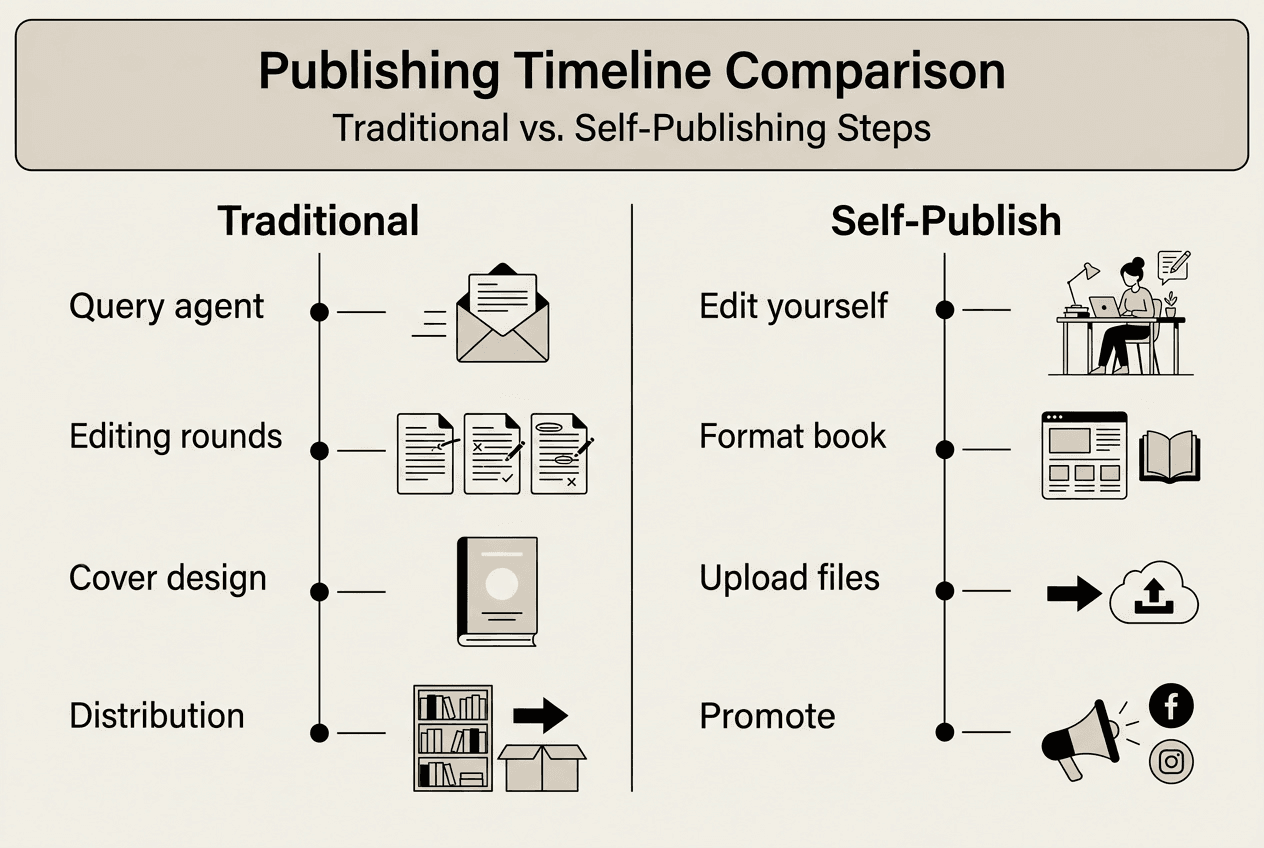
To manage your publishing journey effectively, you first need to understand the typical timelines involved for each path. A publishing timeline represents the complete process from finished manuscript to market availability, encompassing editing, design, production, and distribution stages. The duration varies dramatically based on your chosen route.
Traditional publishing typically takes 2-4 years from the first query to the book being on the shelf. This extended timeline includes querying literary agents, which alone consumes 3-12 months as you craft proposals, submit to multiple agents, and wait for responses. Once an agent signs you, they submit your manuscript to publishers, a process requiring 6-18 months of pitching, negotiations, and contract finalization. After a publisher acquires your book, editing and production take another 12-24 months as your manuscript moves through developmental editing, copyediting, design, printing, and distribution setup.

Self-publishing timelines have accelerated considerably, allowing authors to publish their works within as little as 7 days if they're well-prepared. Most self-published authors spend 3-12 months on the complete process, depending on manuscript readiness, editing needs, and marketing preparation. You control every decision and deadline, trading the gatekeeping delays of traditional publishing for direct responsibility over quality and timeline management.
| Stage | Traditional Publishing | Self-Publishing |
|---|---|---|
| Agent/Publisher Acquisition | 9-30 months | Not applicable |
| Editing & Revisions | 6-12 months | 1-6 months |
| Design & Formatting | 2-4 months | 1-4 weeks |
| Production & Distribution | 3-6 months | 1-7 days |
| Total Timeline | 24-48 months | 7 days to 12 months |
Several factors influence these timelines regardless of your publishing path. Multiple editing iterations extend schedules, particularly if your manuscript requires substantial developmental work. Marketing preparation, including building author platforms and securing advance reviews, adds weeks or months. Print production introduces additional time for proofing, printing, and shipping compared to digital-only releases. Genre complexity matters too, as technical books, illustrated works, or multi-format releases demand more production time than straightforward text manuscripts. Understanding how AI-generated audiobooks fit into modern publishing timelines shows how technology continues reshaping traditional schedules.
How AI transforms and accelerates the publishing timeline in 2026
After understanding general timelines, you can see how AI is reshaping the publishing speed and efficiency landscape. AI-powered tools now handle manuscript editing through grammar checking, style consistency analysis, and structural suggestions that previously required weeks of professional editing time. Formatting automation converts manuscripts into print-ready files and ebook formats in minutes rather than days. Cover design generators create professional mockups based on genre conventions and visual trends, eliminating lengthy designer collaboration cycles. Marketing automation tools generate metadata, book descriptions, and promotional content tailored to your target audience.
The impact shows in concrete numbers. AI-powered book publishing reduces time-to-market by 30-50% compared to traditional methods, compressing what once took years into months. Production costs drop by 60% as AI handles tasks that previously required hiring multiple specialists. Perhaps most significantly, AI improves book discoverability by 40-60% through optimized keywords, category selection, and reader targeting based on massive datasets of successful book launches.
Key benefits of integrating AI into your publishing timeline include:
- Speed: Complete editing, formatting, and design tasks in hours instead of weeks
- Cost savings: Eliminate expenses for professional editors, formatters, and designers on initial drafts
- Scalability: Publish multiple titles or formats simultaneously without proportional time increases
- Consistency: Maintain uniform quality across all production elements through templated workflows
- Data-driven decisions: Leverage market analysis for pricing, categories, and promotional strategies
AI-powered publishing doesn't just save time. It fundamentally changes how quickly authors can respond to market opportunities, test ideas, and build sustainable publishing businesses.
These tools help you focus on creative decisions while technical tasks run automatically. Instead of spending weeks formatting your manuscript for different platforms, you upload once and receive properly formatted files for Kindle, print, and other formats within minutes. Rather than guessing at effective book descriptions, AI analyzes top-selling titles in your genre and generates optimized copy as a starting point. Understanding AI content safety in publishing becomes essential as you integrate these tools into your workflow.
Pro Tip: Balance AI efficiency with human creativity by using AI for technical tasks like formatting and initial editing, then applying your unique voice and expertise to refine content, ensure emotional resonance, and verify accuracy. AI accelerates production, but your creative judgment determines quality.
The AI publishing API documentation shows how modern platforms integrate these capabilities, offering authors programmatic access to publishing workflows that once required coordinating multiple service providers across extended timelines.
Risks and legal considerations when using AI in your publishing timeline
After showing AI benefits, you need to balance the view by addressing serious risks authors must consider. Copyright law remains uncertain around AI-generated content, with meaningful human contribution required for copyright protection. Courts and copyright offices continue debating whether purely AI-generated works qualify for legal protection, potentially leaving your book vulnerable to copying without recourse. This uncertainty means you must document your creative process, showing substantial human authorship beyond simply prompting an AI tool.
Unintentional plagiarism risks emerge because AI systems train on existing copyrighted works and may reproduce patterns, phrases, or structures too similar to source material. While AI doesn't deliberately copy, its outputs can accidentally mirror training data in ways that trigger plagiarism concerns. You bear responsibility for verifying originality, even when AI generates the initial content.
Quality issues plague AI-generated content despite impressive capabilities. Generic tone and voice make AI writing feel flat and indistinguishable from thousands of other AI-produced books flooding markets. Factual errors slip through because AI confidently presents plausible-sounding information without verification mechanisms. Lack of emotional depth and authentic human experience shows in character development, dialogue, and storytelling nuance that readers immediately recognize as artificial.
AI-driven publishing scams target self-published authors in 2026, exploiting your desire for recognition and quick success. Fraudulent services promise instant bestseller status through AI-generated reviews, fake sales manipulation, or guaranteed publishing deals that deliver nothing. These scams damage your author reputation and waste money on worthless services.
Recognize warning signs and protect yourself:
- Unrealistic promises of guaranteed bestseller rankings or specific sales numbers
- Requests for large upfront payments before delivering any tangible results
- Pressure tactics demanding immediate decisions without time for research
- Vague explanations of how their AI technology actually works
- No verifiable track record of successful author clients you can contact
Pro Tip: Always review AI-generated content with a critical eye, running plagiarism checks through multiple tools, fact-checking every claim, and rewriting sections to inject your authentic voice before publishing anything under your name.
Best practices for safe AI use include verifying all sources cited in AI-generated content, adding substantial personal editing that transforms AI drafts into genuinely original work, consulting legal experts about copyright implications for your specific use case, and safeguarding your rights by maintaining documentation of your creative contributions. Understanding AI content safety helps you navigate these challenges while still benefiting from AI acceleration.
Practical steps to streamline your publishing timeline with AI tools
Building on risks and benefits, here are clear actionable steps you can take now to optimize publishing timelines. Adopting an AI publishing pipeline helps indie authors scale publishing efforts without hiring full-time operations help, transforming complex multi-step processes into manageable workflows.
Follow these seven steps to integrate AI effectively:
- Prepare your manuscript in a single source file format, typically a clean Word document or Markdown file with consistent heading styles and minimal formatting that AI tools can easily parse.
- Create a metadata spreadsheet listing title, subtitle, description, keywords, categories, author bio, and other publishing details that AI tools will use across multiple platforms.
- Upload your manuscript to AI editing tools for grammar checking, style analysis, and structural suggestions, then review recommendations critically rather than accepting everything automatically.
- Generate multiple cover design options using AI tools trained on your genre, selecting concepts that match your vision and refining through iterative prompts.
- Format your edited manuscript using AI conversion tools that output print-ready PDFs, EPUB files, and platform-specific formats simultaneously from your source file.
- Produce marketing materials including book descriptions, author bios, and promotional copy through AI generation, then personalize each piece to reflect your authentic voice.
- Validate all AI outputs by checking formatting across devices, verifying metadata accuracy, running plagiarism scans, and conducting final human review before publishing.
Simplifying inputs through a single source file and comprehensive metadata spreadsheet eliminates repetitive data entry across platforms. You maintain one authoritative version of your content and information, letting AI tools propagate updates automatically rather than manually updating each platform separately.
Validating AI outputs carefully before finalizing catches errors that automated systems miss. Preview your ebook on multiple devices to spot formatting glitches. Read your full manuscript aloud to identify awkward AI-generated phrasing. Verify that cover designs display clearly at thumbnail size where most readers first encounter them. This validation step takes minutes but prevents costly mistakes that damage your professional reputation.
AI handles repetitive production tasks like converting file formats, generating alternate cover concepts, or creating social media promotional graphics. This frees you to focus creatively on story development, character depth, and the unique perspectives only you can provide. Instead of spending hours formatting, you invest that time in making your content genuinely compelling.
Pro Tip: Set up consistent rules and templates in your AI tools to scale efficiently across multiple books, creating reusable workflows for formatting styles, cover design parameters, and metadata structures that maintain quality while reducing setup time for each new project.
Integrate AI tools gradually rather than overhauling your entire process immediately. Start with one element like formatting or cover design, master that integration, then expand to additional areas. This measured approach helps you maintain your author voice and quality standards while building confidence in AI capabilities. The AI publishing pipeline offers structured integration paths, and exploring AI autonomous storytelling reveals emerging capabilities that may further transform your workflow.
Time and cost savings compound across multiple projects. Your first AI-assisted book might save 40% of traditional timeline and costs as you learn the tools. Your fifth book might achieve 60% savings as workflows become automatic and you know exactly which AI outputs to trust versus verify carefully.
Discover AI-powered publishing with Librida
Transitioning from actionable advice to practical implementation, Librida offers tools embodying these AI-driven efficiencies. Our AI-powered platform accelerates your book publishing journey through integrated editing, formatting, and promotion capabilities designed specifically for aspiring authors. You can explore the complete AI API documentation to understand how these technologies streamline every stage from manuscript to market.

Authors using Librida's technology have successfully published works like The Quill & The Courtesan and The Lady and The Quill, demonstrating how AI assistance produces professional results without sacrificing creative vision. Our platform combines automation with author control, letting you maintain your unique voice while AI handles technical production tasks.
Start your publishing journey today with expert AI assistance that transforms months of traditional timeline into weeks of focused creative work. Whether you're publishing your first book or scaling to multiple titles, Librida provides the technology and support to help you achieve your publishing ambitions efficiently.
Frequently asked questions
What is a publishing timeline?
A publishing timeline represents the complete duration from finished manuscript to published book available for readers to purchase. It encompasses every stage including editing, design, formatting, production, and distribution. Traditional publishing timelines span years due to agent querying and publisher processes, while self-publishing offers faster routes measured in weeks or months depending on your preparation and chosen tools.
How long does traditional publishing usually take?
Traditional publishing generally lasts 2-4 years from first query to book availability. This extended timeline includes 3-12 months querying agents, 6-18 months for agent submissions to publishers, and 12-24 months for editing and production after acquisition. Authors should prepare for a long, multi-stage process with limited control over timing, as publishers set schedules based on market conditions and internal capacity.
Can AI tools help speed up self-publishing?
AI-powered publishing reduces time-to-market by 30-50% by automating editing, formatting, cover design, and marketing tasks that traditionally required weeks or months. Authors can publish in weeks rather than years when using AI effectively, with some well-prepared manuscripts going from final draft to published book in as little as 7 days. The key is balancing AI automation with human oversight to maintain quality while achieving speed.
What risks should authors watch for when using AI?
AI-generated content may lack copyright protection without meaningful human input, potentially leaving your work vulnerable to copying. Authors face plagiarism risks when AI inadvertently reproduces patterns from training data, requiring careful originality verification. AI-enabled publishing scams are rising in 2026, targeting authors with fraudulent promises of guaranteed success. Vigilance, legal awareness, and thorough vetting of AI tools and services remain crucial when integrating these technologies into your publishing workflow.