

Self-publishing sounds simple: write a book, upload it online, and watch the sales roll in. This myth persists despite the reality that successful self-publishing requires significant investment in editing, design, and marketing. The truth is more nuanced. Self-publishing offers unprecedented creative control and higher royalties, but demands strategic planning and financial commitment. This guide walks you through what self-publishing truly involves, from understanding the process and platforms to navigating costs and marketing challenges. You'll discover realistic income expectations, proven success factors, and practical steps to launch your book effectively in 2026's competitive market.
Table of Contents
- What Is Self-Publishing And How Does It Work?
- Key Benefits And Challenges Of Self-Publishing In 2026
- Who Succeeds With Self-Publishing? Insights And Market Trends
- How To Get Started With Self-Publishing: Practical Steps For Authors
- Discover Librida: Support For Your Self-Publishing Journey
- Frequently Asked Questions
Key takeaways
| Point | Details |
|---|---|
| Independent publishing model | Self-publishing means authors handle editing, design, distribution, and marketing without traditional publishers. |
| Higher royalties, more effort | Authors earn 35-70% royalties versus 10-15% traditionally, but invest $2,000-$7,000 upfront and manage all marketing. |
| Income varies dramatically | Median indie author income is $12,000-$13,500 yearly, with 44% earning under $100 monthly while 8% exceed $10,000 monthly. |
| Success requires strategy | Building a backlist of 30+ titles, cultivating email lists, and focusing on popular genres drive sustainable income. |
| Market growing rapidly | Self-published titles outnumber traditional 4:1, with the market expanding at 16.7% annually through 2026. |
What is self-publishing and how does it work?
Self-publishing is the process where authors independently publish their work without traditional publishers, handling editing, design, formatting, distribution, and marketing themselves. Unlike traditional publishing, where a publishing house manages production and distribution in exchange for most rights and profits, self-published authors retain complete creative control and ownership. This model has exploded in popularity as digital platforms democratized access to readers worldwide.
Authors manage every aspect of bringing their manuscript to market. You handle developmental and copy editing, either personally or by hiring freelancers. Cover design requires either graphic design skills or a professional designer who understands genre conventions. Formatting transforms your manuscript into ebook and print-ready files that meet platform specifications. Distribution happens through platforms like Amazon KDP or IngramSpark, which print and ship books on demand.
The typical self-publishing process follows these steps:
- Polish your manuscript through multiple revision rounds and professional editing
- Commission or create a cover design that signals your genre and appeals to target readers
- Format your book for ebook (EPUB, MOBI) and print (PDF with proper margins and bleeds)
- Acquire ISBNs for each format and register copyright
- Upload files to publishing platforms and set metadata (title, description, keywords, categories)
- Determine pricing strategy based on production costs, royalty tiers, and market positioning
- Launch with coordinated marketing across email, social media, and advertising channels
Many authors wear multiple hats throughout this journey, learning new skills while building their publishing business. Others distribute their books using platforms like KDP and IngramSpark after outsourcing technical tasks to professionals. The key difference from traditional publishing is that you make every decision and invest your own resources upfront. This overview of self-publishing and professional support options shows how platforms have evolved to support independent authors at every experience level.
Key benefits and challenges of self-publishing in 2026
Self-publishing offers compelling advantages that attract thousands of new authors annually. Royalty rates range from 35-70% compared to traditional publishing's 10-15%, meaning you keep significantly more per sale. Speed to market represents another major benefit. Traditional publishers typically require one to three years from contract signing to bookstore shelves, while self-published authors often launch within months of finishing their manuscript. You maintain complete creative control over content, cover design, pricing, and promotional strategies. Rights remain yours forever, allowing you to make changes, unpublish, or switch platforms without seeking permission.
Key benefits include:
- Full ownership of intellectual property and decision-making authority
- Ability to publish niche topics or experimental formats traditional publishers reject
- Direct relationship with readers through email lists and social media
- Flexibility to adjust pricing, run promotions, and respond to market feedback instantly
- No arbitrary word count restrictions or content modifications demanded by editors
Challenges balance these advantages with significant demands on your time and budget. Upfront costs typically range from $2,000 to $7,000 for professional editing, cover design, and formatting. Marketing responsibility falls entirely on your shoulders. 60% of self-published books face rejection due to formatting issues, while 80% experience dramatic sales drops after the first month without sustained marketing efforts. Print-on-demand quality varies, requiring authors to order proof copies and verify color accuracy, paper weight, and binding before public release.

Common mistakes sabotage otherwise promising books. Skipping professional editing leaves typos and plot holes that trigger negative reviews. Amateur cover design signals low quality to browsers, causing them to scroll past your book. Poor metadata optimization buries your title in search results where readers never discover it. Neglecting pre-launch marketing means launching to an empty room with no momentum. These errors compound, making it nearly impossible to recover from a weak debut.
Pro Tip: Invest in professional editing and genre-appropriate cover design before launch. These two elements most dramatically impact reader perception and sales performance, making them worth prioritizing in your budget.
"The difference between successful and struggling self-published authors often comes down to treating publishing as a business. Professional presentation and strategic marketing and discoverability strategies separate hobbyists from career authors building sustainable income streams."
Authors who embrace self-published book marketing services and commit to continuous learning typically navigate these challenges more successfully than those expecting overnight success.
Who succeeds with self-publishing? Insights and market trends
The self-publishing landscape has transformed dramatically, with over 2.6 million self-published titles released in the US during 2023 alone. Self-published books now outnumber traditionally published titles by a 4:1 ratio, fundamentally reshaping the publishing industry. This explosion reflects both increased accessibility through digital platforms and growing author confidence in independent publishing models.
Income data reveals a wide distribution of outcomes. The median indie author earns $12,000-$13,500 annually from their writing, but this figure masks dramatic variation. Approximately 44% of self-published authors earn less than $100 monthly, struggling to gain traction in crowded markets. Conversely, 8% earn over $10,000 monthly, building substantial businesses around their writing. The gap between these groups reflects differences in catalog size, marketing sophistication, and genre selection.
| Income Bracket | Monthly Earnings | Author Percentage | Key Success Factors | | --- | --- | --- | | Struggling | Under $100 | 44% | Single titles, weak marketing, unpopular genres | | Supplemental | $100-$1,000 | 38% | 3-10 books, basic marketing, some genre fit | | Part-time viable | $1,000-$10,000 | 10% | 10-30 books, email lists, series in popular genres | | Full-time income | Over $10,000 | 8% | 30+ books, sophisticated marketing, multiple series |
Success correlates strongly with catalog size. High-earning authors typically maintain 30 or more published titles, creating multiple entry points for readers and enabling cross-promotion between books. Series perform particularly well, as readers who finish one book immediately purchase the next. Romance, mystery, and fantasy dominate self-publishing earnings, while literary fiction and poetry struggle to generate significant income.
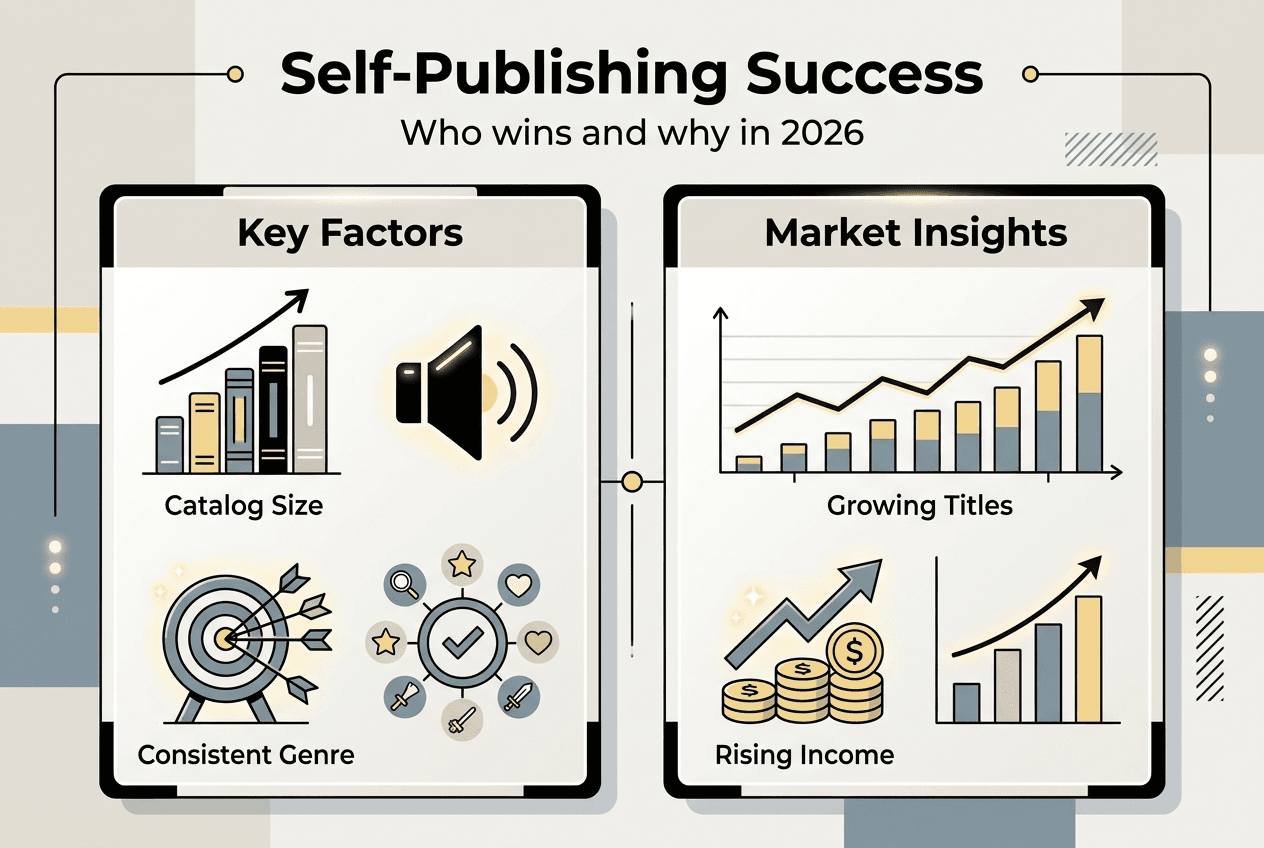
The market continues explosive growth at 16.7% CAGR, driven by improving platform tools, growing reader acceptance of indie titles, and print-on-demand technology that eliminated inventory risk. Niche genres thrive without traditional gatekeeping, allowing authors to serve specific reader communities. Building reader communities and leveraging author-reader marketplaces create additional revenue streams beyond book sales alone.
Pro Tip: Focus on building a backlist in a specific genre rather than publishing standalone titles across multiple categories. Concentrated effort in one genre builds discoverability, reader loyalty, and algorithmic favor on retail platforms.
Email lists emerge as the most valuable marketing asset for successful authors. Direct communication with readers bypasses algorithm changes and platform policies, providing stable promotional channels. Authors with lists exceeding 5,000 subscribers typically earn substantially more than those relying solely on social media or advertising.
How to get started with self-publishing: practical steps for authors
Launching your first self-published book requires methodical preparation across multiple domains. The typical timeline spans 1-3 months with professional assistance, though DIY approaches often extend to six months or longer. Breaking the process into discrete steps prevents overwhelm and ensures you address each critical element.
- Polish your manuscript through multiple revision rounds, incorporating feedback from beta readers or critique partners before hiring a professional editor for developmental and copy editing
- Commission a cover design from a designer experienced in your specific genre, providing comparable titles and clear direction about tone and target audience
- Format your manuscript for both ebook and print, ensuring proper chapter breaks, consistent styling, and print specifications including margins, bleeds, and trim size
- Obtain ISBNs for each format you plan to publish, purchasing directly from your country's ISBN agency or using free ISBNs from platforms like Amazon KDP
- Upload your files to self-publishing platforms, carefully completing all metadata fields including compelling book descriptions, relevant keywords, and appropriate categories
- Set pricing strategically, considering production costs, desired royalty tier, competitive positioning, and promotional pricing plans for launch
- Execute your launch marketing plan, coordinating email announcements, social media promotion, advertising campaigns, and outreach to book bloggers or reviewers
Estimated costs for quality self-publishing range from $2,000 to $7,000, with editing and cover design representing the largest expenses. Developmental editing typically costs $0.03-$0.08 per word, while copy editing runs $0.02-$0.04 per word. Professional cover design ranges from $300 to $1,500 depending on complexity and designer experience. Formatting services cost $50-$500, though many authors learn to format themselves using tools like Vellum or Atticus.
Marketing tactics authors frequently overlook include:
- Building an email list months before launch to create a ready audience
- Optimizing book descriptions with compelling hooks and clear genre signals
- Researching and selecting the most relevant Amazon categories for visibility
- Creating a coordinated launch week with multiple promotional touchpoints
- Soliciting advance reviews from beta readers or reviewer communities
- Planning a series of post-launch promotions rather than treating launch as a one-time event
Pro Tip: Start building your platform and email list six months before your planned launch date. Early audience development dramatically improves launch performance and provides valuable feedback during the writing process.
The book distribution journey from manuscript to reader hands involves numerous technical steps, but platforms have streamlined most processes. Focus your energy on the elements that most impact reader experience: compelling content, professional presentation, and strategic marketing. Many authors benefit from professional book marketing services that handle complex promotional tasks while they focus on writing their next book.
Successful self-published authors treat their work as a business, tracking metrics, testing strategies, and continuously improving their craft and marketing skills. The learning curve is steep initially, but each book becomes easier as you refine your process and build on previous successes.
Discover Librida: support for your self-publishing journey
Navigating self-publishing challenges becomes significantly easier with the right tools and support. Librida offers a comprehensive platform designed specifically for aspiring authors transforming ideas into published books. The platform combines AI publishing tools that streamline manuscript development with professional services covering editing, design, and distribution.

Explore examples of successful self-published works like The Quill & The Courtesan, The Lady and the Quill, and Notes from a Slightly Unstable Life to see what's possible. Librida supports authors at every stage, whether you're outlining your first chapter or preparing to launch your tenth book. Visit Librida today to discover how AI-powered features and expert guidance can accelerate your publishing journey and help you avoid common pitfalls that derail aspiring authors.
Frequently asked questions
What is the easiest way to self-publish a book?
The easiest approach combines Amazon Kindle Direct Publishing for distribution with professional services for editing and cover design. KDP handles printing, shipping, and payment processing automatically, eliminating logistical complexity. However, ease of uploading doesn't guarantee success. Marketing remains essential, as even perfectly published books languish without reader awareness and promotional effort.
How much does it cost to self-publish a book?
Professional self-publishing typically costs $2,000-$7,000, with editing and cover design representing the largest expenses. Developmental editing for an 80,000-word novel runs $2,400-$6,400, while copy editing adds $1,600-$3,200. Professional covers cost $300-$1,500. Formatting, ISBNs, and marketing materials add several hundred dollars more. Budget constraints can reduce costs, but skimping on editing or cover design typically damages sales performance enough to negate the savings.
What are the best platforms for self-publishing?
Amazon Kindle Direct Publishing dominates self-publishing with the largest reader base and straightforward upload process for both ebooks and print books. IngramSpark provides broader distribution to bookstores and libraries, making it valuable for authors seeking retail presence beyond Amazon. Many successful authors use both platforms simultaneously, maximizing reach while maintaining Amazon's promotional tools and reader reviews.
Is self-publishing better than traditional publishing?
Self-publishing offers 35-70% royalties and months-long timelines versus traditional publishing's 10-15% royalties and multi-year waits. You maintain creative control and rights ownership. Traditional publishing provides advance payments, professional editing at no author cost, and established distribution networks. The better choice depends on your goals: self-publishing suits authors prioritizing speed, control, and higher per-sale earnings, while traditional publishing benefits those valuing prestige, bookstore placement, and upfront payment despite lower long-term earnings.