

Choosing between print and digital formats is a major step for aspiring authors. Many writers believe digital publishing is only for self-published amateurs or that e-books lack value, but these myths miss the mark. Digital publishing opens global access, empowers creative control, and eliminates costly barriers. This article clarifies what digital publishing really involves, dispels common misconceptions, and guides you on using AI tools to refine your manuscript for broad digital release.
Table of Contents
- Digital Publishing Defined And Debunked Myths
- Major Formats And Platforms Explained
- AI Integration In The Writing Process
- Cost Savings And Global Accessibility
- Comparing Digital Vs Traditional Publishing
Key Takeaways
| Point | Details |
|---|---|
| Understanding Digital Publishing | Digital publishing allows authors to reach global audiences quickly and keep a larger share of their earnings compared to traditional methods. |
| Myths Debunked | Many common myths, such as digital publishing being only for failures or lacking credibility, are false; both established and new authors thrive in this space. |
| Format and Platform Choices | Selecting the right digital format and platform is crucial for maximizing reach and reader engagement, with EPUB3 being a preferred standard for many authors. |
| AI's Role in Writing | AI tools can enhance writing productivity by assisting with brainstorming, editing, and gathering feedback, helping authors refine their work faster. |
Digital Publishing Defined And Debunked Myths
Digital publishing means distributing written content through electronic formats—e-books, digital magazines, audiobooks, and online platforms—rather than printing physical copies. It's not limited to websites; it includes e-readers, tablets, smartphones, and even CD/DVD formats.
Electronic publishing encompasses far more than you might think. It enables faster market entry, broader reader reach, and opportunities for niche and emerging authors who couldn't compete in traditional markets. This flexibility is exactly what modern authors need.
What Digital Publishing Actually Is
Digital publishing removes the middleman between you and your readers. You write, format, upload, and publish without waiting months for printing presses or distribution negotiations. Your book reaches global audiences within hours.
Key advantages include:
- Instant updates: Fix typos, update content, or revise chapters anytime without reprinting
- Lower costs: No printing, shipping, or warehouse storage expenses
- Direct earnings: Keep higher royalty percentages compared to traditional publishing
- Global reach: Readers access your work from any device, anywhere
- Niche audiences: Smaller, highly specific book categories become viable and profitable
Myths That Hold Authors Back
Myth 1: Digital publishing is only for self-published failures.
This couldn't be further from the truth. Established authors use digital-first strategies, hybrid publishing combines both formats, and major publishers invest heavily in digital distribution. Success depends on your writing quality and marketing, not the format.
Myth 2: Digital books aren't "real" books.
Readers don't care about paper. They care about stories. An e-book reaches more people faster and costs less to produce. Your work has the same value regardless of format.
Myth 3: You need technical skills to publish digitally.
Modern platforms handle the complexity for you. Tools like Librida simplify manuscript formatting, editing, and publication without requiring coding knowledge.
Myth 4: Digital publishing is a recent invention.
The history of digital publishing stretches back decades—from audiobooks in the 1930s through Project Gutenberg's digitization efforts in 1971. Digital standards like EPUB were established in the 2000s. This isn't a fad; it's an evolved, mature publishing method.
Myth 5: You can't make serious money from digital books.
Authors regularly earn sustainable incomes through digital sales. Some earn more than traditionally published authors because they keep higher percentages and reach readers directly.
The Reality Check
Digital publishing democratizes authorship. You maintain creative control, publish on your timeline, and reach global readers. Success requires quality writing and strategic promotion, but the barriers to entry have collapsed.

Pro tip: Start with digital publishing to test your market, build an audience, and prove demand before investing in print editions—this risk-free approach lets you refine your work based on real reader feedback.
Major Formats And Platforms Explained
Choosing the right format and platform shapes your book's reach, accessibility, and earning potential. Different formats serve different reader preferences and device types, so understanding your options matters.
Understanding Digital Formats
Digital publishing formats include EPUB3, PDF, HTML, and DOCX. Each format has distinct strengths depending on your content type and target audience.
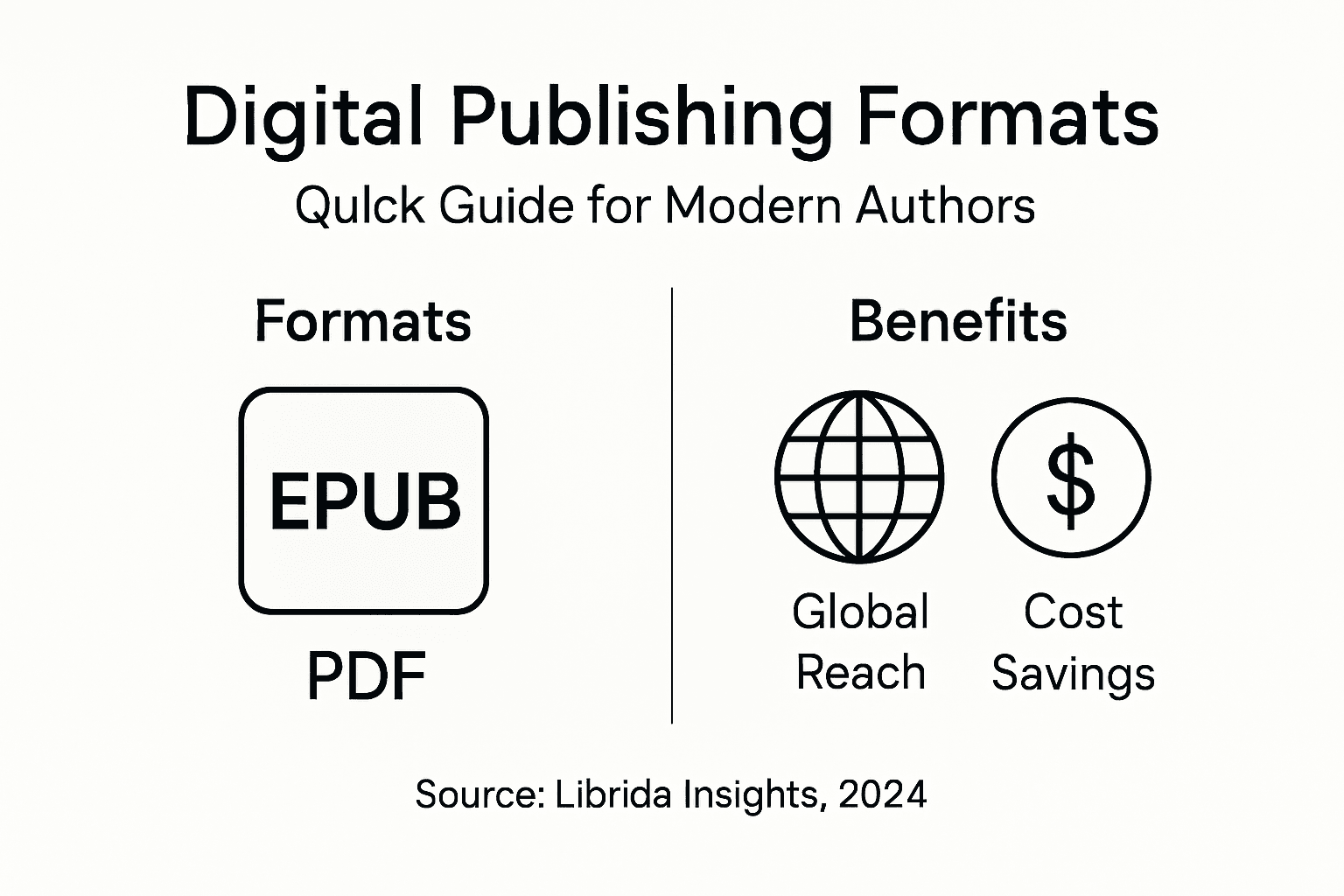
Common formats used today:
Here is a comparison of key digital publishing formats and their best-use scenarios:
| Format | Best For | Device Compatibility |
|---|---|---|
| EPUB3 | Novels, text-heavy books | E-readers, tablets, smartphones |
| Illustrated, fixed layout | Computers, tablets, less mobile-friendly | |
| HTML/XHTML | Interactive, web content | Any browser-enabled device |
| DOCX | Editing, pre-publication | Microsoft Word, most text editors |
- EPUB3: The industry standard for e-books, works on most e-readers and tablets, supports reflowable text that adapts to screen size
- PDF: Fixed layout, perfect for illustrated books, graphic novels, and formatted documents with precise positioning
- HTML/XHTML: Web-based publishing, interactive content, accessible across all devices with a browser
- DOCX/OOXML: Easy to convert into other formats, useful for editing before final publication
Choose EPUB3 for traditional novels and text-heavy books. Use PDF when your design and layout are critical to the reading experience.
Platform Choices for Authors
Digital publishing platforms range from self-publishing marketplaces to open-access repositories. Your platform choice determines distribution reach and royalty rates.
Key platform types include:
- Retail platforms: Distribute directly to Amazon Kindle, Apple Books, Google Play Books with standard royalty structures
- Aggregators: Services that submit your book to multiple retailers simultaneously, expanding visibility
- Open-access repositories: Share your work freely through academic publishing platforms and digital archives
- Your own website: Maintain complete control and higher earnings but handle marketing yourself
Format Accessibility Matters
Modern readers expect books to work on their devices. EPUB formats automatically adjust to phones, tablets, and e-readers. PDFs work everywhere but don't resize gracefully on smaller screens.
Accessibility also means readers with visual impairments can use screen readers. EPUB3 and HTML formats support this; PDFs often don't unless specifically formatted.
Making Your Format Decision
Start by identifying your audience. Novel readers prefer EPUB on e-readers. Cookbook users want PDFs for their fixed layout. Business authors might choose HTML for interactive features.
Most successful authors publish in multiple formats simultaneously. Your manuscript converts between formats easily with modern tools, so limiting yourself to one format unnecessarily restricts your potential readers.
Pro tip: Start with EPUB3 as your primary format since it's the universal standard, then generate a PDF version for print-on-demand and a web version for your author website—this multi-format approach captures every reader type without additional writing work.
AI Integration In The Writing Process
AI tools have transformed how authors write, edit, and refine manuscripts. Rather than replacing your creativity, these tools amplify it by handling tedious tasks and offering real-time feedback. For aspiring authors, AI integration can accelerate your path to publication.
How AI Assists Your Writing
Generative AI technologies like ChatGPT help with content generation, editing suggestions, and structural improvements. They work best as collaborative partners in your creative process, not as replacements for your voice.
AI can help with:
- Brainstorming: Generate plot ideas, character names, dialogue options, and story angles
- First drafts: Overcome blank page anxiety by creating initial outlines or rough chapter summaries
- Editing: Identify inconsistencies, suggest stronger word choices, and catch grammar mistakes
- Pacing adjustments: Flag slow sections or areas needing expansion
- Research support: Summarize topics, explain concepts, and provide background information
AI works best when you direct it with specific, detailed prompts. Vague requests produce generic results; clear instructions yield useful output.
AI In Learning And Development
AI integration in writing education shows how these tools provide personalized support and motivation. They adapt to your writing style and skill level, offering targeted guidance exactly where you need it.
This means AI can help you:
- Improve weak areas without hiring an expensive editor
- Learn writing techniques through examples and explanations
- Get instant feedback on manuscript sections
- Build confidence through consistent practice and encouragement
The Human-AI Partnership
The most successful authors treat AI as a collaborator, not an oracle. You maintain creative control while AI handles mechanical improvements and offers suggestions you accept or reject.
Your role remains irreplaceable. You decide what matters in your story, what voice feels authentic, and what direction your narrative takes. AI suggests; you choose.
This partnership accelerates timelines significantly. Authors using AI tools report reducing editing time by 40-60% while improving manuscript quality. That means you publish faster without sacrificing excellence.
Ethical AI Usage
Use AI transparently. Don't present AI-generated content as entirely your own without disclosure where relevant. Your unique perspective, experience, and creativity are what readers actually want.
Pro tip: Use AI to generate rough drafts and editing suggestions, then revise aggressively with your voice and judgment—this approach maintains authenticity while gaining the speed benefits of AI assistance.
Cost Savings And Global Accessibility
Digital publishing eliminates the biggest expenses of traditional publishing. No printing presses, no warehouses, no shipping trucks. You reach readers worldwide for a fraction of traditional costs, keeping more revenue for yourself.
The Financial Reality
Traditional publishing requires massive upfront investments. Print runs cost thousands of dollars, storage warehouses consume ongoing expenses, and international distribution demands logistics networks. Digital publishing has none of these burdens.
Your actual costs with digital publishing:
- Platform fees: Usually 0-30% commission per sale (varies by platform)
- Cover design: One-time investment, reusable across all formats and platforms
- Editing and proofreading: Quality varies; AI tools reduce costs significantly
- Marketing: Your choice—spend what you can afford when you want
- Distribution: Essentially free once uploaded
Digital publishing removes print and distribution costs entirely, meaning you keep 50-70% of revenue versus 10-25% in traditional publishing deals.
Global Reach Without Global Costs
Digital publishing models reduce costs while expanding accessibility worldwide. A reader in Tokyo pays the same price as someone in Toronto, and your book reaches both instantly.
Traditional publishers hesitate with niche markets because printing and shipping make small audiences unprofitable. Digital changes that equation. Your cookbook about regional cuisine, your technical manual for specialty software, your memoir about underrepresented experiences—all become viable.
Breaking Down Geographic Barriers
Data accessibility enables global participation by removing economic and geographical obstacles. Digital platforms let readers from developing nations access your work at prices they can afford.
This matters because:
- Readers everywhere gain access regardless of local bookstore availability
- Authors reach audiences in markets traditional publishers ignore
- You build a global fan base that translates to sustainable income
- No inventory risk—print only what readers actually buy
Real Numbers
Authors self-publishing digitally typically earn $2-8 per book sold after platform fees. Traditional publishers pay advances averaging $5,000-15,000 (if you're lucky), then royalties only after earning out that advance.
A digital author selling 500 copies monthly earns $1,000-4,000 that month. Traditional authors wait months or years for royalty checks. The math favors digital publishing for most authors.
Your Publishing Timeline
Traditional publishing takes 18-24 months from contract to bookstore shelf. Digital publishing takes days. You respond to trends, capitalize on current events, and reach audiences when your book is relevant.
Pro tip: Calculate your break-even point by dividing your total costs by your target profit margin per book—most digital authors break even within 50-100 sales, then everything after that is profit.
Comparing Digital Vs Traditional Publishing
Both publishing paths have distinct advantages and tradeoffs. Understanding the differences helps you choose the route that aligns with your goals, timeline, and resources. Neither is universally "better"—context determines which serves you best.
This table contrasts critical aspects of traditional and digital publishing paths:
| Factor | Traditional Publishing | Digital Publishing |
|---|---|---|
| Timeline | 18-24 months | Days to weeks |
| Royalty Percentage | 10-25% | 50-70% |
| Creative Control | Publisher makes decisions | Author controls all choices |
| Advance Payment | Common, but limited | None; income from sales only |
Traditional Publishing Overview
Traditional publishing involves investment and marketing with editorial oversight and physical distribution. Publishers handle editing, cover design, printing, and bookstore placement. In return, you surrender creative control and accept lower royalty rates.
Traditional publishing strengths:
- Credibility boost: Published by established houses carries prestige
- Professional services: Editing, design, marketing handled by experts
- Bookstore placement: Physical visibility in retail locations
- Advance payments: Money upfront, even if it takes years to earn out
- Media attention: Publishers pitch to reviewers and media outlets
Traditional publishing weaknesses:
- Long timeline: 18-24 months from contract to shelf
- Low royalties: 10-25% of sales revenue
- Limited control: Publishers make final decisions on cover, title, release date
- Selective acceptance: Must convince agents and editors first
Digital Publishing Overview
Digital publishing puts you in control. You handle decisions, keep higher earnings, and publish immediately. The tradeoff is responsibility—you manage editing, design, and marketing yourself.
Digital publishing strengths:
- Speed: Publish within days, not months
- High royalties: Keep 50-70% of revenue
- Creative control: You decide everything about your book
- Direct feedback: See real-time sales and reader response
- Low investment: Minimal upfront costs
- Flexibility: Update, reissue, or discontinue anytime
Digital publishing weaknesses:
- No advance payment: You earn only from sales
- Solo marketing burden: Success depends on your promotion efforts
- Quality concerns: You're responsible for professional editing and design
- Limited prestige: Self-published books still face credibility questions
The Industry Consolidation Reality
The publishing industry has consolidated with a few large publishers dominating output. This concentration makes traditional publishing harder to access but strengthens the case for digital publishing independence.
Fewer publishers means fewer acquisition slots. They focus on proven categories and celebrity authors. Niche books, experimental genres, and unknown authors face brutal gatekeeping. Digital publishing bypasses this entirely.
Making Your Decision
Choose traditional publishing if you want prestige, advance money, and professional support despite long timelines and low royalties.
Choose digital publishing if you want speed, control, and higher earnings despite requiring personal investment in quality services.
Many successful authors use both: digital first to build an audience and prove demand, then pitch to traditional publishers from a position of strength.
Your choice today isn't permanent. Start digital, build an audience, earn income, then explore hybrid or traditional options later—you maintain leverage once you've already found readers.
Pro tip: If pursuing traditional publishing, build a digital platform with short stories, essays, or a newsletter in your genre first—agents now expect authors to bring existing audiences to the table.
Empower Your Digital Publishing Journey with Librida
The article highlights key challenges modern authors face such as needing creative control, overcoming technical barriers, and gaining global reach quickly. If you are ready to embrace digital publishing to publish faster, maintain full control, and tap into AI-powered support that simplifies formatting and editing, Librida is designed just for you. Say goodbye to long timelines and complicated technical demands, and say hello to a platform that helps you bring your story from idea to published book effortlessly.
Discover how Librida’s intuitive AI tools assist you in every step of your creative process while letting you stay in charge of your narrative and decisions. Start your publishing journey today at Librida and unlock the potential to publish smarter and faster. Begin turning your ideas into compelling books without delay by visiting https://librida.com now.
Frequently Asked Questions
What are the main advantages of digital publishing for modern authors?
Digital publishing offers advantages such as instant market entry, lower costs, higher royalty percentages, global reach, and the ability to target niche audiences effectively.
How does digital publishing differ from traditional publishing?
Digital publishing allows authors to maintain creative control, publish quickly, and keep a larger portion of their earnings, whereas traditional publishing typically involves a longer timeline, lower royalty rates, and less control over the final product.
Do I need technical skills to publish my work digitally?
No, modern digital publishing platforms are user-friendly and simplify the formatting, editing, and publishing processes, so you don’t need technical skills or coding knowledge to get started.
Can I update my digital book after it is published?
Yes, one of the benefits of digital publishing is that you can instantly update your book to correct errors, revise content, or make improvements without the need for reprinting.