

Aspiring authors often confuse hybrid publishing with vanity presses or assume it's just another term for traditional publishing. This confusion can lead to missed opportunities or costly mistakes. Hybrid publishing offers a unique middle path that combines the best aspects of traditional and self-publishing, giving you greater creative control while maintaining professional standards. Understanding the true advantages of hybrid publishing empowers you to make informed decisions about your publishing journey. This article clarifies what hybrid publishing really is, explores its distinct benefits, helps you spot reputable publishers, and provides practical steps for success in 2026.
Table of Contents
- What Is Hybrid Publishing And How Does It Differ From Traditional And Vanity Publishing?
- Advantages Of Hybrid Publishing For Authors
- How To Distinguish Reputable Hybrid Publishers From Vanity Presses
- Practical Steps For Authors Considering Hybrid Publishing In 2026
- Explore Unique Hybrid-Published Titles And Start Your Journey
Key takeaways
| Point | Details |
|---|---|
| Higher royalties | Hybrid publishing typically offers 50% or more in royalties compared to traditional publishing's 5-15%. |
| Author control | You retain creative control over cover design, editing choices, and marketing strategies. |
| Professional services | Customizable packages include editing, design, formatting, and marketing tailored to your budget. |
| Quality distinction | Reputable hybrid publishers maintain professional standards, unlike vanity presses that accept any manuscript. |
| Research required | Careful vetting of publishers and contract terms protects your investment and publishing rights. |
What is hybrid publishing and how does it differ from traditional and vanity publishing?
Hybrid publishing blends the professional services of traditional publishing with the author control and flexibility of self-publishing. You pay for specific services upfront while retaining creative control and earning higher royalties than traditional contracts offer. This model creates a partnership where both publisher and author invest in the book's success.
Traditional publishing grants publishers complete control over your manuscript, cover design, and marketing approach. Publishers absorb production costs but offer minimal royalties, typically between 5% and 15% of net sales. You surrender most creative decisions in exchange for their investment and industry connections. The acceptance process is highly selective, often requiring literary agents and facing rejection rates exceeding 95%.
Vanity publishing accepts virtually any manuscript regardless of quality or market potential. These operations profit primarily from author fees rather than book sales. They provide minimal editing, use generic template designs, and invest little in meaningful marketing or distribution. The focus remains on extracting money from authors, not building successful books.
Hybrid publishing maintains professional standards while empowering authors. Publishers evaluate manuscripts for quality and market viability before acceptance. You pay for services but receive professional editing, custom cover design, proper formatting, and genuine marketing support. The publisher invests in distribution channels and shares your goal of selling books to readers.
Key differences include:
- Traditional publishing controls all creative decisions and offers 5-15% royalties
- Hybrid publishing lets authors choose services and typically pays 50% or more royalties
- Vanity publishing accepts any manuscript and provides minimal professional services
- Hybrid publishers evaluate quality before acceptance, vanity presses do not
- Traditional publishers absorb costs, hybrid authors invest upfront, vanity presses charge excessive fees
Jane Friedman clarifies a critical distinction:
One of the biggest misconceptions is that hybrid publishing is 'vanity publishing'. The key difference is the quality of services provided.
Understanding these differences helps you navigate publishing options confidently. Hybrid publishing creates a fair marketplace token economics approach where both parties benefit from book sales. You maintain ownership and control while accessing professional resources that elevate your work above self-published standards.
Advantages of hybrid publishing for authors
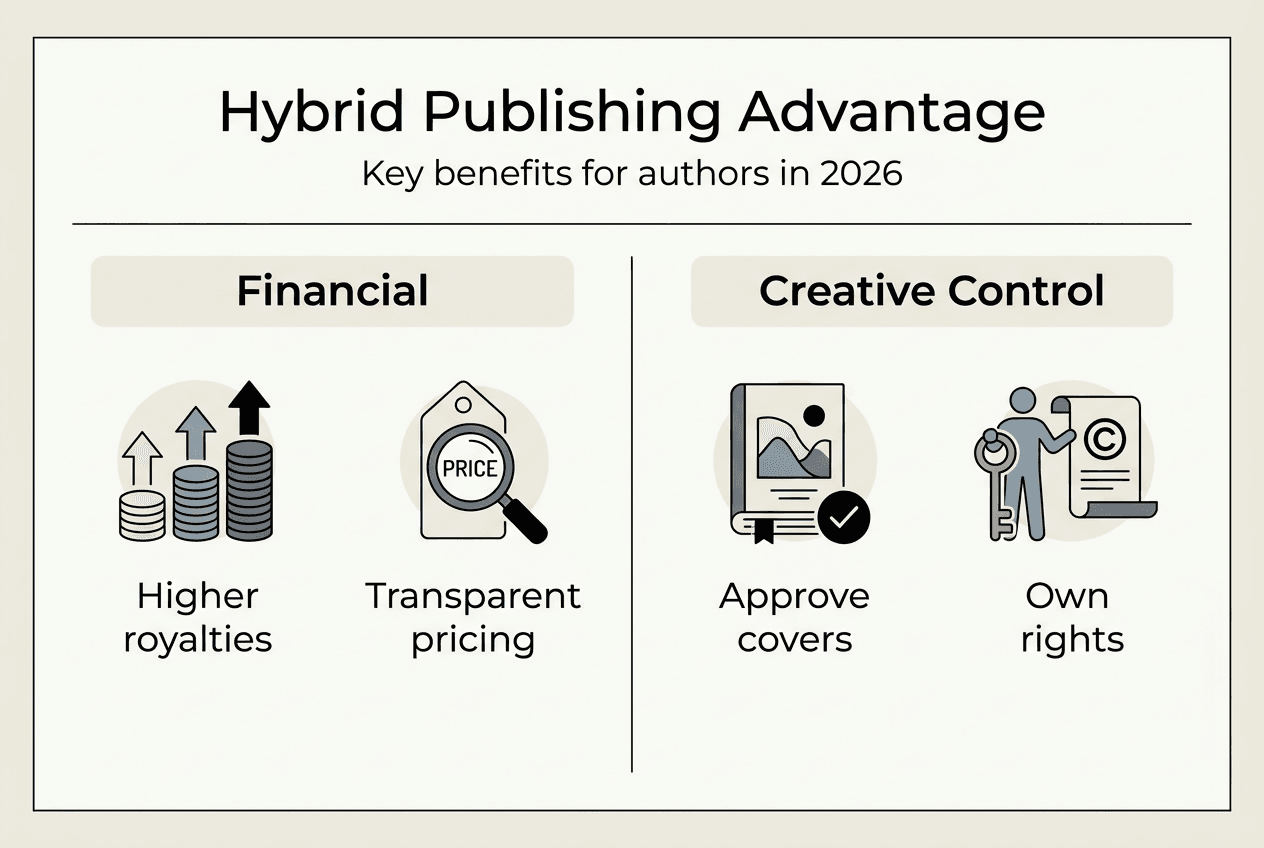
Hybrid publishing delivers substantially higher royalty rates than traditional contracts. Authors typically retain 50% or more of royalties compared to the 5-15% traditional publishers offer. This difference becomes significant when your book gains traction. A book earning $10,000 in sales nets you $5,000 or more with hybrid publishing versus $500 to $1,500 traditionally. Your financial upside grows exponentially with each sale.

Creative control represents another major advantage. You approve or reject cover designs rather than accepting whatever the publisher creates. You participate in editing decisions, ensuring your voice remains authentic throughout the revision process. Marketing strategies align with your vision and target audience preferences. This control matters deeply when your book reflects personal experiences or specialized knowledge.
Hybrid publishers provide customizable services including editing, cover design, formatting, and marketing tailored to your specific needs and budget. You select only the services like editing and cover design where you need professional support. Perhaps you have a talented designer friend who can create your cover, but you need developmental editing expertise. Hybrid publishing lets you allocate resources strategically.
Professional quality elevates your book above typical self-published works. Hybrid publishers employ experienced editors who strengthen your manuscript's structure, pacing, and clarity. Professional designers create covers that compete with traditionally published books on retail shelves. Formatters ensure your interior layout meets industry standards across print and digital formats. This polish builds reader trust and increases sales potential.
| Publishing Type | Typical Royalty Rate | Creative Control | Service Quality | Author Investment |
|---|---|---|---|---|
| Traditional | 5-15% | Minimal | High | None upfront |
| Hybrid | 50%+ | Extensive | High | Moderate upfront |
| Vanity | Varies | Full | Low | High upfront |
| Self-Publishing | 70%+ | Complete | Varies | Time or money |
Key advantages include:
- Royalty rates three to ten times higher than traditional publishing
- Retention of creative control over all major decisions
- Access to professional editing, design, and marketing expertise
- Customizable service packages matching your budget and needs
- Faster publication timelines than traditional routes
- Ownership of your intellectual property and publishing rights
Pro Tip: Evaluate service packages carefully to avoid paying for services you don't need. Request detailed breakdowns of what each package includes and compare offerings from multiple publishers. Some authors need comprehensive support while others only require specific services. Matching services to your actual needs maximizes your investment value.
The combination of higher royalties and professional support creates a compelling value proposition. You invest in your book's success while maintaining control over creative decisions and financial outcomes. This balance attracts authors who value both quality and independence.
How to distinguish reputable hybrid publishers from vanity presses
Vanity presses accept manuscripts without quality evaluation, providing minimal editing and using template designs that make books look amateurish. These operations accept any manuscript regardless of writing quality, plot coherence, or market potential. Their business model depends on author fees, not book sales. You receive generic services that fail to differentiate your work in a crowded marketplace.
Reputable hybrid publishers invest in marketing and distribution because they profit when your book sells. Publishers prioritizing fees over sales indicate poor marketing commitment and limited distribution reach. Quality hybrid publishers maintain relationships with bookstores, libraries, and online retailers. They understand that successful books generate ongoing revenue through royalty sharing.
Marketing investment reveals publisher priorities. Vanity presses offer basic services like creating an Amazon listing and perhaps a single press release. Reputable hybrid publishers develop comprehensive marketing plans including targeted advertising, review copies for industry publications, social media campaigns, and author platform development. They assign marketing professionals who understand your genre and target readers.
Distribution channels separate serious publishers from vanity operations. Quality hybrid publishers secure placement with major distributors like Ingram, ensuring bookstores can easily order your title. They negotiate favorable terms with online retailers and pursue library sales opportunities. Vanity presses often limit distribution to print-on-demand services with restricted reach.
| Characteristic | Vanity Press | Reputable Hybrid Publisher |
|---|---|---|
| Manuscript acceptance | Accepts everything | Selective based on quality |
| Editing quality | Minimal proofreading | Comprehensive developmental and copy editing |
| Cover design | Template-based | Custom professional design |
| Marketing investment | Minimal to none | Substantial campaigns |
| Distribution | Limited POD only | Wide distribution networks |
| Revenue model | Author fees | Book sales royalties |
| Contract terms | Rights grabs common | Author retains rights |
Steps to vet hybrid publishers:
- Research their published titles and assess quality standards across multiple books
- Request references from current authors and contact them directly about experiences
- Review contract terms carefully, focusing on rights retention and royalty structures
- Verify distribution partnerships with major wholesalers and retailers
- Examine marketing case studies showing actual campaign results and sales data
- Check industry memberships like the Independent Book Publishers Association
- Analyze their website for transparency about services, pricing, and author testimonials
Pro Tip: Request sample contracts before committing to any publisher. Compare rights clauses, royalty percentages, and termination terms across multiple publishers. Consult with publishing attorneys or experienced authors if contract language seems unclear. Understanding exactly what you're signing protects your long-term interests and ensures professional publishing standards throughout your partnership.
Red flags include pressure tactics demanding immediate decisions, vague service descriptions without specific deliverables, and reluctance to provide author references. Quality publishers welcome questions and provide detailed information about their processes. They understand that informed authors make better partners.
Practical steps for authors considering hybrid publishing in 2026
Successful hybrid publishing requires careful research and due diligence before signing any contracts or making financial commitments. The landscape continues evolving in 2026, with new publishers emerging and established ones refining their models. Your systematic approach determines whether hybrid publishing serves your goals effectively.
Follow these practical steps:
- Define your publishing goals including timeline, budget, desired control level, and success metrics
- Research at least five hybrid publishers in your genre, comparing services and author experiences
- Create a realistic budget covering publishing services, marketing, and ongoing promotional activities
- Request detailed proposals from your top three publisher choices, asking specific questions about processes
- Verify each publisher's distribution network, marketing capabilities, and editorial standards
- Review contracts with legal counsel or experienced publishing professionals before signing
- Develop your author platform through social media, email lists, and reader engagement strategies
- Plan your marketing calendar extending at least six months beyond publication date
- Set measurable goals for sales, reviews, and reader engagement to track success
- Build relationships with other hybrid-published authors for ongoing support and knowledge sharing
Budget planning prevents financial surprises during your publishing journey. Quality hybrid publishing packages typically range from $3,000 to $15,000 depending on service comprehensiveness. Editorial services consume the largest portion, followed by cover design and marketing. Allocate additional funds for ongoing marketing after publication, as initial launch momentum requires sustained effort.
Compare multiple publishers systematically using spreadsheets tracking services offered, pricing, contract terms, and author testimonials. Ask detailed questions about editorial processes, design revision rounds, marketing campaign specifics, and distribution timelines. Publishers willing to provide transparent answers demonstrate professionalism and author-focused values.
Pro Tip: Understand contract terms related to rights retention and royalty calculations before committing to any publisher. Ensure you retain all rights to your intellectual property and can terminate the agreement if needed. Clarify how royalties are calculated, when payments occur, and what sales reporting you'll receive. Ambiguous contract language often hides unfavorable terms that surface only after publication.
Evolving trends in 2026 influence hybrid publishing decisions significantly. Artificial intelligence tools now assist with manuscript development, editing suggestions, and marketing copy creation. Publishers integrating these technologies often deliver faster turnarounds and more competitive pricing. However, human expertise remains essential for creative decisions and quality assurance.
Direct-to-reader sales channels gain importance as authors build email lists and social media followings. Hybrid publishers supporting these strategies through website development, newsletter tools, and reader engagement platforms provide additional value. Your ability to connect directly with readers amplifies marketing effectiveness and builds sustainable author careers.
Ongoing author engagement determines publishing success beyond initial launch activities. Plan to invest time in reader interactions, social media presence, email communications, and potential speaking opportunities. Hybrid publishing provides professional support, but your active participation drives sales and builds readership. Publishers value authors who treat publishing as a collaborative partnership rather than a passive transaction.
Explore reading community editions insights to understand how engaged reader communities support hybrid-published authors. Building these connections before publication creates launch momentum and sustains long-term sales growth.
Explore unique hybrid-published titles and start your journey
Discover how hybrid publishing brings diverse voices and stories to readers through Librida's curated collection. Real examples illustrate the quality and variety hybrid publishing enables when authors partner with professional publishers who share their vision. Exploring these titles provides inspiration and concrete understanding of hybrid publishing outcomes.
Examine The Quill & The Courtesan, a compelling narrative showcasing professional editing and design quality achievable through hybrid publishing. The Lady and The Quill demonstrates how authors maintain creative control while benefiting from publisher expertise. Notes from a Slightly Unstable Life reveals the personal storytelling hybrid publishing empowers.
Librida supports authors navigating hybrid publishing decisions by connecting you with quality examples and resources. Whether you're researching publishing options or ready to begin your journey, exploring successful hybrid-published works clarifies what's possible when professional support meets author vision.
Is hybrid publishing right for me?
What does hybrid publishing typically cost?
Hybrid publishing packages range from $3,000 to $15,000 depending on service comprehensiveness and publisher reputation. Basic packages include editing, cover design, and formatting, while premium options add extensive marketing campaigns and distribution support. Budget for additional marketing expenses beyond initial package costs.
Do I retain rights to my book with hybrid publishing?
Reputable hybrid publishers allow authors to retain all rights to their intellectual property and creative work. You maintain ownership while the publisher provides services under contract terms you both agree upon. Always verify rights retention clauses before signing any publishing agreement.
How does hybrid publishing differ from self-publishing?
Hybrid publishing provides professional editorial, design, and marketing services through publisher partnerships, while self-publishing requires authors to manage or contract these services independently. Hybrid publishers curate their author lists based on quality, whereas self-publishing platforms accept all submissions. Both models offer higher royalties than traditional publishing.
What royalty percentage can I expect from hybrid publishing?
Hybrid publishers typically offer 50% to 70% royalties on net sales, significantly higher than traditional publishing's 5% to 15% rates. Specific percentages vary by publisher and format, with ebook royalties often higher than print. Review royalty structures carefully during contract negotiations.
How long does hybrid publishing take from manuscript to published book?
Hybrid publishing timelines typically span six to twelve months from contract signing to publication. This includes editorial revisions, design processes, formatting, pre-publication marketing setup, and distribution arrangements. Timelines vary based on manuscript readiness and service package complexity.
Can hybrid-published books get into bookstores?
Quality hybrid publishers maintain distribution relationships enabling bookstore placement through wholesalers like Ingram. However, physical bookstore presence requires active marketing, local author engagement, and often consignment arrangements. Online retail placement through Amazon, Barnes & Noble, and specialty retailers is standard with reputable hybrid publishers.