

Publishing a book used to take months of grinding through edits, formatting nightmares, and marketing puzzles. Now AI tools reduce self-publishing time by 30-90% and costs by 60-80% through automated workflows, letting you focus on storytelling instead of technical busywork. But here's the catch: pure AI books flood platforms and erode reader trust, while smart hybrid approaches deliver real results. This guide reveals exactly why publishing with AI works when you combine automation with human creativity, giving you practical strategies to cut costs, speed production, and maintain authenticity in 2026's competitive market.
Table of Contents
- How AI Cuts Time And Costs In Self-Publishing
- Key AI Capabilities Transforming Publishing Today
- The Pros And Cons Of Publishing With AI: Expert Insights
- Applying AI Tools Effectively For Self-Publishing Authors
- Why Choose Librida For AI-Assisted Publishing
- Frequently Asked Questions About Publishing With AI
Key takeaways
| Point | Details |
|---|---|
| Speed and savings | AI automation slashes publishing timelines from months to weeks while cutting costs by thousands per title. |
| Hybrid wins | Combining AI efficiency with human oversight produces the highest quality and reader acceptance. |
| Genre matters | Nonfiction benefits most from AI tools, while fiction readers still demand human storytelling nuance. |
| Market risks | Pure AI content floods platforms, hurting discoverability and damaging author credibility. |
| Strategic use | Smart authors use AI for repetitive tasks like editing and metadata while preserving their unique voice. |
How AI cuts time and costs in self-publishing
Self-publishing traditionally demanded massive time investments across editing, cover design, formatting, and marketing. You'd spend weeks perfecting grammar, hire designers for covers, wrestle with formatting software, and manually optimize metadata for each platform. AI tools reduce self-publishing time by 30-90% and costs by 60-80% through automated workflows that handle these repetitive tasks in minutes instead of weeks.
Consider the typical publishing timeline: manuscript editing takes 4-8 weeks, cover design another 2-3 weeks, formatting 1-2 weeks, and marketing setup consumes endless hours. AI compresses this entire process dramatically. Grammar checkers like ProWritingAid scan 80,000 words in minutes. AI cover generators produce professional designs in seconds. Formatting tools like Vellum automate layout for print and ebook simultaneously. Marketing platforms generate metadata, descriptions, and ad copy instantly.
The financial impact hits even harder. Traditional publishing services charge $1,500-3,000 for editing, $500-1,500 for covers, $300-800 for formatting, and $500+ for marketing materials. AI alternatives cost $20-100 monthly for unlimited use across multiple titles. Authors publishing 3-4 books yearly save $6,000-15,000 while maintaining professional quality. This democratizes publishing for writers without massive budgets.
Batch processing multiplies these benefits exponentially. Once you've built AI-powered workflows, producing additional titles requires minimal extra effort. Authors now publish 10-20 books yearly instead of 1-2, scaling their catalogs and income potential without proportional time increases. How AI streamlines publishing tasks shows practical examples of this automation in action.
Here's how AI transforms specific publishing tasks:
| Task | Traditional Time | AI Time | Cost Savings |
|---|---|---|---|
| Manuscript editing | 4-8 weeks | 2-5 days | $1,500-3,000 |
| Cover design | 2-3 weeks | 1-2 hours | $500-1,500 |
| Formatting | 1-2 weeks | 2-4 hours | $300-800 |
| Metadata optimization | 3-5 hours | 15-30 minutes | $200-500 |
| Marketing copy | 1-2 weeks | 1-2 hours | $500-1,000 |
Pro Tip: Start with one AI tool per publishing phase rather than overhauling everything at once. Master grammar checking first, then add cover design, then formatting. This gradual integration prevents overwhelm and helps you identify which tools deliver the most value for your specific workflow.
Key AI capabilities transforming publishing today
AI excels at specific publishing tasks that traditionally consumed disproportionate time and money. Grammar and style checking through AI reduces errors efficiently, catching typos, awkward phrasing, and inconsistencies human eyes miss after multiple manuscript passes. Tools like Grammarly and ProWritingAid analyze voice consistency, readability scores, and genre-appropriate language, providing instant feedback that would take professional editors days to compile.
Metadata optimization represents another AI superpower. Amazon's algorithm weighs keywords, categories, and descriptions heavily when ranking books. AI tools analyze top-performing titles in your genre, identify high-traffic keywords with low competition, and generate optimized metadata that improves discoverability by 40-60%. This technical SEO work requires hours of manual research but takes AI seconds to execute perfectly.
Cover design democratization changes everything for indie authors. Professional designers charge premium rates, but AI generators like Midjourney and DALL-E create genre-appropriate covers matching bestseller aesthetics. You input genre, mood, and visual preferences, then iterate through dozens of options in minutes. While human designers still excel at nuanced branding, AI covers work perfectly for rapid publishing strategies and testing market response before investing in custom designs.

Multi-platform publishing automation eliminates tedious reformatting. Upload your manuscript once, and AI tools generate properly formatted files for Kindle, IngramSpark, Apple Books, and other platforms simultaneously. This scalability means publishing wide across all retailers requires minimal extra effort, maximizing your book's reach without proportional time investment.
Authors leveraging these AI capabilities report saving $2,000+ per book while maintaining professional standards. More importantly, batch publishing becomes viable. Instead of producing one carefully crafted title yearly, you can publish 6-12 books by automating repetitive tasks and focusing human effort on creative decisions and storytelling quality. Optimizing book metadata and marketing with AI provides detailed strategies for maximizing these discoverability benefits.
The efficiency gains compound over time. Your second book takes half the time of your first because you've refined AI workflows. Your tenth book takes a fraction of your second's time. This learning curve acceleration separates successful AI-adopting authors from those stuck in traditional publishing bottlenecks.
The pros and cons of publishing with AI: expert insights
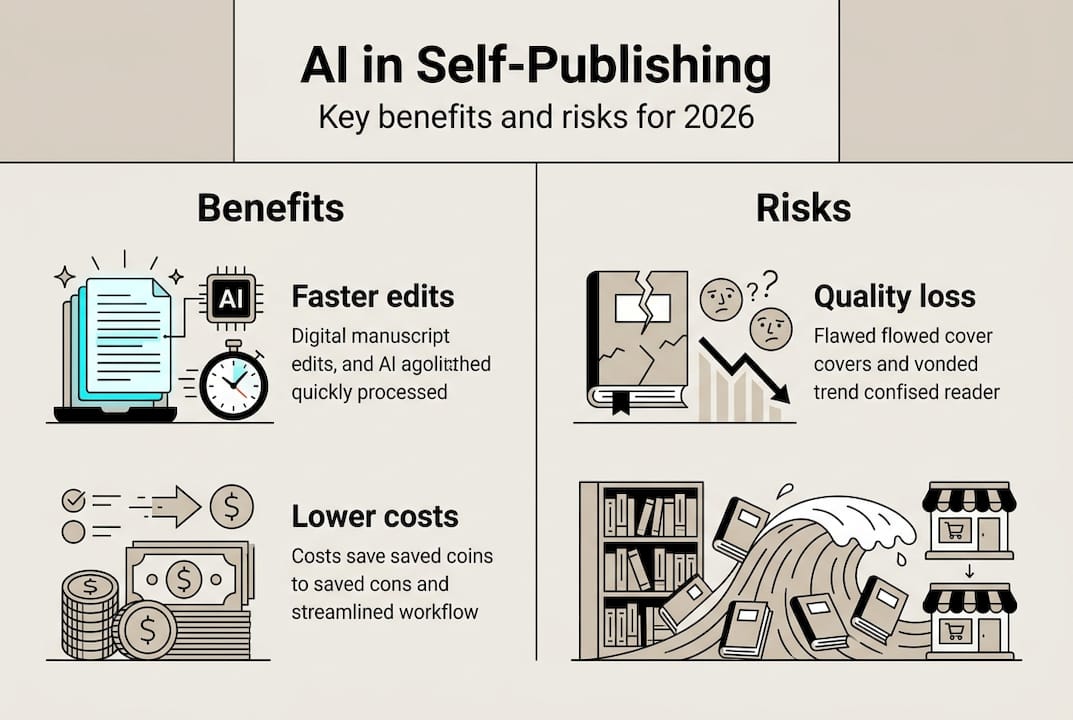
AI publishing delivers undeniable benefits but carries significant risks that demand honest evaluation. The advantages center on democratization and efficiency. Authors without technical skills or large budgets now access professional-quality tools previously reserved for traditional publishers. Publishing speed increases dramatically, letting you test multiple ideas, respond to trends quickly, and build substantial catalogs that generate consistent income through volume.
Cost reduction transforms publishing economics entirely. Where traditional self-publishing required $3,000-5,000 per title for professional services, AI tools deliver comparable results for $50-200. This 95% cost reduction lets authors experiment with niche topics, series launches, and market testing without risking financial ruin. The barrier to entry drops from prohibitive to accessible for virtually anyone with stories to tell.
However, serious drawbacks emerge when examining market realities. AI nonfiction floods platforms hurting discoverability as low-quality content proliferates faster than readers can filter it. Amazon's Kindle store now contains millions of AI-generated books, many indistinguishable from human work at first glance but lacking depth, originality, and genuine insight. This flooding degrades the entire ecosystem, making quality books harder to find.
Authenticity concerns plague AI-heavy publishing. Readers increasingly detect AI-generated prose through telltale patterns, repetitive phrasing, and lack of genuine human experience. Fiction readers prefer human-authored nuance over AI-generated plots because emotional resonance, character depth, and storytelling craft require lived experience AI cannot replicate. Pure AI novels receive harsh reviews and poor sales despite technical correctness.
The solution lies in hybrid approaches. Hybrid AI-human workflows yield highest ROI, while pure AI risks rejection and reader distrust. Use AI for mechanical tasks like grammar checking, formatting, and metadata optimization, but maintain human control over creative decisions, voice, and storytelling. This balance preserves authenticity while capturing efficiency gains.
Genre considerations matter enormously. Nonfiction benefits more from AI because readers prioritize information accuracy over stylistic nuance. How-to guides, reference books, and educational content work well with heavy AI assistance. Fiction demands human creativity, emotional intelligence, and cultural understanding AI lacks. Memoirs and narrative nonfiction fall somewhere between, benefiting from AI editing but requiring authentic human voice.
| Approach | Benefits | Drawbacks | Best For |
|---|---|---|---|
| Pure AI | Fastest, cheapest, highest volume | Low quality, reader rejection, platform flooding | Quick nonfiction, testing ideas |
| Hybrid AI-Human | Efficiency + authenticity, best ROI | Requires skill, moderate cost | Most genres, serious authors |
| Pure Human | Highest quality, reader trust | Slowest, most expensive, limited scale | Literary fiction, premium memoir |
Pro Tip: Maintain your unique author voice by writing first drafts entirely yourself, then using AI only for editing, formatting, and technical optimization. This preserves authenticity while capturing efficiency gains where they matter most. Readers connect with genuine human perspectives, not polished but soulless prose.
Ethical and legal issues with AI publishing require careful navigation. Copyright questions, disclosure requirements, and platform policies evolve rapidly. Stay informed about regulations and maintain transparency with readers about your AI usage to build lasting trust and avoid future complications.
Applying AI tools effectively for self-publishing authors
Successful AI integration requires strategic implementation rather than wholesale replacement of human effort. Start by identifying your publishing bottlenecks and pain points. Most authors struggle with editing speed, formatting complexity, or marketing overwhelm. Target AI tools at these specific problems rather than trying to automate everything simultaneously.
Follow this proven integration sequence for optimal results:
- Draft your manuscript entirely yourself to preserve authentic voice and creative vision. AI cannot replicate your unique perspective, experiences, or storytelling instincts.
- Use AI grammar and style checkers for initial editing passes, catching obvious errors and inconsistencies before human review. This eliminates 80% of mechanical issues quickly.
- Conduct human review and revision focused on voice, pacing, character development, and emotional resonance. AI cannot evaluate these crucial elements effectively.
- Apply AI formatting tools to generate print and ebook files simultaneously, eliminating tedious layout work and ensuring professional presentation across platforms.
- Leverage AI for metadata optimization, keyword research, and marketing copy generation, then refine outputs to match your authentic author brand.
- Use AI to create initial cover concepts or marketing graphics, but consider human designers for final versions if budget allows, especially for series branding.
This workflow maximizes efficiency while maintaining quality and authenticity. Hybrid AI-human workflows yield highest ROI; pure AI risks rejection from both platforms and readers. The key lies in using AI for repetitive, technical tasks while reserving human judgment for creative and strategic decisions.
Manual review remains non-negotiable regardless of AI sophistication. Always read your final manuscript thoroughly before publication. AI tools miss context, introduce subtle errors, and occasionally generate nonsensical suggestions. Your reputation depends on quality control that only human oversight provides.
Build a personal workflow checklist documenting exactly which AI tools you use for each publishing phase, including specific settings and prompts that work best for your style. This systematization compounds efficiency gains across multiple titles. Your fifth book publishes faster than your first because you've refined every step.
Pro Tip: Schedule monthly reviews of new AI publishing tools and techniques. The technology evolves rapidly, with new capabilities emerging constantly. Authors who continuously update their skills and tool knowledge maintain competitive advantages over those using outdated workflows. Join author communities focused on AI publishing to share discoveries and learn from others' experiments.
Combining AI with human expertise in publishing demonstrates how platforms successfully blend automation with quality control. Study these examples to understand what works and what fails in real-world applications.
Balance remains everything. Too much AI produces soulless content readers reject. Too little AI means you're competing at a severe efficiency disadvantage against authors who've mastered hybrid workflows. Find your optimal mix through experimentation, reader feedback, and honest evaluation of results. Your goal is publishing more quality books faster, not just publishing more books.
Why choose Librida for AI-assisted publishing
Navigating AI publishing tools alone feels overwhelming with hundreds of options and conflicting advice. Librida solves this by providing an integrated platform specifically designed for authors combining AI efficiency with human creativity. You get AI publishing tools that handle technical tasks while preserving your unique voice and vision throughout the creative process.

The platform guides you through proven hybrid workflows, from initial concept development through final publication and marketing. Real success stories like The Quill & The Courtesan and Notes from a Slightly Unstable Life demonstrate how authors achieve professional results using Librida's AI-assisted approach. You'll save thousands in publishing costs while maintaining the quality and authenticity readers demand. Whether you're publishing your first book or scaling to multiple titles yearly, Librida provides the tools, templates, and support to make AI work for your specific goals without sacrificing what makes your writing special.
Frequently asked questions about publishing with AI
What are the main benefits of using AI in self-publishing?
AI dramatically reduces publishing time by 30-90% and costs by 60-80% through automation of editing, formatting, cover design, and marketing tasks. Authors can publish multiple titles yearly instead of one, building substantial catalogs that generate consistent income. The technology democratizes access to professional-quality tools previously available only through expensive services or traditional publishers.
How can authors avoid losing authenticity when using AI?
Write your first drafts entirely yourself to preserve your unique voice and perspective. Use AI only for technical tasks like grammar checking, formatting, and metadata optimization rather than creative decisions. Always conduct thorough human review before publication to ensure emotional resonance and storytelling quality remain intact. Ethical considerations in AI publishing provides detailed guidance on maintaining authenticity while leveraging AI efficiency.
Is AI publishing accepted by major platforms?
Major platforms like Amazon, Apple Books, and IngramSpark allow AI-assisted content but require human oversight and creativity. Pure AI-generated books without substantial human input face rejection or removal if quality issues arise. Hybrid approaches combining AI tools with human authorship receive full platform acceptance and perform well commercially when executed properly.
Can AI help indie authors publish more books faster?
Absolutely. Authors using AI workflows publish 6-12 books yearly compared to 1-2 with traditional methods. Batch processing and automated formatting enable rapid production once you've refined your systems. However, speed must balance with quality to maintain reader trust and positive reviews. Focus on publishing more quality books faster rather than just increasing volume.
What tools should I use for AI-assisted book marketing?
Start with AI metadata optimization tools that analyze top-performing books in your genre and generate high-traffic keywords. Use AI copywriting assistants for book descriptions, ad copy, and email campaigns, then refine outputs to match your author brand. AI and book discoverability tips covers specific strategies for maximizing visibility using AI marketing tools while maintaining authentic reader connections.