

Writing your first book can feel overwhelming when faced with choices about how to publish and promote your work. For many aspiring authors, the real question becomes whether to surrender creative control or claim full responsibility and the rewards. Understanding the difference between traditional publishing and self-publishing opens a path to making confident decisions about your book's future. Discover how complete creative control and faster publishing timelines transform your journey as a new writer.
Table of Contents
- Traditional vs. Self-Publishing Paths Compared
- Key Benefits: Control, Royalties, and Speed
- Common Risks, Costs, and Mistakes to Avoid
- How AI Empowers New Authors to Succeed
Key Takeaways
| Point | Details |
|---|---|
| Traditional vs. Self-Publishing | Traditional publishing offers professional support but less control and lower royalties, while self-publishing provides complete creative control with higher earnings and faster timelines. |
| Investment in Quality | Self-publishing requires upfront investment in editing, cover design, and marketing to ensure professionalism and success. |
| AI Tools for Authors | AI technologies assist with writing, editing, cover design, and marketing, enhancing productivity and allowing authors to compete effectively in the publishing landscape. |
| Consider a Hybrid Approach | Starting with self-publishing can build credibility and audience, potentially attracting traditional publishers for future projects. |
...
Traditional vs. Self-Publishing Paths Compared
Choosing between traditional and self-publishing means understanding what each path demands from you. The two routes differ fundamentally in control, speed, costs, and support.
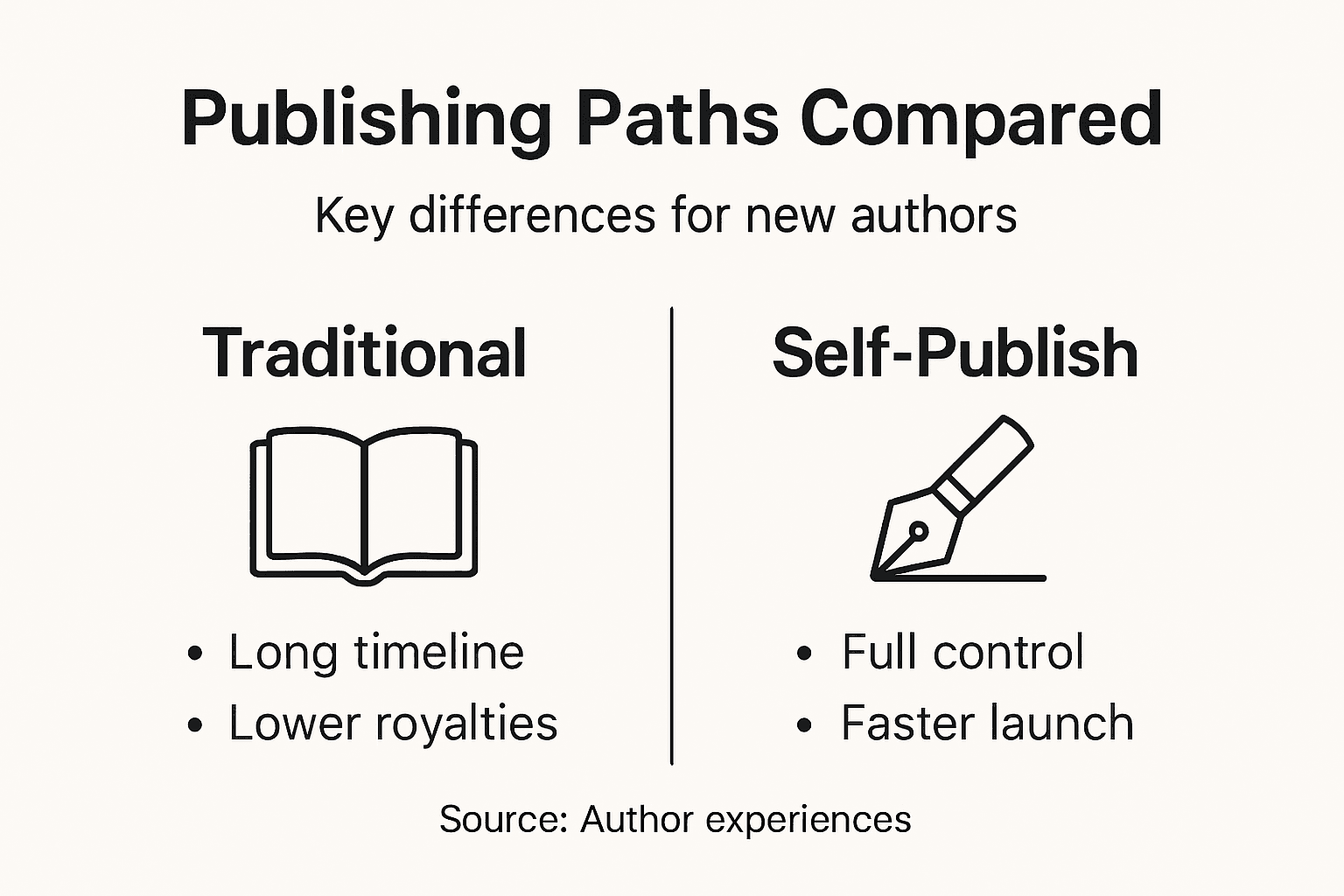
Traditional publishing places your manuscript in the hands of a publishing house. They handle editing, design, distribution, and marketing—professionally and at their expense. You gain prestige, advance payments, and access to bookstore shelves.
But traditional publishers retain significant control over your work. They decide your cover design, pricing, and marketing strategy. You also earn lower royalties, typically 10-25% per sale.
The traditional route moves slowly. Expect 12-24 months from agent acceptance to bookshelf release. Your manuscript gets rejected repeatedly before finding the right fit.
Self-publishing inverts this equation. You handle everything yourself or hire contractors. Digital and print-on-demand technologies make this feasible without massive upfront investment.
With self-publishing, you keep creative control completely. Your cover, pricing, marketing message—all yours. You also earn significantly higher royalties, often 35-70% per sale.
Speed becomes your advantage. You can publish within weeks, not years. Respond to market trends or reader feedback immediately.
Here's the trade-off: You carry all responsibility and costs. Editing, cover design, formatting, ISBN registration—these expenses add up. You must also handle your own marketing and distribution.
- Traditional publishing: Professional support, prestige, slower timeline, lower royalties, loss of creative control
- Self-publishing: Complete control, faster publication, higher royalties, higher personal costs, full responsibility
Self-publishing demands more from you upfront, but you keep the rewards and maintain complete creative authority over your work.
Your choice depends on your priorities. Want professional backing and bookstore presence? Traditional publishing suits you. Prefer speed, control, and higher earnings? Self-publishing aligns better with your goals.
Here's a side-by-side summary comparing traditional and self-publishing pathways:
| Factor | Traditional Publishing | Self-Publishing |
|---|---|---|
| Upfront Cost | Paid by publisher | Paid by author |
| Timeline | 12-24 months | 2-8 weeks |
| Creative Control | Publisher decides | Author retains |
| Bookstore Access | Wide placement | Limited placement |
| Royalty Rate | 10-25% per sale | 35-70% per sale |
Pro tip: Consider a hybrid approach—self-publish your first book to build credibility and audience, then use that success to attract traditional publishers for future projects if desired.
Key Benefits: Control, Royalties, and Speed
Self-publishing unlocks three massive advantages that traditional publishing simply cannot match. These benefits compound over time and directly impact your success as an author.
Creative control sits at the heart of self-publishing. You decide everything—cover design, title, pricing, marketing angle, even when to release your book. No committee debates your vision or waters down your message.

This matters because your book reflects your authentic voice. You don't compromise to fit a publisher's commercial formula. Readers sense this authenticity and respond to it.
Traditional publishers often redesign covers, change titles, and adjust pricing without author input. Self-published authors avoid this friction entirely.
Royalty rates reveal the financial advantage of self-publishing. Authors typically earn 35-70% per sale through self-publishing platforms, compared to 10-25% through traditional publishers. The difference adds up fast.
Say you sell 1,000 copies at $12.99. Traditional publishing nets you roughly $1,300-$3,300. Self-publishing generates $4,500-$9,000. That's your money—directly in your account.
Speed to market changes everything for aspiring authors. Self-published authors can release books within weeks, not the 18-24 months traditional publishing requires. This speed matters for capitalizing on trends, building momentum, and testing what readers want.
You can publish a book, gather reader feedback, and improve your next one within months. Traditional authors wait years between projects.
Consider these concrete benefits:
- Keep 35-70% royalties instead of 10-25%
- Launch your book within weeks, not years
- Make all creative decisions independently
- Adjust pricing, marketing, or content instantly
- Build your author platform faster
- Test ideas and pivot quickly based on reader feedback
Speed, control, and money—self-publishing lets you keep all three while traditional publishing forces you to choose.
These three benefits work together. Speed lets you publish multiple books and build audience quickly. Control ensures each book aligns with your vision. Royalties reward your success directly.
Pro tip: Track your sales, reader feedback, and marketing performance meticulously after launch—this data reveals what works and informs your next book's strategy.
Common Risks, Costs, and Mistakes to Avoid
Self-publishing offers freedom, but that freedom comes with real responsibilities. Understanding the pitfalls saves you money, time, and heartbreak.
The biggest mistake aspiring authors make is underestimating what publishing actually requires. You think you'll write the book and launch it. Reality demands much more.
Editing costs money. Professional editing runs $500-$3,000 depending on your book length and editor experience. Skipping this destroys your credibility. Readers notice poor editing immediately and leave bad reviews.
Your manuscript needs developmental editing (story structure), copy editing (grammar and clarity), and proofreading (final polish). Many authors try to self-edit. Don't. You miss your own mistakes consistently.
Cover design matters enormously. A cheap or DIY cover signals low quality before readers open the first page. Professional cover design costs $300-$1,500. This investment directly impacts sales.
Readers judge books by covers—it's not shallow, it's human nature. Invest here.
Marketing demands time and money. Authors often underestimate marketing responsibilities, assuming the book will sell itself. It won't. You need a marketing budget for ads, social media, book launches, and promotional activities.
Without marketing, your book sits invisible. Budget $500-$2,000 minimum for your first book's launch campaign.
Vanity press scams exist. Some services prey on author desperation, charging excessive fees for basic services. Watch for red flags like guaranteed bestseller promises or high upfront costs for unclear services.
Common costly mistakes include:
- Skipping professional editing to save money
- Using amateur or generic cover designs
- Publishing without a marketing strategy
- Ignoring ISBN and formatting requirements
- Failing to proofread before launch
- Choosing unreliable service providers
- Setting unrealistic price points
The cheapest route often produces the poorest results—invest strategically in editing and design, then market relentlessly.
Budget realistically. Most self-published authors spend $2,000-$5,000 bringing their first book to professional quality. This isn't waste—it's investment in your author career.
Plan before you publish. Know your costs, timeline, and marketing approach. Rushing leads to mistakes.
The following table outlines major self-publishing expenses and their impact:
| Expense Type | Typical Range | Impact on Success |
|---|---|---|
| Editing | $500-$3,000 | High—professional quality |
| Cover Design | $300-$1,500 | Crucial—boosts sales |
| Marketing | $500-$2,000 | Essential—drives visibility |
| Formatting/ISBN | $100-$300 | Required for distribution |
Pro tip: Research service providers thoroughly—read reviews, ask other authors for recommendations, and get quotes from multiple editors and designers before committing.
How AI Empowers New Authors to Succeed
Artificial intelligence removes barriers that once blocked aspiring authors from publishing. AI tools handle time-consuming tasks, letting you focus on writing and building your audience.
Writing assistance accelerates your creative process dramatically. AI helps you brainstorm plot ideas, develop characters, and overcome writer's block. Instead of staring at a blank page for hours, you generate ideas in minutes.
AI doesn't write your book for you—it supports your writing. You maintain complete creative control while AI handles repetitive thinking tasks.
Editing and refinement become faster and more accessible. AI tools analyze your manuscript for grammar, clarity, and readability issues. You catch problems traditional proofreading would miss.
Many self-published authors previously couldn't afford professional editors. AI-powered editing tools democratize this advantage, making quality editing affordable.
Cover design and marketing materials no longer require expensive designers. AI image generators create professional-quality cover concepts in minutes. You refine them until they match your vision.
Marketing becomes less overwhelming too. AI generates social media posts, email campaigns, and promotional materials tailored to your audience.
Audiobook narration expands your reach without hiring narrators costing $2,000-$5,000. AI voices sound increasingly natural and professional. Audiobooks tap into commuters and multitasking readers.
Self-published authors lead in AI adoption because they're flexible and willing to experiment. You don't need permission from a publisher to try new tools.
Key ways AI supports your publishing journey:
- Generate writing prompts and brainstorm story ideas
- Improve grammar, clarity, and sentence structure
- Create cover design concepts and marketing visuals
- Write promotional materials and social media content
- Produce audiobook narrations at minimal cost
- Analyze reader feedback and market trends
- Optimize pricing and distribution strategies
AI amplifies your effort—it doesn't replace your creativity, it multiplies your productivity.
The authors winning today aren't the richest ones or those with agents. They're the ones using AI strategically to work smarter.
This technology levels the playing field. A new author with AI tools can compete with traditionally published authors on speed, quality, and marketing sophistication.
Pro tip: Start with one AI tool you're comfortable using, master it thoroughly, then gradually add others—trying everything at once creates overwhelm instead of productivity.
Take Full Creative Control and Publish Faster with Librida
Struggling with the challenges of self-publishing such as editing, cover design, and marketing costs Can you imagine having powerful AI tools to guide you through these steps while keeping complete creative control over your book Librida understands the pain points every aspiring author faces in managing their entire publishing journey alone from shaping ideas to launching a polished manuscript
Unlock the benefits of speed higher royalties and total creative freedom by using Librida to simplify and accelerate your self-publishing experience Librida's intelligent platform supports you in developing your story refining your draft and creating professional quality covers so you avoid costly mistakes and focus on what matters most your unique voice Take control now and turn your ideas into published success faster than traditional routes can offer Visit Librida to start transforming your creative vision into reality today
Frequently Asked Questions
What are the main benefits of self-publishing?
Self-publishing offers complete creative control, higher royalty rates (35-70% compared to 10-25% in traditional publishing), and the ability to publish quickly—often within weeks rather than years.
How much should I budget for self-publishing?
Most self-published authors typically spend between $2,000 to $5,000 on professional editing, cover design, and marketing to ensure their book meets high-quality standards.
What common mistakes should I avoid when self-publishing?
Common pitfalls include skipping professional editing, using amateur cover designs, neglecting a marketing strategy, and rushing the publication process without proper planning.
How can AI tools aid in the self-publishing process?
AI tools can assist in writing, editing, cover design, marketing, and even audiobook narration, helping authors streamline their processes and maintain quality while saving time.