

TL;DR:
- Effective book writing requires breaking projects into small, specific tasks and establishing consistent routines to build momentum. Using targeted tools at each workflow stage and maintaining focus through monotasking enhances productivity without burnout. Thoughtful integration of AI supports essential tasks while preserving the writer's unique voice and creative integrity.
You've got a great idea for a book. You sit down, open a blank document, and then... nothing moves. Days pass. The word count barely budges. That stalled-draft feeling isn't a sign you lack talent; it's a sign you lack a system. Aspiring authors lose enormous amounts of time not because they can't write, but because they haven't yet paired the right mental frameworks with the right tools. This guide walks you through proven productivity habits and smart AI strategies that actually move your manuscript forward, session by session, without burning you out.
Table of Contents
- Establish your productivity foundations
- Tools and workflow essentials for writers
- Mastering focus: Monotasking and time strategies
- AI as your writing accelerator (and common pitfalls)
- Our perspective: Why process beats hustle and how the right AI approach unlocks author potential
- Take your book further with Librida solutions
- Frequently asked questions
Key Takeaways
| Point | Details |
|---|---|
| Break big goals down | Unpacking your project and setting clear deadlines makes writing consistently achievable. |
| Monotasking boosts focus | Sticking to one project at a time avoids wasted energy and increases output. |
| Find your daily rhythm | Peak writing efficiency usually comes from regular 1–2 hour sessions, not long marathons. |
| Use AI wisely | Leverage AI for outlining and cleanup, but keep your unique voice front and center by controlling revision. |
| Pick tools by workflow | Choose digital and AI tools specific to each writing stage to avoid distraction and streamline your process. |
Establish your productivity foundations
The single biggest reason book projects stall is that writers treat the whole manuscript as one enormous, vague task. Your brain resists enormous and vague. The fix is structural: break the project into small, clearly defined pieces, build a visible outline, and then commit to a writing schedule you treat like a non-negotiable appointment.
Think of your book as a series of scenes or chapters, each with its own mini-goal. Instead of "write Chapter 4," your task becomes "write the confrontation scene between Maya and her mentor, 800 words." That specificity is motivating because it's completable. You can check it off. That small dopamine hit matters more than most writers realize.
A visible outline does double duty. It acts as a directional document that keeps you from wandering off-plot mid-session, and it gives you a bird's-eye view of what's left to write. When you sit down and can see exactly where you are in the larger structure, starting is far less intimidating.
Scheduling is where most writers underestimate themselves. Using specific "assignments" and word-count deadlines creates external structure that your internal motivation alone rarely provides. Block your writing hours in your calendar the same way you'd block a doctor's appointment. Guard that time ruthlessly.
Pro Tip: The Pomodoro Technique (25 minutes of focused writing, 5-minute break, repeat) is particularly effective for authors because it makes the session feel finite. You're not writing for hours; you're writing for 25 minutes. Most writers find they naturally extend sessions once they're in flow, but having that short target removes the resistance to starting.
Here's a quick comparison of common productivity approaches for authors:
| Approach | Best for | Potential drawback |
|---|---|---|
| Daily word-count goal | Building consistent output habits | Can feel mechanical on slow creative days |
| Chapter-by-chapter milestones | Long-form structure and pacing | Less useful for short daily sessions |
| Pomodoro sessions | Focus and reducing procrastination | Interrupts flow if you're on a roll |
| Weekly deadline assignments | External accountability | Requires a partner or community |
| Outline-first drafting | Reducing mid-draft confusion | Can feel restrictive for discovery writers |
Key habits that support a strong foundation:
- Write at the same time each day to build a neurological habit loop
- Keep your outline document open alongside your draft
- Set a minimum word count (even 300 words counts as a win)
- Tell someone your weekly goal to add social accountability
- Review your previous session's last paragraph before starting to rebuild momentum
Exploring AI productivity workflows can also help you see how structured systems translate into real, measurable output over time.
Tools and workflow essentials for writers
Once you've built a strong routine, the right tools can further accelerate progress and eliminate bottlenecks. The key word is "right." More tools don't mean more productivity. In fact, the opposite is often true.
AI tools should be selected by workflow stage, and using the wrong tool at the wrong stage, or switching between too many apps, creates cognitive overhead that quietly drains your energy. Every time you switch contexts, your brain pays a switching cost. Over a two-hour writing session, those costs add up fast.
Map your workflow into five clear stages: research, outlining, drafting, revising, and formatting. Then assign one or two tools to each stage and stick with them.
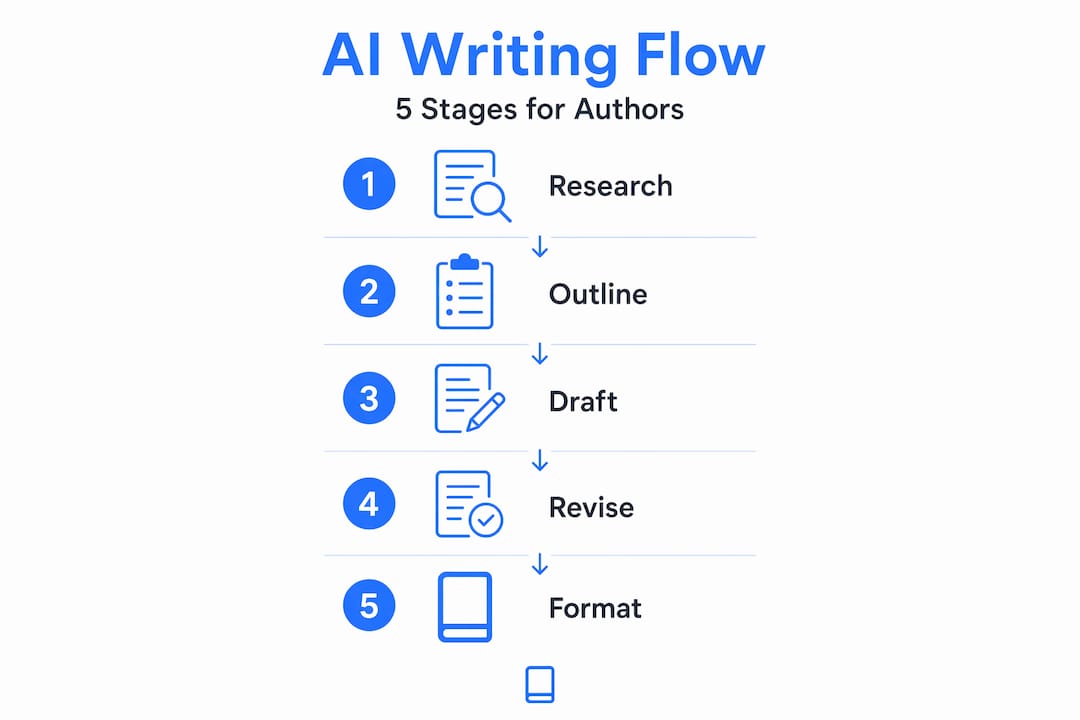
| Workflow stage | Useful tool types | What to automate |
|---|---|---|
| Research | AI research assistants, note-taking apps | Citation organization, source tagging |
| Outlining | AI ideation tools, mind-mapping apps | Structural suggestions, chapter sequencing |
| Drafting | Distraction-free writing apps, AI co-writers | Repetitive scene elements, placeholder text |
| Revising | Grammar checkers, AI style analyzers | Basic grammar, passive voice flags |
| Formatting | Document formatters, publishing templates | Heading styles, chapter breaks, margins |
Practical tool habits that protect your productivity:
- Choose one drafting environment and stay in it (switching apps mid-draft kills flow)
- Set up automatic cloud backup so you never lose work
- Use AI ideation tools only during the outlining stage, not while drafting
- Batch your research sessions separately from your writing sessions
- Automate formatting tasks at the end, not throughout the process
If you're curious about how AI is reshaping the reading and listening experience, AI-powered reading tools show how technology is expanding the ways audiences engage with books. And for a deeper look at how AI can support creative structure, AI storytelling workflows offer fascinating real-world examples.
Pro Tip: Resist the urge to try every new writing app that gets buzz online. Pick your core stack (one outliner, one drafting tool, one grammar checker) and use them consistently for at least 30 days before evaluating whether you need something different.
Mastering focus: Monotasking and time strategies
After optimizing your toolkit, you need to intentionally cultivate the conditions for flow and focus each writing session. This is where most authors quietly sabotage themselves without realizing it.

Task switching is the enemy. Switching tasks frequently reduces attention and breaks the mental thread you need to write coherent, emotionally resonant prose. The solution is monotasking: staying with one major project until it's done, or at least until a natural stopping point like a completed chapter or act.
Here's a practical sequence for a focused writing session:
- Close all browser tabs unrelated to your current chapter
- Put your phone in another room or use a focus-mode app
- Open only your outline and your draft document
- Set a timer for your first Pomodoro block
- Write without editing; let the draft be messy
- After the session, note where you stopped and what comes next
- Close everything before you're tempted to check email or social media
"The most productive writing days aren't the longest ones. They're the ones where you protect your attention from the moment you sit down."
Data from a data-driven writing sprint makes this concrete: across 80 hours of creation time and 69,000 words typed, peak writing efficiency occurred on days with just 1 to 2 hours of total writing. Productivity dropped noticeably when daily writing exceeded 4 hours. More time at the keyboard does not equal more usable words on the page.
The 30 to 70 percent trap is worth naming specifically. Many authors abandon projects right in the middle, when the initial excitement has worn off but the end isn't yet in sight. This is the most dangerous zone for distraction and project-switching. Recognizing that this zone exists, and committing to push through it, is itself a productivity strategy.
Applying deep work principles to character development is one concrete way to use focused sessions productively, especially when the plot feels stuck and you need to reconnect with your characters' motivations.
AI as your writing accelerator (and common pitfalls)
With foundational habits and deep focus in place, you're ready to harness AI: here's how to use it effectively without losing your voice.
AI works best as a support layer, not a creative director. Treat AI as an assistant for research, clarity, and specific tasks rather than a replacement for your own narrative judgment. The distinction matters enormously in practice.
Here's where AI genuinely accelerates the writing process:
- Brainstorming: Generate 20 possible directions for a stuck scene, then pick the one that feels most authentically yours
- Outlining: Use AI to pressure-test your chapter structure and spot pacing gaps before you draft
- Research organization: Summarize source material and pull relevant details so you can draft faster
- Repetitive elements: Draft formulaic sections (chapter headers, scene transitions, back-cover copy) with AI assistance
- Grammar and clarity: Use AI-powered grammar tools during revision, not during drafting
What AI should not do, at least not until you're deep into revision:
- Provide editorial feedback on an unfinished draft that doesn't yet reflect your intent
- Suggest structural changes before your core narrative voice is established
- Rewrite scenes in ways that optimize for "readability" at the expense of your distinctive style
"AI editorial feedback is getting better, but using it too early can flatten voice and steer your writing toward the mean."
The "flattening" effect is real. AI models are trained on enormous amounts of text, which means their suggestions trend toward the most common, most average version of good writing. Your voice, by definition, is not average. It's specific, idiosyncratic, and shaped by your particular way of seeing the world. Protect it.
Pro Tip: Use AI for a "brainstorm dump" at the start of a stuck session. Ask it to generate 10 possible next scenes, read them quickly, then close the AI tool and write your own version from memory. You'll often find the AI's suggestions sparked an idea that's entirely your own.
Watch for signs that AI is diluting your work: sentences that sound polished but feel empty, predictable three-act structures that don't serve your story, or a voice that reads like a competent stranger wrote it. If you notice any of these, step back and revise from your gut, not from AI prompts.
Exploring the narrative risks of early AI use and understanding how to maintain balance between AI and author intent are both worth your time as you develop your own AI-integrated workflow.
Our perspective: Why process beats hustle and how the right AI approach unlocks author potential
Here's what most productivity advice for writers gets wrong: it treats writing like manufacturing. More hours in, more words out. That model breaks down fast, and it burns out writers even faster.
The authors who finish books consistently are not the ones who write 10-hour marathon sessions on weekends. They're the ones who write 45 minutes every Tuesday, Thursday, and Saturday without fail. Slow and steady isn't a consolation prize. It's the actual winning strategy, backed by the data we cited earlier on peak efficiency at 1 to 2 hours per day.
The same logic applies to AI. The temptation is to use AI as a shortcut: feed it your rough idea, get back a draft, polish it, publish. That approach produces books that read like they were written by a committee of algorithms. Readers feel it, even if they can't name it. Something is missing. That something is you.
The real power of AI in book writing is in the unsexy middle work: organizing research, generating options during a stuck moment, flagging passive voice in revision. When you use AI for those tasks, you free up your creative energy for the work only you can do: deciding what your story means, what your characters truly want, and what you're trying to say to your reader.
Protecting creative integrity isn't about avoiding AI. It's about being intentional about where in your process you invite it in. The most memorable writing comes from keeping tight control in revision. That's where your voice either survives or gets edited into something generic. Treat revision as sacred, author-only territory, and use AI everywhere else to make the path to that revision stage faster and less painful.
Take your book further with Librida solutions
Ready to apply these productivity breakthroughs? Here's how Librida can help you write, finish, and share your book.
Librida is built specifically for authors who want to move from idea to published book without losing their creative voice along the way. The platform combines AI-assisted drafting, structural templates, and collaborative publishing tools into one focused environment, so you're not juggling five different apps across five different stages.

Whether you want to see how a community-driven project comes together by exploring a community-authored project, or you're ready to jump straight into your own manuscript, Librida gives you the structure, tools, and support to make consistent progress. Start your book with Librida and turn the productivity strategies in this guide into actual finished pages.
Frequently asked questions
How many hours a day should I write for maximum productivity?
Peak writing efficiency occurs during 1 to 2 hour daily sessions, with output quality and efficiency dropping when writing exceeds 4 hours per day. Shorter, focused sessions consistently outperform marathon writing days.
Should I use AI to get editorial feedback on my unfinished draft?
Wait until your draft genuinely reflects your intent and voice before inviting AI feedback. Early AI intervention can flatten your narrative voice and push your story toward generic, predictable structures.
How can I avoid getting distracted when writing my book?
Monotasking, focusing on one project at a time and closing all unrelated tabs and apps before each session, significantly improves attention depth and completion rates compared to multitasking.
What's one productivity mistake new authors make with AI?
Introducing AI too early in the writing process is the most common trap. Relying on AI before your own voice and narrative intent are established leads to writing that sounds competent but lacks originality and emotional specificity.