

TL;DR:
- Building characters requires delving beyond appearance into wounds, fears, and survival lies that shape their behavior. Using archetypes, flaws, and the wound-fear-misbelief structure creates psychologically rich personalities that resonate deeply with readers. Consistent character arcs intertwined with plot pressure evoke believable growth, making characters feel authentic and memorable.
Most writers can describe what their character looks like within seconds. Ask them what their character fundamentally believes about the world, and the room goes quiet. That gap, between surface description and psychological depth, is where most stories lose their readers. Learning how to build characters means going past hair color and occupation into the territory of wounds, fears, and the lies people tell themselves to survive. This guide walks you through a practical, layered approach to character creation that produces personalities readers can't stop thinking about.
Table of Contents
- Key takeaways
- How to build characters: the foundational layer
- Flaws, wounds, and the lies characters believe
- Connecting character arcs with plot
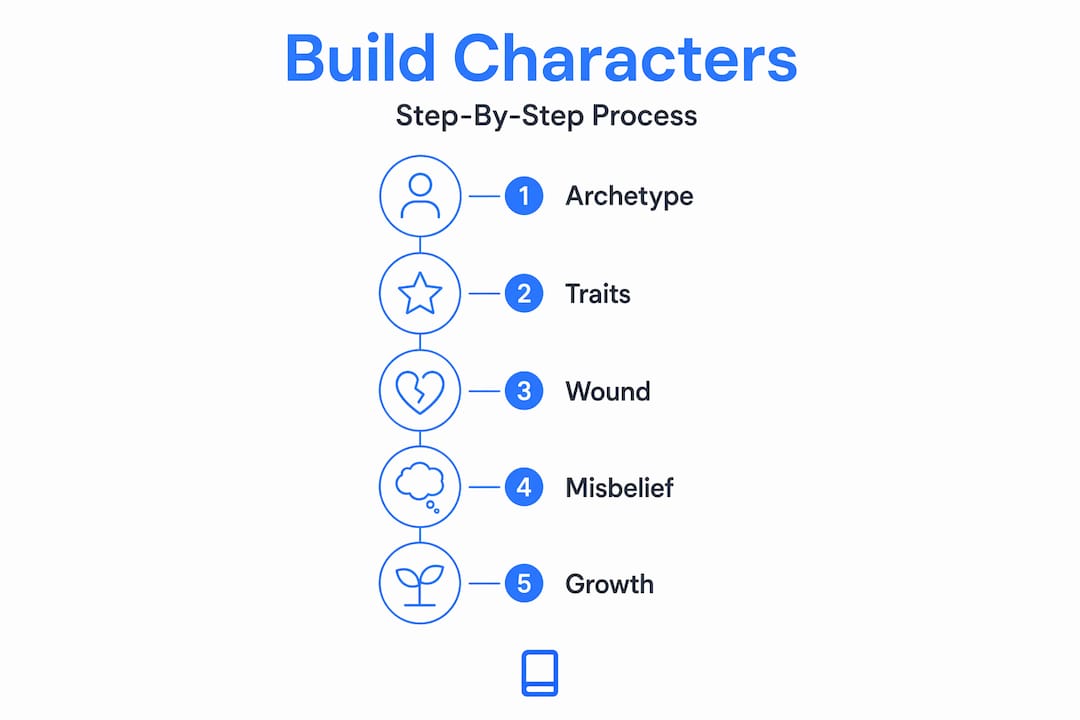
- A step-by-step process for creating believable characters
- Troubleshooting common character development problems
- My take on what actually makes characters resonate
- Build characters faster with Librida's AI writing tools
- FAQ
Key takeaways
| Point | Details |
|---|---|
| Start with archetype and role | Use archetypes as a framework, then layer in specific traits that serve your story's purpose. |
| Flaws drive the story forward | A character's internal flaw should make the plot inevitable, not interchangeable. |
| Use the wound-fear-misbelief structure | Every compelling character carries a past wound that shapes a protective misbelief the story must challenge. |
| Connect arc to plot deliberately | External plot events must pressure your character's specific flaw to make growth feel earned. |
| Build iteratively, not perfectly | Start rough, interview your character, and refine through drafts rather than trying to get it right the first time. |
How to build characters: the foundational layer
Every character starts somewhere, and the most practical place to begin is with archetype and role. Archetypal characters and myth forms transcend cultures globally, which explains why the reluctant hero and the corrupted mentor keep showing up across centuries of storytelling. They work because they tap into patterns readers already recognize.
That recognition is not a weakness. It is a starting point. You borrow the archetype and then subvert it.
| Archetype | Core function in narrative |
|---|---|
| The hero | Drives the central conflict; forces the reader to invest in the outcome |
| The mentor | Provides wisdom, then exits so the hero must act alone |
| The trickster | Disrupts the status quo and reveals truth through chaos |
| The shadow | Embodies what the hero could become; creates moral stakes |
| The ally | Reflects the protagonist's growth by mirroring or contrasting their choices |
Once you know your character's role, choose traits that serve the story's purpose rather than traits that simply make the character interesting in isolation. A charming extrovert is a description. A charming extrovert who uses charm to avoid genuine intimacy, and whose story forces him into sustained vulnerability, is a character. The distinction matters enormously.
Pro Tip: Start with three core personality traits and one visible behavioral habit. Don't lock in backstory or secondary traits until you've written at least twenty pages. Characters reveal themselves under pressure, and pressure only comes from writing scenes.
Flaws, wounds, and the lies characters believe
This is where character creation stops being about surface traits and starts being about psychology. The wound-fear-misbelief framework is worth understanding deeply: a past wound breeds fear, and that fear causes the character to adopt a protective misbelief, which the story then challenges and forces them to evolve. Think of the character who was abandoned as a child and now operates under the misbelief that "relying on others means getting hurt." Every relationship, every decision, every refusal to ask for help flows from that one lie.

Misbeliefs are not character flaws in the casual sense. They are the character's survival strategy that has now become their obstacle.
Common misbeliefs and their narrative implications:
- "I have to be perfect to deserve love" leads to controlling behavior that destroys relationships
- "Success is the only measure of worth" produces ambition that blinds the character to what actually matters
- "I am fundamentally broken" creates self-sabotage right before the character reaches their goal
- "Vulnerability is weakness" drives isolation and emotional shutdown under exactly the conditions that require openness
The mistake most writers make is telling readers about a flaw rather than showing it in action. Show flaws through behavior by depicting the character using their flaw successfully in normal life before the story's pressure cracks that strategy open. If your character's flaw is emotional detachment, show her navigating a difficult negotiation brilliantly because of her detachment before showing how that same detachment devastates her marriage.
Pro Tip: Write a scene from your character's past, before your story begins, where their misbelief actively helped them. This makes their resistance to change feel logical rather than stubborn.
Pitfalls to avoid when writing character flaws:
- Making the flaw cosmetic rather than structural (a "short temper" that never actually costs the character anything)
- Giving protagonists flaws but not showing them affecting core decisions
- Resolving the flaw too quickly or without sufficient pressure
- Confusing a likable quirk with a genuine internal obstacle
Connecting character arcs with plot
A character arc and a plot are not two separate things you weave together. They are the same thing, expressed differently. The hero's flaw and plot obstacles must be inseparable. If you can swap your protagonist's flaw for a different one and the plot still works exactly the same way, your arc is weak.
The three primary arc types give you a structural framework:
- Positive arc: The character confronts and overcomes their misbelief. They change. The external victory mirrors or enables the internal one.
- Negative arc: The character doubles down on their misbelief under pressure and is destroyed by it. Think Breaking Bad or Macbeth.
- Flat arc: The character's core belief is already correct. The story challenges it, the character holds firm, and the world around them changes instead.
Strong external plot events should pressure the character's specific flaw to produce believable, earned growth. If your protagonist's flaw is distrust, the plot must put them in situations where they must trust someone, where refusing means losing something irreplaceable.
Characters who undergo setbacks before meaningful change feel more human and relatable. One revelation scene does not constitute a character arc. The character changes, reverts, changes again, and finally commits to the change when the cost of reverting becomes too high. That rhythm, between challenge and brief recovery, is what Robert McKee describes as the essential storytelling swing between serenity and challenge.
Supporting characters should function as mirrors, foils, and catalysts reflecting the protagonist's internal journey. The best friend who models what healthy trust looks like. The antagonist who embodies the protagonist's misbelief taken to its logical extreme. These relationships should pressure the wound, not just provide plot assistance.
A step-by-step process for creating believable characters
Good character creation is iterative. Here is a sequence that works whether you are writing your first novel or your tenth.
- Define the core concept. One sentence: who is this person, what do they want, and what do they falsely believe is stopping them?
- Establish the wound. Identify the formative experience that created the misbelief. You don't need to show this directly in the story, but you need to know it.
- Build the psychological profile. How does the misbelief show up in daily behavior? What does the character avoid? What do they overdo to compensate?
- Assign a role and arc type. Decide whether they will grow, fall, or hold steady. This shapes every plot decision from here.
- Conduct a character interview. Write five to ten pages of Q&A with your character. Ask uncomfortable questions. Ask what they lie about, who they have hurt, what they are most afraid of admitting. The answers will surprise you.
- Place them in their ordinary world. Write a scene showing the character functioning with their flaw intact and their misbelief unchallenged. This is your baseline.
- Track the evolution through drafts. Note where the character changes and whether those changes are earned by specific plot events.
| Step | Focus | Outcome |
|---|---|---|
| Core concept | Desire and misbelief | Clear narrative direction |
| Wound and profile | Psychology and behavior | Authentic, specific personality |
| Arc type | Growth trajectory | Structural clarity for plotting |
| Character interview | Hidden truths and contradictions | Surprising, believable complexity |
| Ordinary world scene | Flaw in action | Earned baseline for later breakdown |
For practical examples of how this process plays out across different genres, Librida's character development examples are worth reviewing before you draft.
Pro Tip: If you can't answer "what does my character fundamentally believe about human nature?" you are not ready to write their arc. That belief is the engine. Everything else is the vehicle.
Troubleshooting common character development problems
Even writers who understand character theory get stuck. Here are the most common problems and how to fix them.
- Flat characters who don't drive the story: Check whether the character's desire can be satisfied without addressing their flaw. Plot must arise from character weaknesses. If it can, you need to redesign either the plot or the flaw so they are truly interdependent.
- Stereotypes and clichés: These happen when writers rely on archetype without adding specificity. Give the archetype a contradicting trait. The stoic warrior who writes letters to his dead mother. The manipulative villain who genuinely loves his dog. One real contradiction breaks the stereotype.
- Writer's block around character: This usually signals a structural problem, not a creative one. Amateurs get stuck around pages 20 to 30 because they haven't linked plot to character change. Go back to the wound and misbelief. Ask: what is the next event that must happen to pressure this specific flaw?
- Characters who change too fast or too conveniently: Transformation must be earned through scary, transformative actions under pressure, not realizations or conversations alone. If your character changes because someone gave them good advice, you need a different mechanism.
For help connecting your characters to a larger narrative structure, the story arc guide at Librida covers arc types in practical depth.
My take on what actually makes characters resonate
I've read a lot of advice about character development that focuses almost entirely on external details: occupation, appearance, speech patterns. In my experience, that approach produces characters who feel like costumes rather than people.
What I've found actually works is starting from the wound and working outward. When I know the lie a character believes, every decision they make becomes inevitable rather than arbitrary. The plot stops feeling like something I'm forcing onto them and starts feeling like something they are creating through their own damage.
I've also learned to stop trying to resolve character arcs cleanly. The stories that stay with me longest are the ones where the transformation is partial and costly. The character changes, but they also lose something in the process. That tension, between who they were and who they are becoming, is where readers actually live.
The other thing I'd push back on is the idea that you need to fully know your character before you start writing. I've started dozens of stories with a rough psychological sketch and discovered who the character really was through the act of writing scenes. The character interview and the backstory document are useful, but they are tools for discovery, not requirements for permission to begin.
If you are stuck on a character, write a scene that has nothing to do with your plot. Put them at a dinner party. Make them handle a minor inconvenience badly. Watch what they do. You'll learn more in two pages than in ten hours of planning.
— Mikael
Build characters faster with Librida's AI writing tools
Creating psychologically rich characters takes time, but the right tools can cut through the fog significantly. Librida's AI-powered platform helps aspiring writers build and develop characters through structured workflows that cover everything from psychological profiling to arc planning.

Whether you're developing a protagonist's wound-fear-misbelief structure or mapping out how your plot pressures specific flaws, Librida's tools guide you through each stage with prompts, templates, and real-time feedback. The platform is built for writers who have the ideas but want support turning them into a coherent manuscript. If you're ready to move from concept to finished story, explore AI-powered writing guidance on Librida and start building characters that actually drive your narrative forward.
FAQ
What is the most important element of a strong character?
A strong character needs a specific internal flaw rooted in a past wound and a misbelief that the story challenges. Without that psychological core, even detailed characters feel hollow.
How do you develop a character arc?
Identify the character's misbelief, then design plot events that force them to confront it. The arc moves from misbelief intact, through increasing pressure, to either transformation or destruction depending on whether the arc is positive or negative.
What are common mistakes when building characters?
The most common mistakes include giving characters surface flaws that never affect their decisions, resolving growth too quickly without earned pressure, and creating characters whose desire can be met without addressing their core flaw.
How do supporting characters help with character development?
Supporting characters work best as mirrors, foils, and catalysts that reflect and challenge the protagonist's internal journey. A foil embodies the opposite belief; a mirror shows where the protagonist is headed if they don't change.
How many character traits should you define before writing?
Start with three core personality traits and one misbelief. Add backstory and secondary traits as you write scenes. Characters reveal complexity through action, not through pre-writing documentation.