

TL;DR:
- Feedback in book editing is a constructive process that transforms rough manuscripts into engaging books readers complete. It includes developmental, copyediting, and beta reader insights, each serving distinct purposes at different stages of writing and revision. Authors should seek feedback after establishing a stable voice, analyze it systematically, and view it as a professional opinion that enhances their unique vision.
Most authors assume feedback means someone found fault with their work. That framing makes the whole process feel like a verdict rather than a conversation. But the role of feedback in book editing is far more constructive than that. Feedback is what takes a rough manuscript with real potential and turns it into a book readers actually finish. This guide breaks down what editorial feedback is, when to seek it, how to sort through it without losing your mind, and how to apply it in ways that strengthen your story without stripping out your voice.
Table of Contents
- Key takeaways
- The role of feedback in book editing: types and purposes
- When to ask for feedback
- How to evaluate and apply feedback well
- Common challenges and how to get past them
- My take on why feedback changed how I write
- How Librida can support your editing process
- FAQ
Key takeaways
| Point | Details |
|---|---|
| Know your feedback type | Developmental, copyediting, and beta reader feedback serve distinct purposes at different stages. |
| Timing changes everything | Seek feedback only after your manuscript has enough pages and voice to withstand outside perspective. |
| Patterns matter most | Consistent issues across multiple readers reveal real problems; one-off comments may not. |
| Sit before you rewrite | Delaying your revision response leads to more deliberate, higher-quality changes. |
| Your vision still leads | Good feedback is a professional opinion, not a command. You decide what serves the story. |
The role of feedback in book editing: types and purposes
Editorial feedback is not a single thing. It arrives in different forms at different stages, and confusing them is one of the most common mistakes aspiring authors make. Understanding what each type does helps you use it properly instead of treating every note as equally urgent.
Developmental feedback is the big-picture layer. It addresses structure, pacing, character arcs, plot logic, and thematic clarity. A developmental editor will typically deliver both inline comments and an overarching edit memo that explains the root causes of story problems, not just the symptoms. This is a critical distinction. Inline marks show you where something goes wrong. The memo shows you why, which is what allows you to fix it at the source rather than patch it scene by scene.
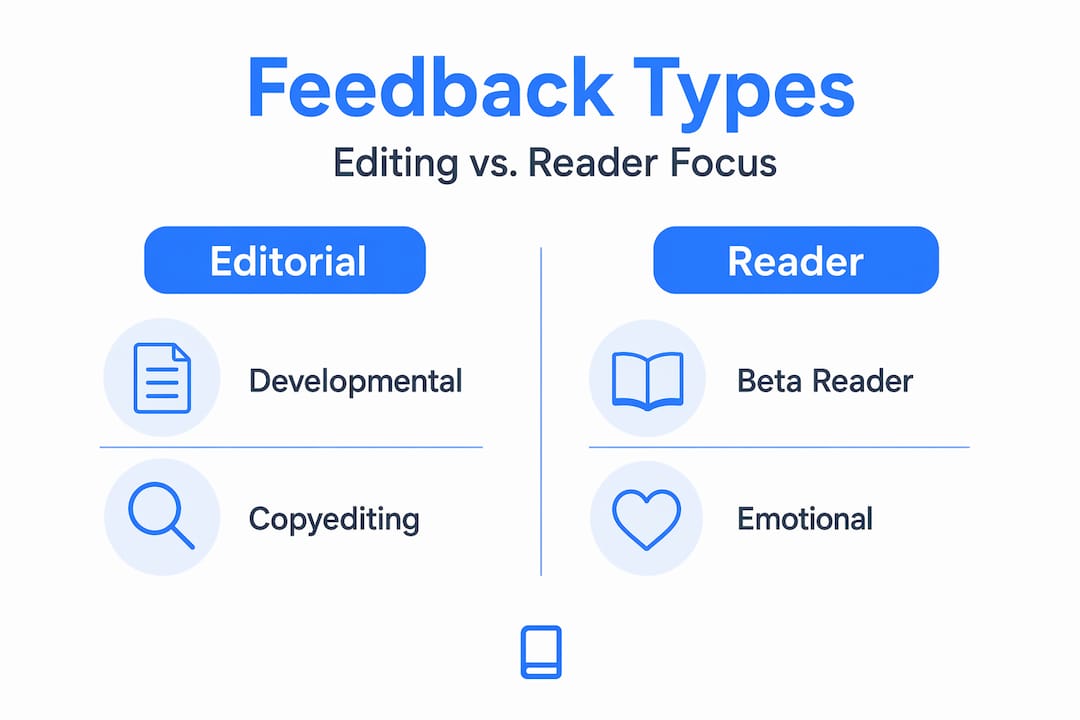
Copyediting is a narrower, later-stage process. It covers grammar, punctuation, word choice, and sentence-level clarity. If your developmental edits have done their job, the copyediting stage should not require rewriting full chapters. If it does, that signals unresolved structural issues from earlier rounds.
Beta readers bring a reader-first perspective. They are not editors. They respond emotionally and experientially, telling you where they got bored, confused, or hooked. That reaction is data. You can learn more about how to use beta reader insights and why their contribution belongs in any serious revision process.
Here is how the main feedback types compare:
| Feedback type | Focus area | Delivered by | Best used for |
|---|---|---|---|
| Developmental editing | Structure, pacing, arc | Professional editor | Major revision decisions |
| Copyediting | Grammar, clarity, flow | Professional editor | Final language polish |
| Beta readers | Reader experience | Volunteer readers | Emotional truth-testing |
| Editorial letter | Patterns and priorities | Editor or writing coach | Understanding the full picture |
What makes this system work is treating inline comments and editor letters as complementary rather than redundant. Together they give you both the detail view and the aerial view of your manuscript's problems.
When to ask for feedback
Timing your feedback requests poorly is like asking someone to critique the blueprint after you've already poured the foundation. You need to be far enough into your manuscript that the request makes sense, but not so far that the wrong input derails months of work.
A widely cited principle among writing coaches is to wait until 50 to 75 pages are complete, or until your voice and basic story flow feel stable. Before that threshold, outside opinions can send you chasing a direction that doesn't actually fit your story. You end up with a manuscript that sounds like a committee wrote it.
Here is a practical sequence for timing feedback requests:
- Polish before you share. Read through your draft and resolve the obvious problems yourself first. When feedback arrives on a cleaner manuscript, it zeros in on the issues you genuinely cannot see.
- Wait for a natural milestone. The end of an act, the midpoint, or the full draft are better moments than chapter three. You want enough material for a reader to see patterns.
- Use feedback when you're stuck. If you've written yourself into a corner, a fresh read from a trusted reader can break the logjam faster than another solo revision pass.
- Let the manuscript rest after receiving notes. This is not laziness. It is strategy. Delaying revision after receiving feedback reduces impulsive reactions and creates space for purposeful rewriting decisions.
Pro Tip: Before sending your manuscript out for feedback, write down the specific questions you want answered. "Does the pacing drag in Act Two?" gets you more useful information than "What do you think?"
Receiving feedback at the wrong stage of manuscript development risks undermining your confidence and voice before either is fully formed. Protect the early drafting phase fiercely.
How to evaluate and apply feedback well
This is where most authors either get it right or lose weeks to unproductive second-guessing. The feedback processes in editing are only as effective as the system you use to receive and sort what you get back.

Start by reading everything before touching a single word of your manuscript. Read the editorial letter. Read the inline comments. Read the beta reader notes. Do not revise as you go. You need the full picture before you can make good decisions about any individual part.
Then separate feedback into categories:
- Consistent patterns: If three different readers say the same character feels flat, that is signal. Act on it.
- Isolated reactions: One reader hated your ending. Another loved it. Investigate, but do not overreact.
- Vision misalignments: Some suggestions simply do not fit the story you are writing. You can set those aside without guilt. Feedback is professional opinion, not a mandate.
- Craft questions: Turn confusing feedback into specific questions. "Why does this scene feel slow?" is more useful to hold in your head during revision than a vague "this drags."
One of the more practical frameworks comes from taking notes during feedback calls and converting editor guidance into craft questions you can answer through your revisions. This approach treats feedback as a dialogue rather than a checklist.
Pro Tip: Build a simple change list organized by chapter or story section. Tackle structural changes first, then scene-level adjustments, then line-level polish. Mixing all three levels in one pass creates confusion and missed revisions.
The effectiveness of critiques in writing depends on this kind of structured approach. Reacting immediately, or trying to implement every note at once, produces a manuscript that feels scrambled rather than improved. Good editorial feedback focuses on measurable, specific issues, like noting that your opening delays the inciting incident by thirty pages, rather than vague statements like "the start is slow." When feedback is that specific, applying it becomes a practical task rather than an emotional one.
Common challenges and how to get past them
Receiving feedback is emotionally harder than most writing guides admit. Your manuscript is personal. It carries ideas you have been turning over for months, sometimes years. When someone points out that your structure is off or your protagonist lacks agency, it can feel like a judgment on your imagination rather than a note about craft.
A few of the most common challenges authors face:
- Feeling like the feedback misses the point. This happens. Sometimes an editor misreads your intent. Before dismissing the note, ask whether a reader misreading you is itself a story problem worth fixing.
- Resistance born from attachment. You love a scene. The editor says it needs to go. This is the hardest kind of feedback to process, because your attachment is real. Sit with it. Read that section again with fresh eyes three days later.
- Fear of losing your voice. This is the most common worry self-publishing authors bring to the editing conversation. The truth is, feedback as professional opinion that you verify against your own vision almost never erases voice. It usually clarifies it.
- Contradictory feedback from different readers. Two readers gave you opposite reactions. Rather than treating this as a coin flip, dig into the structural inconsistency that might explain both reactions.
"The goal of feedback is not to change who you are as a writer. It is to help you write the book you already meant to write, but more clearly."
The most practical technique for managing these challenges is writing down your craft questions after receiving feedback, then revisiting your manuscript at least 48 hours later. Distance is not avoidance. It is how you move from an emotional response to a strategic one.
My take on why feedback changed how I write
I spent my first three years treating feedback like a threat. I would read an editor's notes looking for the parts I could argue against rather than the parts I could learn from. The result was manuscripts that got better slowly, and only on the surface.
What shifted was learning to separate the edit memo from inline marks. Once I understood that the memo was trying to teach me something structural, and that the inline marks were just symptoms of that deeper issue, I stopped patching and started actually understanding my own work. That understanding is what made the revision faster and the result stronger.
I have also learned that delaying my reaction is not a sign of weakness. Some of the best revision decisions I have made came two weeks after I received feedback, once the defensiveness cleared and the actual story problem became obvious.
The authors I have seen grow fastest treat their editor as a partner, not a gatekeeper. They bring their own perspective to the revision, weigh it honestly against what the feedback suggests, and make decisions from that combination. That is not compromising your vision. It is finishing it properly.
— Mikael
How Librida can support your editing process
Working through feedback is challenging enough without the right tools and guidance around you.

Librida is built specifically for authors who want to write and revise smarter. The platform combines AI-powered writing support with resources that help you understand editorial feedback, structure your revisions, and stay productive through every draft stage. Whether you are decoding your first developmental edit or preparing a self-published manuscript for launch, Librida's tools meet you where you are. If you want to sharpen your overall approach to editing and productivity, the AI-powered author guide on Librida covers the full workflow from drafting to polished manuscript. It is one of the most practical resources available for writers who want to move faster without cutting corners.
FAQ
What does editorial feedback actually include?
Editorial feedback typically includes an overarching edit memo and detailed inline comments, which together address both specific language issues and larger structural patterns across the manuscript.
When should I seek feedback on my manuscript?
Most writing coaches recommend waiting until you have at least 50 to 75 pages complete, or until your draft feels voice-stable, so outside input strengthens rather than derails your direction.
How do I handle feedback that contradicts my vision?
Treat it as a professional opinion rather than a rule. Set aside suggestions that genuinely do not fit your story, and look for patterns in the feedback that reveal real issues worth addressing.
Why is the edit memo more important than inline comments?
The edit memo explains root causes of story problems, while inline marks only identify symptoms. Addressing the root cause produces lasting improvements instead of cosmetic fixes.
How long should I wait before revising after feedback?
At minimum, give yourself 48 hours after reading feedback before touching your manuscript. Longer breaks, up to a week or two, often lead to more deliberate and higher-quality revision decisions.