

TL;DR:
- Understanding plot structure provides writers with an organizational blueprint that controls pacing and engages readers effectively.
- Different frameworks like the three-act structure, Freytag's Pyramid, and the Hero's Journey help shape story events around emotional and character transformation needs.
Many new writers sit down with a great idea and immediately hit a wall. They know what happens in their story, but they do not know how to organize it so readers actually stay invested from page one to the end. Understanding what is plot structure gives you a blueprint for that organization. It is not a rigid cage that kills creativity. It is the invisible skeleton that holds your story upright. This article breaks down the core elements, the most useful frameworks, and practical steps you can take today to start outlining stories that work.
Table of Contents
- Key Takeaways
- What is plot structure and why it matters
- Popular plot structure frameworks
- How to structure a plot using an outline
- The 5 C's: a structural checklist for writers
- My honest take on learning plot structure
- Start building your story with Librida
- FAQ
Key Takeaways
| Point | Details |
|---|---|
| Plot structure is a blueprint | It organizes story events into a sequence that controls pacing and reader engagement. |
| Five classic elements exist | Exposition, rising action, climax, falling action, and resolution each serve a specific narrative purpose. |
| Multiple frameworks apply | Three-act structure, Freytag's Pyramid, and the Hero's Journey each suit different story styles. |
| Outlining prevents common pitfalls | Mapping beats before drafting helps you avoid sagging middles and missing moments of change. |
| The 5 C's act as a checklist | Character, Conflict, Context, Change, and Conclusion together ensure your story feels complete. |
What is plot structure and why it matters
The definition of plot structure is straightforward: it is the organized sequence of events that carries a story from beginning to end. Think of it as the order in which you reveal what happens, and more importantly, why it happens in that order.
Effective plot structures shape pacing, tension, and character development in ways that directly affect reader satisfaction. When structure is weak, readers complain about slow pacing or confusing story flow, even if they cannot pinpoint exactly what went wrong.
The five stages that most writers learn first are:
- Exposition: Introduces your characters, world, and the status quo before anything disrupts it.
- Rising action: A series of events and complications that escalate tension after the initial conflict appears.
- Climax: The peak moment of tension where the central conflict reaches its breaking point.
- Falling action: The aftermath of the climax, where consequences begin to settle.
- Resolution: The final state of the story world, showing what has changed for the characters.
These five plot stages create a recognizable emotional rhythm that audiences respond to almost instinctively. Kurt Vonnegut argued that readers seek familiar story shapes, specific trajectories of fortune rising and falling, which means your job as a writer is not to invent a new shape but to execute a familiar one with originality.
Pro Tip: Do not rush the exposition. New writers often spend too little time establishing the world before they throw readers into conflict. Give your audience just enough context to care before you start shaking things up.
Understanding plot structure at this level tells you what pieces you need. The frameworks below show you how to arrange them.
Popular plot structure frameworks
Once you understand the core elements, you need a model to hang them on. Three frameworks show up constantly in writing guides, and each serves a different type of story.
The three-act structure
The three-act structure divides a story into setup, confrontation, and resolution. Act one establishes your protagonist and their world, then ends with an inciting incident that forces change. Act two is the longest section, usually about half the story, where your character struggles against escalating obstacles. Act three resolves the central conflict and shows who your character has become.

Freytag's Pyramid
Developed in the 19th century by Gustav Freytag, this model maps a dramatic arc with five distinct points: introduction, rising action, climax, falling action, and catastrophe (or resolution). It was originally designed to analyze classical tragedies, but the shape applies to virtually any narrative. The pyramid is especially useful because it visualizes momentum, showing you at a glance whether your story has the right energy at the right moments.
The Hero's Journey
The Hero's Journey is a transformational framework that follows a character from their ordinary world through a call to adventure, trials, a decisive ordeal, and finally a return home changed. It remains popular across genres from fantasy to memoir because it mirrors a deeply human experience: facing a challenge that forces you to grow.
| Framework | Best suited for | Core strength |
|---|---|---|
| Three-act structure | Most genres, especially commercial fiction | Simple and flexible for beginners |
| Freytag's Pyramid | Drama, literary fiction, tragedy | Visualizes dramatic momentum clearly |
| Hero's Journey | Adventure, fantasy, personal transformation | Builds a strong character arc into the plot |
Choosing the right model comes down to your story's emotional core. If your story is primarily about external conflict and plot events, the three-act structure gives you clean structure. If your story is about a character's internal transformation, the Hero's Journey keeps that growth central to every plot decision you make.
How to structure a plot using an outline
Knowing the frameworks is one thing. Putting them to work before you write a single scene is where most novice writers gain the biggest leap forward.
Outlining before drafting allows writers to visualize their story's structure and catch pacing problems or plot holes before they become expensive rewrites. Think of an outline as a test drive. You find out the road is missing a bridge before you build the whole car.
Here is a practical process for how to structure a plot using an outline:
- Write your premise in one sentence. Who is your protagonist, what do they want, what is stopping them, and what is at stake? If you cannot state this clearly, your story does not have a foundation yet.
- Identify your key turning points. These are the moments that shift the direction of the story: the inciting incident, the midpoint reversal, and the climax. Pin these down before filling in the scenes between them.
- Map the rising action with specific beats. Do not just write "tension increases." Name the actual events. What happens? What does the character try? What goes wrong? Beat sheets with specific narrative pivots help you maintain tight pacing and avoid the dreaded sagging middle.
- Check for a midpoint shift. Many beginners skip this. Your story needs a moment roughly halfway through where something fundamentally changes for the protagonist, raising the stakes higher than before.
- Confirm your character changes. Before you finalize your outline, ask: who is my character at the start, and who are they at the end? If the answer is "the same person," your story is missing its emotional engine.
Failing to create a structured outline is consistently the leading mistake among novice writers. The good news is that fixing it requires no talent, only the willingness to plan before you write.
Pro Tip: Your outline is not a contract. You can change it. The goal is not to cage your creativity but to give you a map so you are not wandering when you should be writing.
Connecting your plot outline workflow to a clear planning process makes a real difference when you sit down to draft. It removes the blank-page paralysis because you already know what scene comes next.
The 5 C's: a structural checklist for writers
Beyond the classic five-stage model and the major frameworks, the 5 C's give you a practical checklist to evaluate whether your story is truly complete. The elements are Character, Conflict, Context, Change, and Conclusion.
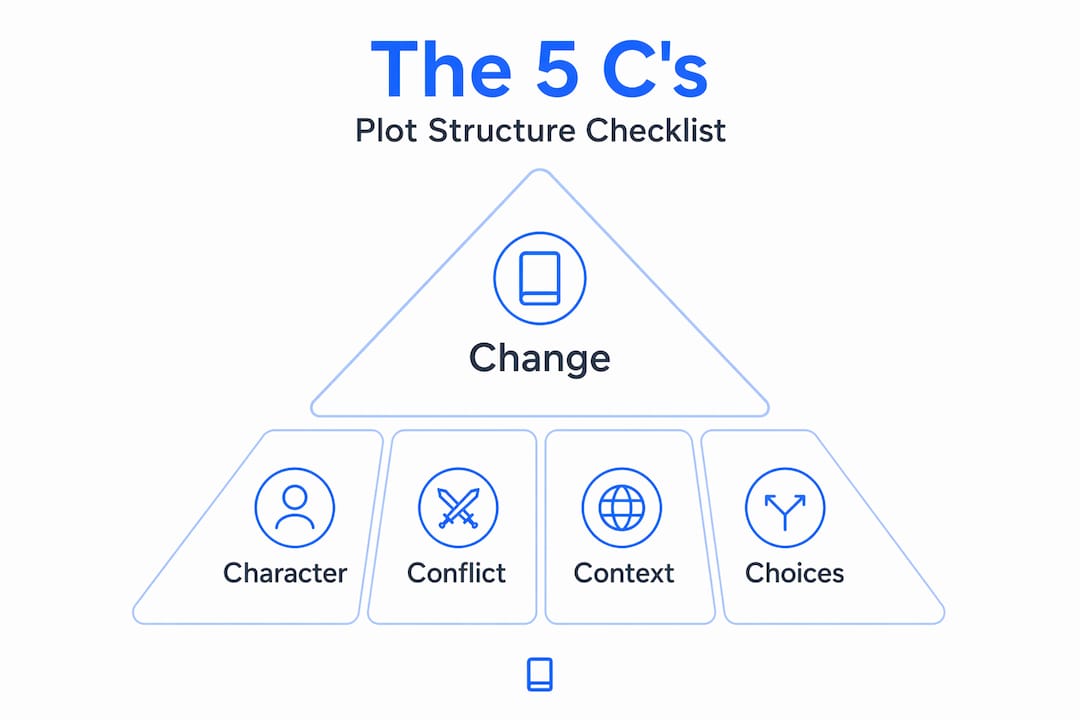
Applying the 5 C's before you begin writing helps you confirm that the key building blocks are present and balanced. Here is what each one means in practical terms:
| The C | What it requires | Question to ask yourself |
|---|---|---|
| Character | A protagonist readers can connect with | Does my reader have a reason to care about this person? |
| Conflict | A clear obstacle or antagonistic force | What is standing between my character and their goal? |
| Context | Setting, background, and stakes | Does the reader understand why this world and moment matter? |
| Change | Internal or external transformation | How is my character or world different by the end? |
| Conclusion | A resolution that addresses the central conflict | Does the ending answer the question the story opened with? |
The most commonly missed element is Change. Stories without transformation describe problems but lack momentum and a satisfying resolution. Readers finish them feeling cheated, even if they enjoyed individual scenes.
Think about a story where a character overcomes financial hardship but ends the book with the exact same worldview they started with. Nothing changed inside them. The external problem was solved, but the emotional journey never landed. That is a story missing its core.
The 5 C's work best when you use them alongside your chosen structural framework. The framework gives you the shape of the plot. The 5 C's make sure the story inside that shape actually has something to say. You can learn more about connecting these elements in this guide on story arc fundamentals.
My honest take on learning plot structure
I have seen a lot of new writers treat plot structure frameworks as a checklist to tick off rather than a language to learn. They read about the three-act structure, label their story "Act 1, Act 2, Act 3," and wonder why the draft still feels flat. That misses the point entirely.
What I have found actually helps is obsessing over the rising action. Most beginner stories have a fine beginning and a rushed ending. The middle is where the real work lives, and most writers abandon it too quickly. If your protagonist is not hitting real walls, making real mistakes, and paying real costs in the middle of your story, no structural framework will save you.
I also think the fear of outlining is overblown. Writers talk about being "pantsers" (writing by the seat of your pants) as if it is a badge of creative freedom. In my experience, pantsers spend three months writing a draft they then spend six months fixing. Outliners spend two weeks planning and two months writing a draft that needs one solid revision pass. Neither approach is wrong, but I have never met a writer who regretted outlining. I have met many who regretted not doing it.
The uncomfortable truth about understanding plot structure is that it does not constrain good stories. It reveals weaknesses in weak ones. Structure is a diagnostic tool as much as it is a creative one. Use it early, use it honestly, and let it show you what your story still needs.
— Mikael
Start building your story with Librida
If this breakdown of plot structure clicked for you, the next step is putting it into practice with real tools. Librida is an AI-powered writing platform built specifically for aspiring authors who want to go from idea to finished manuscript without getting lost in the process. You get story planning templates, outlining support, and guided frameworks that match everything covered in this article. Whether you are working through your first three-act outline or applying the 5 C's checklist to a story you have already started, Librida gives you a structured space to do it. Start developing your manuscript and see how much faster a story comes together when you have the right structure behind it.
FAQ
What is the simplest definition of plot structure?
Plot structure is the organized sequence of events in a story, typically built around five stages: exposition, rising action, climax, falling action, and resolution. It gives your narrative a shape that controls pacing and reader engagement.
How many types of plot structures are there?
There are several recognized types, including the three-act structure, Freytag's Pyramid, the Hero's Journey, and the Mountain structure, which builds tension progressively by raising stakes continuously rather than concentrating conflict in one place.
Why do novice writers struggle with the middle of a story?
Novice writers commonly hit what is called the "sagging middle" because they do not plan enough rising action and conflict escalation. Using a beat sheet with specific turning points helps maintain tension through the full length of the story.
What is the difference between plot structure and story arc?
Plot structure refers to the sequence of events in a story, while a story arc describes the emotional or transformational journey a character undergoes across those events. Strong stories align the two so that external plot events drive internal character change.
Do I need to follow a plot structure framework exactly?
No. Frameworks like the three-act structure or Hero's Journey are flexible guides, not strict rules. The goal is to use them as starting points to understand where your story needs tension, change, and resolution, then adapt them to fit your specific narrative.