

TL;DR:
- Editing is essential in refining story structure, character development, and prose clarity to create engaging narratives. It involves distinct stages—developmental, line, and proofreading—that Target different narrative layers, with sequence crucial for effective improvement. Professional editing enhances reader understanding by resolving plot issues and balancing pacing, making stories more accessible to diverse audiences.
Editing is the strategic force that refines plot development, character arcs, pacing, and narrative voice to create a clear, emotionally engaging story. Without it, even the most original ideas collapse under structural inconsistency, uneven pacing, and unclear prose. The role of editing in storytelling spans three distinct stages: developmental editing, line editing, and proofreading. Tools like Grammarly, ProWritingAid, and Hemingway Editor support the sentence-level work, but the deeper craft of editing shapes whether a story actually lands with readers. Understanding each stage and how they interact is the foundation every aspiring writer needs before publishing a single word.
What are the main stages of editing in storytelling?
Editing is not one task. It is a sequence of increasingly precise interventions, each targeting a different layer of the story. Skipping stages or reversing their order costs time, money, and quality. At least three editing rounds are standard before a manuscript reaches publication quality, and newer writers or complex projects often need more.
Developmental editing: the architecture of your story
Developmental editing focuses on what story information to include and how it is organized. This stage addresses structural consistency, plot effectiveness, character arc coherence, and subplot logic. Changes at this level are architectural, not cosmetic. A developmental editor might combine two characters into one, relocate entire chapters, or remove subplots that dilute the central conflict. Think of it as deciding what the building looks like before you paint the walls.

Line editing: sharpening how the story reads
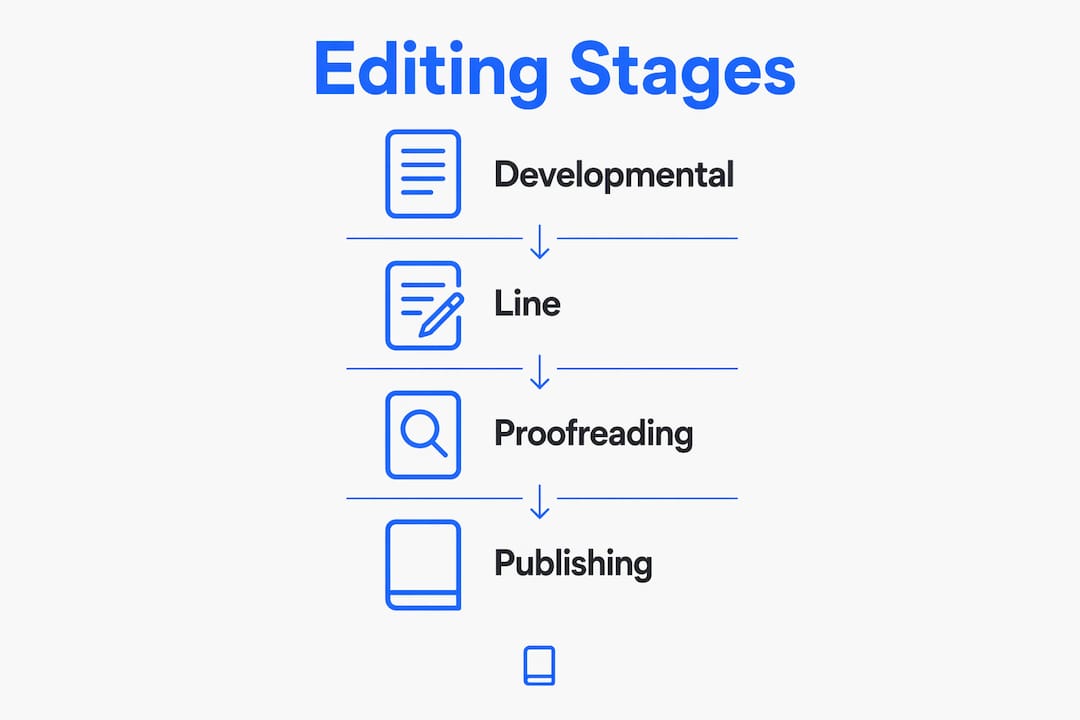
Once the structure is solid, line editing improves sentence-level flow, clarity, pacing, and expression. This stage does not decorate prose. It strengthens and clarifies it so the writing serves the story's impact without pulling readers out of the experience. A line editor uses scene function checklists to verify that every sentence and paragraph advances the scene's purpose and that pacing choices are intentional, not accidental.
Proofreading: the final layer of precision
Proofreading is the last pass before publication. It catches spelling errors, punctuation mistakes, inconsistent formatting, and typographical issues that survived earlier rounds. Proofreading does not restructure or rewrite. Its only job is to make the manuscript clean. Treating it as a substitute for developmental or line editing is one of the most common and costly mistakes aspiring writers make.
- Complete developmental editing first (structure, plot, character arcs)
- Move to line editing once the structure is locked
- Finish with proofreading as the final quality check
Pro Tip: Never start line editing before developmental changes are complete. If you polish sentences in a chapter that later gets cut or restructured, you have wasted effort on work that disappears.
How does editing enhance narrative structure and reader engagement?
The importance of editing in narrative goes beyond fixing errors. Editing shapes how readers experience a story at every level, from the logic of the plot to the emotional weight of a single scene. Editing transforms scattered drafts into cohesive narratives by trimming unnecessary content and ensuring every scene supports story direction. That is not a minor improvement. It is the difference between a story that holds attention and one that loses readers by chapter three.
Research published in 2026 found that narrative structural edits improve reading comprehension for low-achieving readers by reducing cognitive load. This means editing affects not just aesthetics but how readers mentally build coherence as they move through a text. A well-edited story is more accessible to a wider audience, including readers who struggle with dense or disorganized prose.
Here is what editing specifically does to strengthen narrative structure and engagement:
- Resolves plot inconsistencies. Editing identifies gaps, contradictions, and logic failures in the plot before readers encounter them.
- Balances pacing. Scenes that drag slow momentum; scenes that rush deny emotional payoff. Editing calibrates both.
- Refines character motivation. Readers disengage when characters act without believable reasons. Editing clarifies why characters do what they do.
- Sharpens emotional beats. The moments that make readers cry, laugh, or feel dread require precise setup and delivery. Editing builds that precision.
- Improves readability. Cleaner prose reduces friction, keeping readers inside the story rather than rereading confused sentences.
"Editing for engagement not only changes wording but modifies how readers mentally build coherence, improving accessibility for diverse reader groups." — Understanding the impact of changing text structure on reading comprehension
The impact of editing on plots is especially visible in stories where the timeline or cause-and-effect chain is complex. A thriller with a nonlinear structure, for example, depends entirely on an editor's ability to track what the reader knows at each point and whether the reveals land with the right weight.
What editing techniques can aspiring writers use right now?
Practical editing techniques for stories do not require a professional editor at every stage. Self-editing, done strategically, can dramatically improve a draft before outside eyes ever see it. Expert revisers revise strategically rather than making excessive changes, which means the goal is focused, purposeful revision, not endless rewriting.
The most effective self-editing approach uses multiple passes, each with a single focus:
- Pass one: structure. Read the full manuscript and ask whether each scene advances the plot or deepens character. Cut scenes that do neither.
- Pass two: character consistency. Track each major character's motivation, voice, and arc across the full story. Flag any moment where they act out of character without justification.
- Pass three: pacing. Read chapters aloud. Slow sections will feel slow. Fast sections will feel rushed. Your ear catches what your eye misses.
- Pass four: sentence-level clarity. Use tools like Grammarly, ProWritingAid, or Hemingway Editor to identify passive constructions, overlong sentences, and repeated words.
The most common self-editing pitfall is starting at the sentence level before the structure is resolved. Writers who spend hours perfecting a paragraph in a chapter that later gets cut have not edited. They have procrastinated with polish.
Pro Tip: Before revising any scene, write one sentence that states the scene's single purpose. If you cannot state it clearly, the scene probably needs to be cut or rebuilt before you touch the prose.
For writers building their craft, Librida's story development guide walks through how to structure a manuscript from concept to draft, which gives self-editing a much clearer target to work toward.
How do professional editors support storytelling beyond the writer's perspective?
Every writer has blind spots. You know what you meant to write, which makes it nearly impossible to see what you actually wrote. Editors provide essential outside perspectives that help writers see those blind spots, improving clarity and narrative effectiveness. The editorial relationship is collaborative, not corrective. A good editor's goal is to support and enhance the writer's vision, not replace it.
Professional editors bring three things a writer cannot provide for themselves:
- Specialized expertise. A developmental editor has read hundreds of manuscripts and recognizes structural problems that first-time writers do not know to look for.
- Reader objectivity. An editor reads as a reader, not as the author. That shift in perspective reveals where the story loses momentum, confuses, or fails to deliver on its promises.
- Structural suggestions. Authors often protect scenes or characters they love even when those elements weaken the story. An editor can name the problem without the emotional attachment that prevents the writer from seeing it.
Writers often feel defensive when they first receive editorial feedback. That reaction is natural, but it misreads the purpose of the feedback. Editorial notes aim to improve clarity for readers, not to criticize the writer's ability. The distinction matters because writers who treat feedback as personal criticism tend to make surface changes while leaving the real problems untouched.
Knowing when to hire a professional editor is also a practical question. For a first novel or a complex narrative structure, developmental editing is worth the investment before querying agents or self-publishing. For shorter projects or writers with strong structural instincts, starting with a manuscript assessment (a lighter version of developmental editing) can identify the biggest issues at lower cost. Librida's guide on what editors do in publishing breaks down each editorial role and when each type of support makes sense.
Key takeaways
Editing is the craft layer that separates a finished story from a published one, and skipping any stage of the process weakens the final result.
| Point | Details |
|---|---|
| Editing shapes every story layer | Developmental, line, and proofreading edits each target a distinct level of narrative quality. |
| Sequence matters | Always complete structural edits before sentence-level work to avoid polishing content that gets cut. |
| Editing improves reader comprehension | Narrative structural edits reduce cognitive load and make stories accessible to a wider audience. |
| Self-editing requires focused passes | Each revision pass should target one specific element: structure, character, pacing, or prose clarity. |
| Professional editors close blind spots | Outside editorial perspective identifies problems the writer cannot see due to proximity to the material. |
Why I stopped treating editing as the enemy of my creative vision
The first time a developmental editor returned a manuscript to me with a note suggesting I cut the first three chapters entirely, I closed the document and did not open it for a week. That reaction tells you everything about how most writers misunderstand editing as a storytelling tool. We write to express something, and the idea that expression needs to be restructured feels like a contradiction.
What changed my thinking was a simple reframe: the first draft is for the writer. The edited draft is for the reader. Those are two different documents with two different jobs. Once I accepted that distinction, editorial feedback stopped feeling like criticism and started feeling like intelligence about whether the story was actually working for someone other than me.
The writers I have seen struggle most with editing are the ones who conflate their prose with their identity. A sentence you love that slows the story down is still a sentence that slows the story down. Cutting it is not a loss of voice. It is a decision to prioritize the reader's experience over your own attachment to a particular phrase.
The practical lesson I keep returning to is this: edit in the right order, and editing becomes faster and less painful. Start with structure. Lock the architecture. Then refine the prose. Writers who reverse this sequence spend enormous energy polishing work that disappears in the next structural pass, and that experience is what makes editing feel exhausting rather than clarifying.
Librida's resource on editorial feedback for authors captures this dynamic well. Feedback is not a verdict on your talent. It is data about how your story reads.
— Mikael
Take your storytelling further with Librida
Editing is where good stories become great ones, and you do not have to figure out the process alone.

Librida combines AI-powered writing support with structured editorial guidance to help aspiring authors move from rough draft to publication-ready manuscript. Whether you are working through your first developmental pass or refining prose at the sentence level, the platform gives you the tools and frameworks to edit with purpose. The resource AI-Powered Success: From Beginner to Pro is a practical starting point for writers who want to apply both creative instinct and technical precision to their work. Pair self-editing with the right support, and the gap between your draft and your vision closes faster than you expect.
FAQ
What is the role of editing in storytelling?
Editing refines plot structure, character arcs, pacing, and prose clarity to transform a rough draft into a story that engages readers. It operates across three stages: developmental editing, line editing, and proofreading, each targeting a different layer of narrative quality.
How does editing improve narrative structure?
Developmental editing addresses structural issues like plot gaps, weak character motivations, and subplot inconsistencies before any sentence-level work begins. Research shows that narrative structural edits also reduce cognitive load, making stories more accessible to a broader range of readers.
What editing techniques work best for self-editing?
The most effective approach uses multiple focused passes: one for structure, one for character consistency, one for pacing, and one for sentence-level clarity using tools like Grammarly or Hemingway Editor. Starting with structure before prose ensures you do not polish content that later gets cut.
When should a writer hire a professional editor?
A professional developmental editor is worth hiring before querying agents or self-publishing, especially for a first novel or a story with a complex structure. For shorter projects, a manuscript assessment provides structural feedback at a lower cost than a full developmental edit.
Does editing affect how readers understand a story?
Editing shapes how readers mentally build coherence as they move through a narrative. A 2026 study found that narrative structural edits improved reading comprehension for lower-performing readers, confirming that editing affects cognitive processing, not just surface aesthetics.