

TL;DR:
- Outlining provides essential structure that helps writers overcome writer's block and identify plot issues early.
- It shifts creative energy from structural problem-solving to vivid scene writing while remaining flexible and adaptable.
Most writers resist outlining because they believe it will cage their creativity. That fear makes sense, but it also keeps a lot of good stories unfinished. Understanding why outline your story matters is not about following a formula. It is about giving your ideas the structure they need to survive the long, difficult process of actually becoming a book. This article covers what outlining really is, what it does for your writing process, and how to use it in a way that keeps your creative instincts fully intact.
Table of Contents
- Key takeaways
- Why outline your story before you start writing
- The real benefits of story outlining
- Outlining methods and how to pick the right one
- How to build your outline step by step
- Keeping creativity alive after you outline
- My take: structure is where freedom lives
- Start writing with Librida by your side
- FAQ
Key takeaways
| Point | Details |
|---|---|
| Outlining prevents writer's block | A clear story map gives you direction when motivation drops and blank pages feel impossible. |
| Outlines are flexible, not fixed | Treat your outline as a living document you update as your story evolves and surprises you. |
| Plot holes are cheaper to fix early | Catching structural problems before drafting saves hours of painful mid-manuscript revision. |
| Different methods suit different writers | From bare-bones beat sheets to detailed scene lists, there is an outlining style for every creative personality. |
| Creativity is not lost in outlining | Outlining shifts your creative energy from big-picture problem-solving to vivid, emotionally charged scene writing. |
Why outline your story before you start writing
Before getting into tactics, it helps to understand what an outline actually is. A lot of writers picture a rigid list of chapters with every moment pre-decided. That is not what a useful outline looks like.
Grammarly defines a story outline as a structured overview of main events, characters, conflicts, and emotional turning points used before writing scenes or dialogue. Notice what that definition does not say. It does not say every line of dialogue is planned. It does not say every sensory detail is locked in. An outline is a map of the territory, not a script of every conversation you will have while traveling through it.
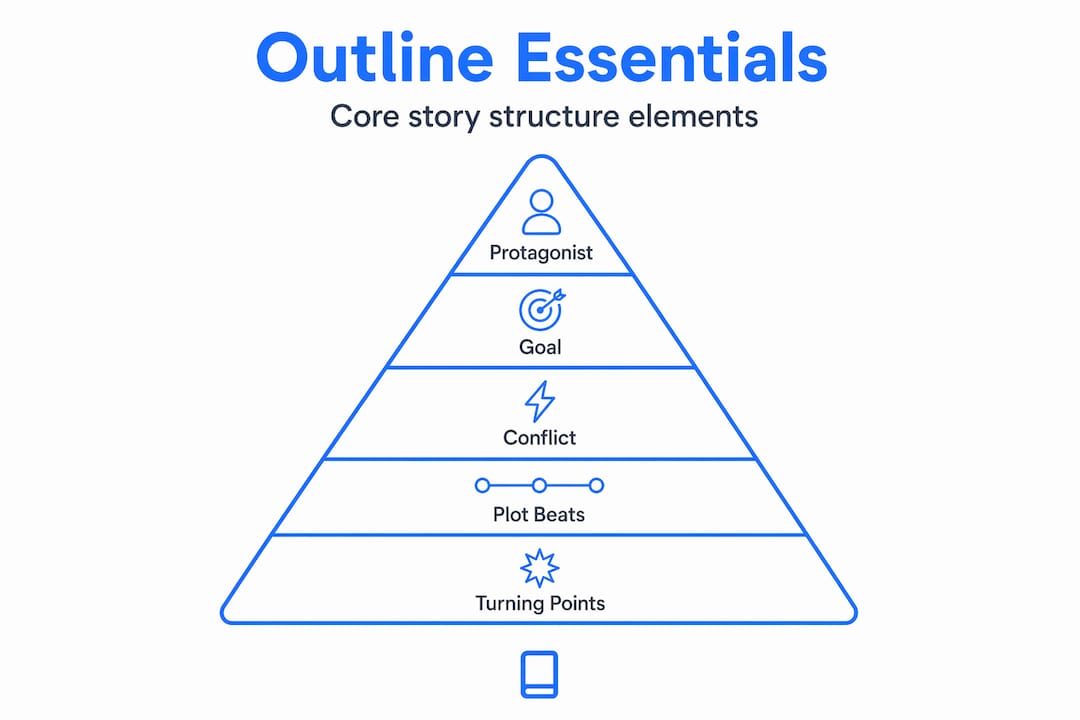

An outline is also different from a summary. A summary describes what happened after the fact. An outline guides what you plan to make happen before you write a single scene. That distinction matters because it means an outline is a working tool, not a finished product.
Here is where an outline fits in your process:
- Brainstorming: You generate raw ideas, characters, themes, and fragments without any filter.
- Outlining: You shape those raw ideas into a cause-and-effect sequence with a clear beginning, middle, and end.
- Drafting: You write scenes, dialogue, and description guided by the outline's direction.
- Revising: You refine language, deepen character, and fix what the outline could not predict.
Outlining lives between brainstorming and drafting, and that position is exactly what makes it so powerful. It takes chaos and gives it a spine. A structurally sound outline makes cause-and-effect clear and reveals when scenes do not advance the story before you have spent weeks writing them.
The real benefits of story outlining
The case for outlining your story is practical, psychological, and creative all at once. Here are the six most significant advantages.
-
It beats writer's block before it starts. Writer's block usually is not a creativity problem. It is a direction problem. When you sit down to write and have no idea what happens next, you stop. An outline removes that uncertainty. A good outline functions as a map that guides narrative direction even through the hardest stretches of drafting.
-
It catches plot holes while they are still cheap to fix. Plot holes discovered in chapter twenty mean rewriting chapters two through eighteen. An outline lets you test your story logic before you invest weeks in scenes that will not hold together. Outlining saves drafting time by revealing weak plot points and structural problems early, which reduces mid-draft restructuring significantly.
-
It improves pacing without extra effort. When you can see your whole story laid out, you notice if three slow scenes are stacked together or if your climax arrives too early. Adjusting pacing in an outline takes minutes. Adjusting it in a full draft takes days.
-
It clarifies what your characters actually want. Characters without clear goals drift. An outline forces you to answer the hard questions about what each character wants, what stands in their way, and how they change. This clarity makes every scene feel purposeful rather than decorative.
-
It frees your creative energy during drafting. When the big structural problems are solved, you can focus entirely on writing beautiful sentences, surprising details, and emotionally resonant moments. You stop worrying about whether the story works and start making it sing.
-
It gives you psychological safety. Knowing where your story is going gives you the confidence to keep writing on days when inspiration feels distant. A strong outline serves as a safety net that remains fluid as the plot evolves, so you are never truly lost.
Pro Tip: Before you outline a single scene, write one sentence that captures your whole story: who your protagonist is, what they want, what stands in their way, and what is at stake. That sentence becomes the compass you return to whenever the outline gets complicated.
Outlining methods and how to pick the right one
Not every writer needs the same kind of outline. The most important thing is finding a method that gives you enough structure to stay on track without making you feel like you are filling out a form.
| Style | Best for | What it includes | What it skips |
|---|---|---|---|
| High-level beat sheet | Pantsers and discovery writers | Major turning points, inciting incident, climax | Scene-by-scene detail, dialogue notes |
| Scene-by-scene outline | Plotters and detailed planners | Each scene's purpose, POV, cause-and-effect | Specific dialogue, sensory description |
| Hybrid outline | Writers who want flexibility | Key plot beats plus a loose scene list | Over-specification of emotional beats |
| Character arc map | Character-driven writers | Character goals, conflicts, transformation points | Plot mechanics, subplots |
The old debate between "outliners" and "pantsers" (writers who fly by the seat of their pants) often misses a more useful point. Almost every writer benefits from some level of outline. The question is how much. A pantser who hates detailed planning might thrive with just a ten-point beat sheet. A plotter might need a full scene-by-scene breakdown to feel confident.
An effective outline includes enough detail to eliminate paralyzing decisions but leaves space for discovery during drafting. That balance is the goal regardless of your style. Over-specifying kills the joy of writing. Under-specifying leaves you stranded.
One technique worth knowing is "next scene targeting." Instead of looking at your full outline and feeling overwhelmed by everything left to write, you focus only on what comes next. This is especially useful for longer projects like novels, where the sheer scope can feel suffocating. You wrote one outline. Now write one scene.
Pro Tip: If you are new to outlining, start with just five beats: the opening situation, the inciting incident, the midpoint shift, the crisis, and the resolution. Five beats is enough to keep a short story or chapter on track without making the process feel heavy.
How to build your outline step by step
Creating a practical story outline does not require a special system. It requires a clear sequence. Here is how to do it.
-
Write your premise sentence. Define your protagonist, their goal, the main obstacle, and the stakes. Example: "A burned-out teacher discovers her late mother's secret life as a forger and must decide whether to expose the truth at the cost of her family's legacy."
-
Map your character arcs. For each major character, note where they start emotionally, what they want versus what they actually need, and how they change by the end. Character arcs drive plot. Get them clear early.
-
Identify your major plot beats. Every story needs an inciting incident (the event that kicks the story into motion), a midpoint shift (a revelation or reversal that changes the direction), a crisis moment (the lowest point), and a resolution. These four beats are your structural anchors.
-
Build a beginning, middle, and end. Assign your plot beats to these three sections. The beginning sets up character and world while planting the core conflict. The middle escalates tension and complicates the character's goal. The end delivers on the story's central promise.
-
Write brief scene summaries. Keep each summary to one or two sentences focused on cause and effect. "Maya confronts her sister about the hidden letters, which leads her to question everything she believed about their mother" is more useful than "a tense conversation."
-
Review and update as you draft. Your outline is not finished when you start writing. It is a living document. Revisit it regularly, update scenes that have changed, and let the story you are actually writing inform the road ahead.
For a deeper look at the full process from idea to manuscript, the story development guide from Librida walks through each stage with concrete examples.
Keeping creativity alive after you outline
Here is something no one tells you. Many writers finish an outline and immediately feel deflated. The excitement of discovery disappears because the story feels "solved." This is normal and it does not mean outlining was a mistake.
Outlining changes the type of creativity you use. During outlining, you are solving the big puzzle: logic, structure, character arcs, plot mechanics. During drafting, you shift into execution mode: sensory detail, emotional texture, voice, rhythm. Both are creative. They just feel different.
A few ways to stay engaged after your outline is done:
- Focus on one scene at a time. Do not look at the full outline and think about how much is left. Open the document and write the next scene only.
- Add surprises within scenes. Your outline says what happens. It does not say how a character reacts emotionally or what unexpected detail appears. Leave room for discovery inside each beat.
- Deepen sensory details during drafting. The outline handles structure. Drafting is your chance to make a scene feel real through what characters see, hear, smell, and feel.
- Let the outline change. If a scene you write opens up something better than what you planned, update the outline. A fluid outline offers a safety net that can evolve as the plot develops.
Pro Tip: Keep a "discoveries" list alongside your outline. Every time drafting surprises you with something good, note it down. This list reminds you the story is still alive and growing, even when the skeleton is already built.
If you want support connecting outlining with your broader creative workflow, understanding storytelling craft fundamentals can help you make better decisions at both the outline and drafting stages.
My take: structure is where freedom lives
I have spent years watching writers treat outlining as the enemy of real creativity. I used to believe it myself. What changed my mind was finishing a story for the first time.
In my experience, every manuscript I abandoned had one thing in common: I did not know where it was going. I thought I was being free and spontaneous. What I was actually doing was flying blind into a fog. Eventually the fog won. The outline did not take away my freedom. It gave me somewhere to land.
The uncomfortable truth about outlining is that motivation dips are real. You finish your outline and the story no longer feels exciting. I have been there many times. What helped was recognizing that the outline only solved the architectural problem. The emotional problem, the sentence-level problem, the character voice problem: those were still fully open and waiting for me in the draft.
What I have learned is that frequent outline revisions actually unlock richer story discoveries. Every time I updated my outline mid-draft to reflect something better I had found in the writing, I ended up with a stronger story than I had planned. The outline was not the ceiling. It was the floor.
If you are holding back from outlining because you are afraid it will make your story feel mechanical, I want you to flip that fear. Structure is not where creativity goes to die. It is where creativity goes to survive long enough to become something real.
— Mikael
Start writing with Librida by your side
You now understand the practical and creative reasons to outline your story before diving into a draft. Putting that knowledge to work is where things get exciting.

Librida is built for exactly this stage of the writing journey. The platform combines AI-powered tools with guided workflows that help you shape your premise, map your character arcs, and build a working story outline without getting stuck. Whether you are writing your first short story or pushing toward a full novel, Librida gives you the structure to move forward without losing the creative energy that sparked your idea. Explore AI-powered writing guidance to go from your first outline to a finished, polished manuscript. You can also check out how AI supports storytelling at every stage of the creative process.
FAQ
Why should I outline my story before drafting?
Outlining before drafting helps you visualize story structure, catch plot holes early, and prevent writer's block. It gives you a clear direction so that when you sit down to write, you already know what happens next.
Does outlining a story kill creativity?
No. Outlining shifts your creative focus from solving structural problems to writing vivid scenes and emotional moments. Motivation may drop after outlining only because the type of creativity required changes, not because creativity disappears.
What should a basic story outline include?
A solid outline covers your protagonist's goal, the main conflict and obstacles, major plot beats (inciting incident, midpoint, crisis, resolution), and a rough sequence of scenes. Keep scene summaries short and focused on cause and effect.
Can I change my outline while writing?
Absolutely. A useful outline stays fluid and evolves as your story develops. Treating it as a fixed contract is the fastest way to feel creatively trapped. Update it freely whenever the draft shows you something better.
How detailed does my story outline need to be?
It depends on your style, but the goal is to eliminate paralyzing decisions without over-specifying every moment. Most writers do best with a clear sequence of major beats plus brief scene-level notes rather than a fully scripted breakdown.