

TL;DR:
- Creative writing automation involves AI handling mechanical tasks like outlining, drafting, and revision, while authors retain creative control. It functions through multi-stage workflows that improve efficiency without replacing the author's voice or thematic choices. This approach boosts productivity, shortens production time, and helps authors focus on higher-level storytelling decisions.
Most writers assume AI either threatens to replace them or is too mechanical to touch real storytelling. Neither is true. Creative writing automation is actually the practice of designing smart workflows where AI handles the repetitive, structural, and mechanical tasks while you stay firmly in the driver's seat of every creative decision. Think of it as hiring a tireless assistant who never gets writer's block but always needs your vision to move forward. This article breaks down exactly what creative writing automation means, how the workflows function, what the genuine benefits and limits are, and how you can start building your own pipeline today.
Table of Contents
- What is creative writing automation?
- How do automated creative writing workflows work?
- Benefits and limitations of automating creative writing
- Real-world examples: Building your automated writing pipeline
- What most writers miss about automation and creativity
- Take the next step with AI-powered creative writing
- Frequently asked questions
Key Takeaways
| Point | Details |
|---|---|
| AI as creative assistant | Creative writing automation uses AI to streamline routine tasks while authors keep full creative control. |
| Workflow beats one-shot generation | The best results come from structured, multi-stage processes rather than asking AI to write everything at once. |
| Quality requires human judgment | AI accelerates drafts, but authors remain essential for story coherence and originality. |
| Pitfalls to avoid | Don't rely solely on AI feedback—blind spots and generic critique can lead to bland stories. |
| Practical applications | Start with automating structural and revision tasks to gain time for creativity in your manuscript. |
What is creative writing automation?
With expectations set, let's break down what creative writing automation truly means.
The term sounds technical, but the concept is practical. Creative writing automation is using software, often AI language models combined with workflow "agent" features, to automate or semi-automate steps in the creative writing pipeline, such as ideation, outlining, drafting, revision, and continuity checks, while the human author retains creative direction and final judgment.
This is fundamentally different from two things people often confuse it with. Full AI text generation is when you hand the entire manuscript over to a model and accept what comes out. That produces generic, authorless content. Classic manual writing is when you do every single step yourself, which is time-consuming and prone to bottlenecks like writer's block or inconsistency tracking. Creative writing automation lives in the productive middle ground between those extremes.
"Creative writing automation is not about removing the author from the story. It's about removing the friction that slows authors down so their best creative work can actually reach the page."
Here's where automation genuinely helps across the creative process:
- Ideation: Brainstorming character concepts, plot hooks, setting details, and thematic threads faster than solo freewriting
- Outlining: Structuring acts, chapters, and scene beats with AI-generated scaffolding you then shape and refine
- Drafting: Generating first-pass prose for scenes you've already mapped, using your voice guidelines as a constraint
- Revision: Flagging passive voice, pacing issues, repetitive phrases, and tonal inconsistencies at speed
- Continuity checks: Catching plot holes, mismatched character details, and timeline errors that human eyes often miss after hours of reading
Authors who treat these stages as separate, automatable tasks report dramatically faster drafts without sacrificing the creative ownership that makes their work unique. Building strong AI productivity habits around these stages is what separates authors who use AI effectively from those who feel frustrated by it.
How do automated creative writing workflows work?
Having defined creative writing automation, let's explore how these workflows actually function in practice.

The key insight is that effective creative writing automation means running a multi-stage workflow, covering planning, character and world building, drafting prose, and critique or revision, rather than generating a whole manuscript in one pass. Breaking the creative process into defined segments is what makes automation actually useful.
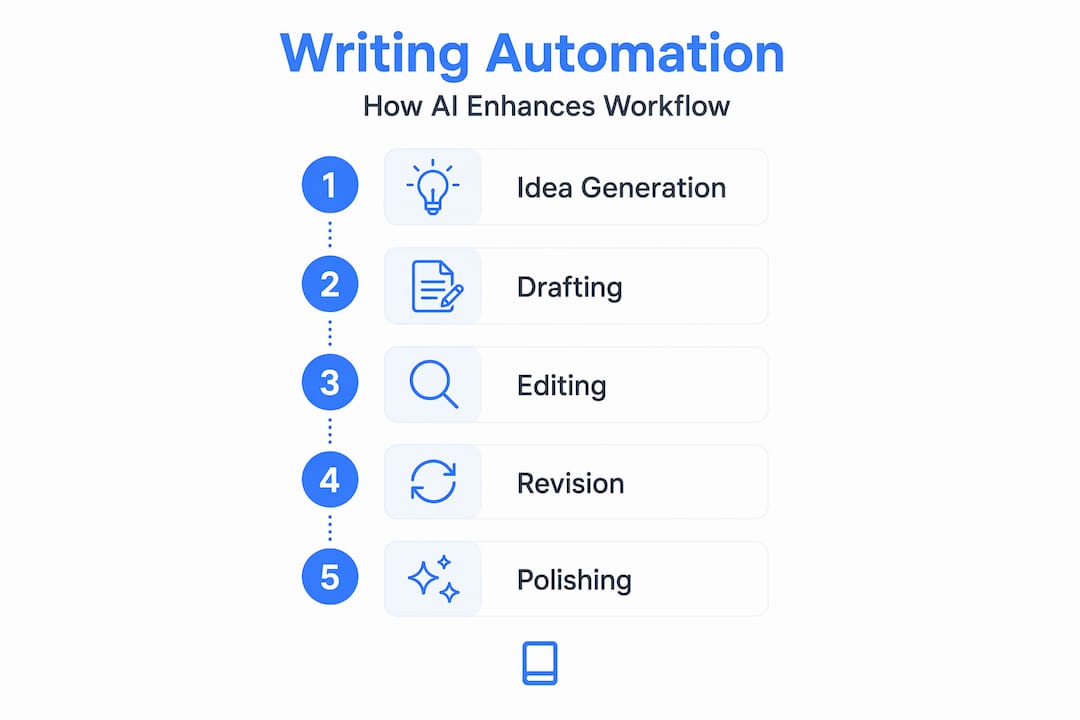
Here's a typical automated creative writing workflow, step by step:
- Planning mode: You define your story's premise, genre, tone, and major character arcs. AI agents help you expand and pressure-test these ideas, flagging logical gaps and suggesting alternatives. You make all final calls.
- Character and world building mode: The AI helps populate a character bible, location database, and cultural or historical context. You review every entry and adjust for authenticity and originality.
- Outlining mode: Structured chapter-by-chapter or scene-by-scene outlines are generated based on your approved story parameters. You restructure, cut, or expand until the architecture feels right.
- Drafting mode: Individual scenes are drafted using your outline as a blueprint. You provide style notes, POV constraints, and voice samples so the AI stays in your register. You edit every scene before it becomes canon.
- Critique and revision mode: AI tools flag craft issues like head-hopping, overused phrases, or logic breaks. You decide which suggestions serve your vision and which to ignore.
Pro Tip: Treat each mode as a separate session with fresh prompts. Blending modes in a single session causes AI outputs to drift and makes it harder to maintain your authorial voice across chapters.
This workflow structure also clarifies the author's role at each stage. You are not a passive recipient of AI output. You are the director, and the AI handles specific sub-tasks under your guidance.
| Stage | Traditional approach | Automated approach |
|---|---|---|
| Ideation | Solo freewriting, hours of notes | AI-expanded brainstorm, author-curated in minutes |
| Outlining | Manual beat-by-beat planning | AI draft outline, author restructures |
| Drafting | Word-by-word from scratch | AI first-pass prose, author edits and deepens |
| Revision | Multiple solo read-throughs | AI flags issues, author evaluates and revises |
| Continuity | Manual tracking with spreadsheets | AI continuity audit, author verifies and corrects |
Learning how to turn ideas into manuscripts through structured workflows like this is what transforms AI from a novelty into a genuine creative partner.
Benefits and limitations of automating creative writing
Now that we've mapped the workflow, let's weigh the concrete pros and cons when putting automation into practice.
The benefits are real and measurable. Automation accelerates the drafting and revision cycle significantly, often cutting the time to first draft by 30 to 50 percent for authors who use structured workflows. It removes mechanical bottlenecks like continuity tracking and repetitive line-level edits, freeing cognitive bandwidth for the deeper creative decisions that only you can make. Exploring the benefits of publishing with AI shows that these productivity gains extend all the way through the publishing process, not just the drafting stage.
Empirical research confirms measurable quality differences between AI-generated and human-written text. Studies using LitBench and stylometric methods demonstrate that benchmarks involving judge alignment, stylometry, and long-form coherence consistently reveal where AI output diverges from skilled human writing. This is actually useful knowledge: it tells you precisely which tasks to automate and which require your full human attention.
Here's a direct comparison of AI-assisted versus fully human outcomes across key writing benchmarks:
| Benchmark | Fully human writing | AI-assisted writing | AI-only writing |
|---|---|---|---|
| Voice consistency | High | High (with author guidance) | Low to moderate |
| Structural coherence | High | High | Moderate |
| Emotional depth | High | Moderate to high | Low |
| Long-form continuity | Moderate (fatigue risk) | High (with continuity tools) | Low |
| Production speed | Slow | Fast | Very fast |
| Originality | High | High (author-directed) | Low |
The limitations are equally important to understand:
- Long-form consistency is the biggest challenge. AI models lose track of subtle details over extended narratives, creating continuity errors in character motivation, setting, and timeline.
- Meaningful critique from AI can sound confident but often misses the author's intent, producing feedback that would homogenize rather than sharpen the work.
- Theme and voice are almost impossible to delegate. If you let AI lead thematic development, you risk ending up with a story that feels technically competent but has no identifiable perspective.
- Emotional authenticity requires lived experience and human judgment. As critics have noted, AI models predict plausible text rather than understanding emotional stakes, which means nuanced emotional arcs always need author-driven direction.
Pro Tip: Use AI critique tools for structural and mechanical feedback only. For thematic or emotional feedback, rely on trusted human readers or an experienced developmental editor.
Real-world examples: Building your automated writing pipeline
Understanding both strengths and weaknesses, see how aspiring authors are building workflows that play to AI's real strengths.
The most effective approach treats AI as an assistant for specific mechanical or high-leverage sub-tasks, such as building a structure, creating a character bible, or running continuity audits, rather than as a replacement for the writer's taste and intent. Here's what a practical pipeline looks like in action:
- Idea capture: Write a one-paragraph premise in your own words. Feed it to an AI tool to expand it into five alternate versions. Choose elements from each to form a richer concept.
- Structure scaffolding: Input your premise and genre into an AI outlining tool. Ask for a three-act structure with chapter-level beats. Rewrite every beat in your own voice, cutting anything that doesn't serve your story.
- Character bible creation: Use AI to generate detailed character profiles based on your rough descriptions. Review each profile critically and rewrite backstory, motivation, and flaw to reflect your actual vision.
- Scene drafting: Write a detailed scene brief (setting, emotional goal, conflict, POV character). Feed it to an AI drafting tool with a sample of your prose style. Take the output as a starting point, not a finished product. Rewrite heavily.
- Continuity audit: After completing a significant chunk of manuscript, run an AI continuity check. Feed it your character bible, timeline, and chapters. Review every flagged inconsistency and resolve it yourself.
- Mechanical revision: Use AI revision tools to flag passive voice, repetition, and pacing issues. Accept only the changes that genuinely serve the story.
Building a consistent writing routine around these stages is what makes the pipeline sustainable over a full book project rather than just a short sprint.
Pitfalls to avoid when building your pipeline:
- Letting AI dictate theme or POV. These are authorial decisions. The moment AI starts shaping what your story is about, you've lost the most important creative control.
- Accepting AI feedback without evaluating context. Trusting AI feedback blindly can introduce revisions that sound polished but flatten your distinctive voice.
- Skipping the review stage to save time. Automation speeds up production but never eliminates the need for deep author review.
- Using AI output as the final draft. Every AI-drafted scene should be treated as a rough first pass requiring substantial rewriting.
Using a structured AI-powered self-publishing checklist helps you track where automation fits into your overall publishing process and ensures you never skip the author-review stages that keep your book authentically yours.
What most writers miss about automation and creativity
Most writers arrive at creative writing automation with one of two expectations: it will do the creative work for them, or it will corrupt their artistic voice. Both responses miss the real dynamic entirely.
Automation is a force multiplier for good process, not a substitute for creative thinking. If your story concept is vague, automation will produce vague drafts faster. If your character motivations are muddled, AI will amplify that muddiness at scale. The quality of your automation outputs is almost entirely determined by the quality of your creative inputs. This is actually great news, because it means the author who invests in strong story foundations will consistently outperform someone who hopes AI will fill in the gaps.
There's also a specific risk that most articles on this topic gloss over: generic AI critique. When you feed your manuscript to a large language model and ask for feedback, it evaluates your work against a statistical center of all training data. That means its critiques trend toward the average. It will push you toward more familiar structures, more conventional phrasing, more predictable emotional beats. AI models predict plausible text rather than understanding what makes your story worth telling. Relying on AI critique for anything beyond mechanical issues is genuinely risky for writers developing a distinctive voice.
The best-performing authors we see working with AI automation share a specific habit: they treat AI suggestions as data, not direction. They collect the suggestions, evaluate each one against their own creative intent, and accept only what strengthens their vision of the story. Exploring how autonomous storytelling and AI intersect shows just how nuanced this balance can become when writers push these tools to their limits.
The honest truth is that automation rewards intentional authors more than any other type. The more clearly you know your story, your characters, and your thematic goals, the more powerfully automation amplifies your work.
Take the next step with AI-powered creative writing
You now have a clear map of what creative writing automation is, how the workflows run, and where human judgment is non-negotiable. The next step is putting these concepts into practice with tools and resources built specifically for authors like you.
Librida's AI-powered success guide walks you through the complete journey from beginner to published author using AI assistance at every stage, structured exactly the way this article describes. If you want a concrete example of what compelling, AI-assisted storytelling can look like on the page, explore The Lady and the Quill for creative inspiration. Both resources give you a practical foundation to start experimenting with your own automated writing pipeline today, with Librida's platform guiding the process from first idea to finished manuscript.
Frequently asked questions
Can AI fully write a novel on its own?
AI can draft individual segments, but authors must steer plot, style, and coherence throughout. Multi-stage workflows are far more effective than trying to generate an entire manuscript in a single pass.
How do you keep an automated story consistent in voice and plot?
Use structured templates and regular author-led revision sessions, since LLMs often struggle with long-range consistency across POV, theme, and continuity.
How can I evaluate the quality of AI-assisted writing?
Research shows that LitBench and stylometric methods can identify meaningful differences in writing origin and quality, giving authors measurable ways to assess their AI-assisted output.
Is feedback from an AI writing tool reliable?
AI feedback can sound authoritative but may be misaligned with your intent. LLMs can give confident but contextually wrong suggestions, so always filter recommendations through your own authorial judgment.
What types of creative writing tasks are easiest to automate?
Structural tasks like outlining, continuity checking, and mechanical line edits are ideal candidates. AI works best on sub-tasks with clear parameters, freeing your attention for the creative decisions that define your story.