

TL;DR:
- Story ideation is a deliberate, learnable process that helps writers develop emotionally resonant and original narratives before drafting. Effective techniques include freewriting, mind mapping, rapid sketching, and trope spinning, which deepen conceptual clarity and uniqueness. Using AI as a supportive tool enhances ideas without replacing the writer's voice, ensuring a compelling starting point for storytelling.
Most writers have stared at a blank page waiting for inspiration to strike, convinced that great ideas just appear. They don't. What separates writers who finish books from those who abandon drafts isn't talent or luck. It's a deliberate practice called story ideation, and once you understand what it is and how to work it, the blank page stops being a threat. This guide breaks down the story ideation process from definition to execution, covering proven story brainstorming techniques, the role of AI tools, and how to develop raw sparks into narratives worth writing.
Table of Contents
- Key Takeaways
- What is story ideation and why it matters
- Proven story brainstorming techniques
- AI and digital tools in the ideation process
- Selecting and developing your ideas after ideation
- My take on story ideation
- Start your story with Librida
- FAQ
Key Takeaways
| Point | Details |
|---|---|
| Ideation is a skill, not chance | Story ideation is a learnable, repeatable process, not a mysterious burst of inspiration. |
| Push past the first idea | Probing your concepts multiple times uncovers the original, non-obvious story angles that editors and readers want. |
| AI assists but doesn't replace you | AI tools work best at the ideation stage when you initiate with your own raw thoughts first. |
| Voice makes ideas matter | A great idea without your specific perspective and emotional context is just a premise anyone could write. |
| Refine before you write | Evaluating emotional resonance and originality before drafting saves you from building on a weak foundation. |
What is story ideation and why it matters
Story ideation is the deliberate process of generating, exploring, and selecting narrative concepts before writing begins. It is not the same as general brainstorming. General brainstorming produces a list of possibilities. Story ideation goes further: it asks what kind of story this wants to be, who needs to tell it, and whether the concept has enough emotional and intellectual weight to carry a full narrative.
Think of it as the architecture phase of writing. You wouldn't pour a foundation before knowing how many floors you're building. Story ideation gives your creative process that blueprint before a single scene is drafted.
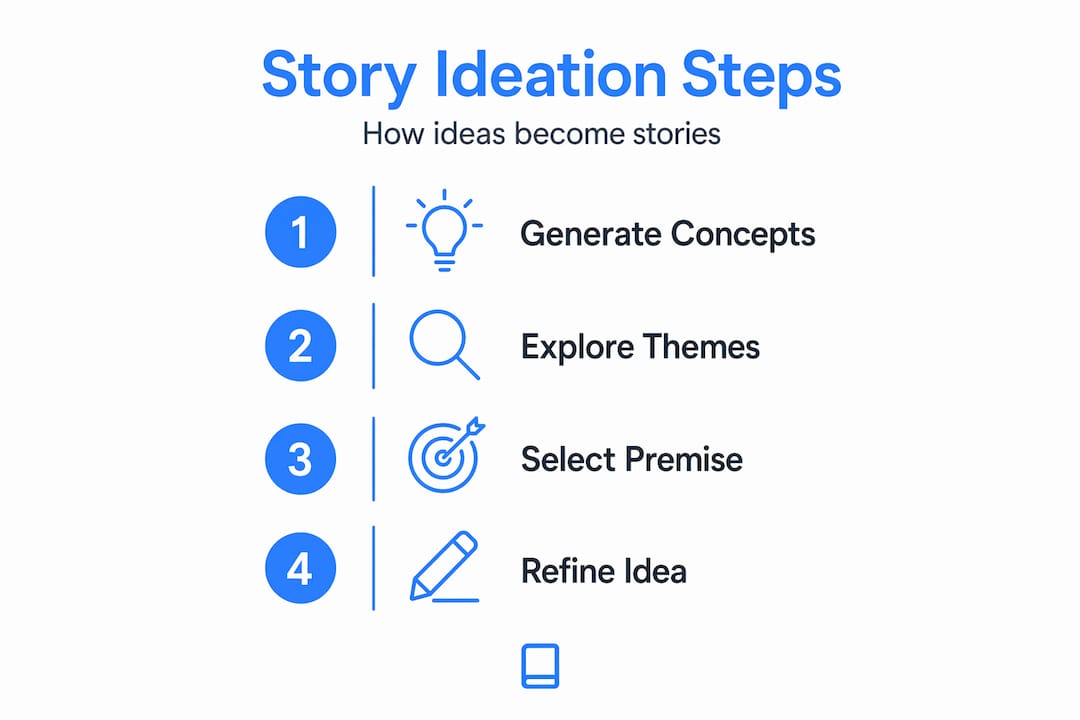
Why does this matter? Because writer's block often stems from failure at the ideation stage, not from an inability to write. Writers get stuck mid-draft not because they can't write sentences, but because they started building on an idea that was never fully developed. A strong story ideation process fixes that problem at the source.
Here is what a solid story ideation process addresses:
- Concept clarity: It forces you to articulate what your story is actually about, not just what happens in it.
- Emotional anchoring: It helps you identify the feeling you want readers to walk away with.
- Originality pressure: It pushes you to find angles that are specific to you and not interchangeable with a thousand other stories.
- Writer's block prevention: It gives you a reservoir of connected ideas to draw from when momentum stalls.
- Narrative direction: It establishes the "why this story now" question that editors and agents ask immediately.
Understanding what is narrative ideation also means recognizing what it is not. It is not outlining. It is not worldbuilding. Those are downstream activities. Ideation is the generative stage where possibility is wide open and commitment is low.
Proven story brainstorming techniques
Once you understand ideation as a distinct creative phase, the next step is knowing which techniques actually work. Not every method suits every writer, but exposure to several approaches gives you a toolkit to draw from depending on the project.
Classic methods that still work
Freewriting remains one of the most effective story brainstorming techniques for unlocking ideas you didn't know you had. Set a timer for 10 minutes, write your premise at the top of the page, and write without stopping or editing. No punctuation rules. No coherence required. The goal is to outrun your internal editor.

Mind mapping works differently. You place a central concept in the middle of a page and branch outward with related characters, themes, settings, conflicts, and questions. It's non-linear by design, which mirrors how story ideas actually form: not in straight lines but in clusters that connect unexpectedly.
Going deeper with advanced methods
The Crazy 8 rapid ideation method is borrowed from UX design but applies cleanly to narrative work. You sketch or write 8 distinct story concepts in 8 minutes, one per minute. The speed is the point. Perfectionism can't keep up with one minute per idea, so you stop filtering and start generating. Many writers find their most original concepts appear in rounds 6, 7, and 8, after the obvious ideas are exhausted.
For writers who work better in groups, brainwriting offers a structured alternative. The 6-3-5 brainwriting technique has six participants write 3 ideas every 5 minutes silently, passing their sheets to build on each other's concepts. This can generate up to 108 distinct ideas in 30 minutes while avoiding the groupthink that kills verbal brainstorming sessions.
Scenario storming is a technique where you place a character archetype inside an unusual or high-stakes situation and ask what they would do. Trope spinning works as a companion method: take a familiar story trope (enemies to lovers, chosen one, found family) and ask what happens if the central assumption is reversed, complicated, or applied to an unexpected genre.
- Start with a classic story structure you know well.
- Identify the core assumption that makes it feel familiar.
- Flip, complicate, or relocate that assumption to a completely different context.
- Write three versions of what that change produces.
- Ask "what else?" at least three more times before settling on anything.
David Farland's advice to probe your ideas repeatedly captures this well: push past the first 3 answers and you start finding concepts nobody else thought to look for.
Pro Tip: Before any brainstorming session, write one sentence about a real personal experience that connects, even loosely, to your story's theme. Ideas grounded in lived experience almost always carry more emotional specificity than those generated purely in the abstract.
AI and digital tools in the ideation process
AI has entered the writing world in a big way, and most of the conversation focuses on prose generation. That's not where it's most useful for writers. Most AI writing tools focus on generating sentences and paragraphs, which leaves writers stuck at the ideation stage with no structured support. The smarter use of AI is as an ideation partner, not a ghostwriter.
Here is how human-led ideation compares to AI-assisted ideation:
| Approach | Strengths | Limitations |
|---|---|---|
| Human-only ideation | Deep personal voice, emotional specificity, original angle | Can get stuck in familiar patterns, slower output |
| Generic AI chatbot ideation | Fast volume of ideas, crosses genre conventions easily | Generic framing, no persistent memory of your voice |
| Specialized AI story tools | Genre-aware, emotionally resonant suggestions, scalable | Requires intentional prompting to stay original |
| Human-initiated, AI-assisted | Preserves voice and originality while expanding possibilities | Requires discipline to not defer creative control too early |
Specialized AI story generators that understand genre conventions and emotional resonance produce noticeably more usable ideas than generic chatbots. The difference comes down to whether the tool has been trained on narrative structure or just language patterns.
The IDEA framework offers a useful structure for keeping your voice intact: Initiate with your raw personal thoughts, Develop those thoughts into scenarios, Edit what the AI returns against your original instinct, and Assemble the final concept yourself. Maintaining sovereignty over the angle is the core discipline here. The human starts the process. AI responds to that start. You never hand the wheel over entirely.
You can also use "Voice DNA" samples when working with AI tools. This means pasting examples of your own writing into the prompt context so the AI's suggestions match your natural register, rather than defaulting to a generic literary tone. It's a small adjustment that significantly closes the gap between what AI proposes and what actually sounds like you.
Pro Tip: When using AI for ideation, give it constraints before you give it freedom. Tell it the one thing the story must NOT be before asking for concepts. Constraints force the tool toward less obvious territory, which is exactly where the most interesting ideas live.
As for Librida's approach to AI-assisted storytelling, the platform is built around keeping the author in the driver's seat while making the generative phase faster and less frustrating.
Selecting and developing your ideas after ideation
Generating ideas is only half the work. The story ideation process is incomplete without a clear method for evaluating what you've produced and deciding which concept deserves your time.
Start with two filters: originality and emotional resonance. An idea is original not when it has never been done before, but when it could not have been written by anyone other than you. Voice and context are what make ideas meaningful. Emotional resonance means you can articulate, in one sentence, the feeling the story is trying to leave behind. If you can't do that yet, the idea needs more development.
Here is a practical framework for refining ideas after your initial ideation session:
- The one-sentence test: Write what your story is about in one sentence without using character names or plot events. If you can't, the concept isn't clear enough to build on yet.
- The combination test: Take two of your weaker ideas and merge them. Forced combinations often produce the most original concepts because neither idea fits neatly into an existing category.
- The "why you" test: Ask why you are the person to write this story. Your answer is your angle. If the answer is "I don't know," keep developing until you find one.
- The five-year test: Would you still want to read this book five years from now? Ideas you commit to need to have staying power, not just immediate excitement.
- The conflict layer check: Every strong idea contains at least two levels of conflict: one external and one internal. If your concept only has surface-level tension, it needs another layer.
Developing ideas iteratively is not a sign that the idea is weak. It is how good stories are built. Revision at the ideation stage is far cheaper than revision at the manuscript stage. The aspiring author's guide on story development offers structured steps for taking a raw concept through these kinds of evaluations without losing the original creative spark.
Tips for story development at this stage also include building a "concept folder" where promising but unready ideas live until something clicks. The best stories often emerge from two ideas that waited in separate folders for years before suddenly belonging together.
My take on story ideation
I've seen writers at every level treat ideation as a brief, throwaway step. They land on a premise, feel excited about it, and start writing before the idea has any real depth. Three chapters in, the momentum dies, and they can't figure out why.
What I've learned is that most abandoned manuscripts aren't writing failures. They're ideation failures. The writer built something real on a foundation that was never fully examined. The excitement of a new idea masks its weaknesses, and by the time those weaknesses surface, you're already hundreds of pages in.
The part of story ideation that most guides skip is the emotional accountability phase. It's not enough to ask "is this a good idea?" You need to ask "why does this idea matter to me specifically?" Without an honest answer to that question, your story will feel constructed rather than felt. Readers can tell the difference even when they can't explain it.
My other strong opinion: don't defer to AI too early in the process. AI is genuinely useful as a productivity tool for writers, but it defaults to narrative patterns that are recognizable precisely because they're common. The unique angle, the unexpected framing, the personal context that makes your story yours. That has to come from you first. Let AI expand on what you bring, not replace the bringing.
— Mikael
Start your story with Librida
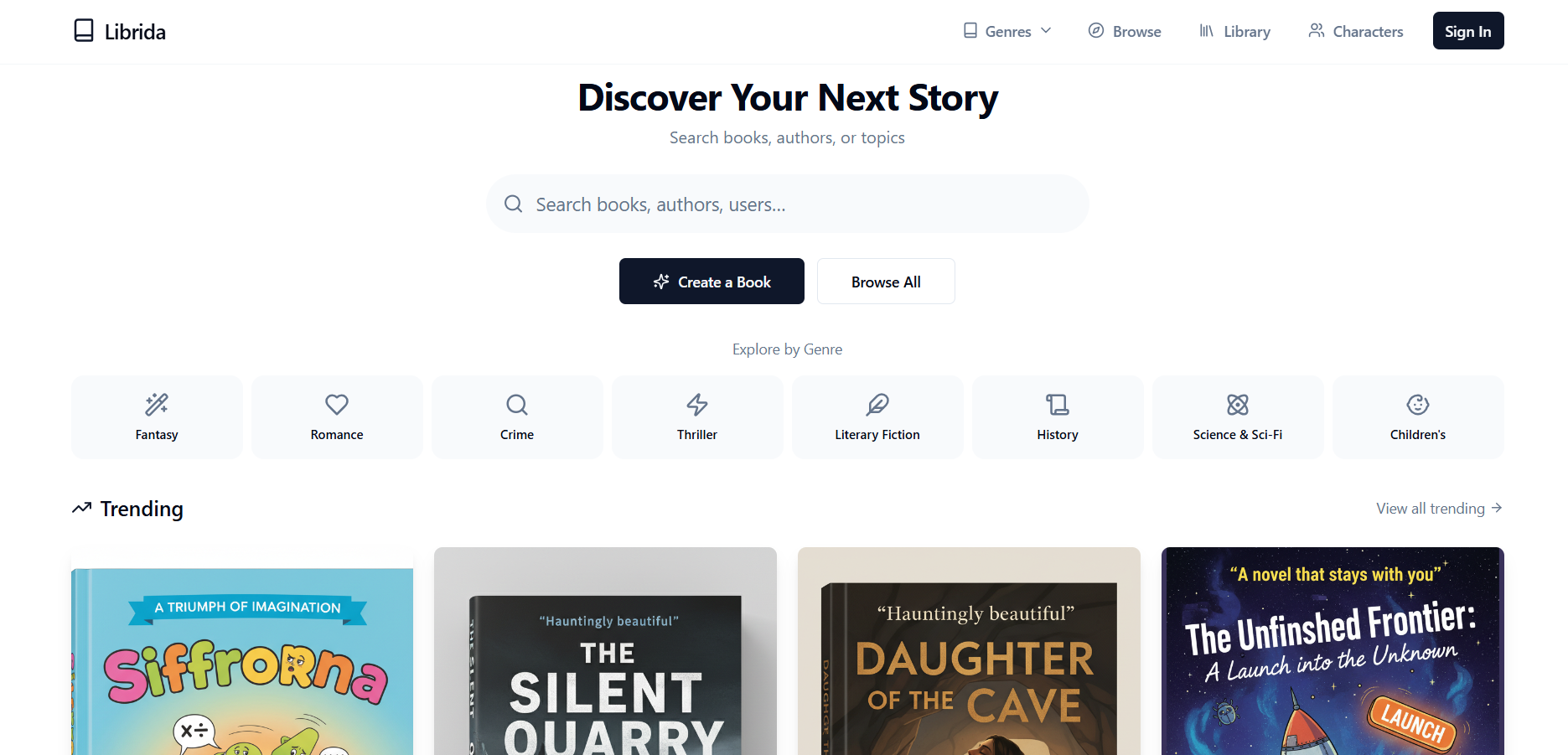
Story ideation doesn't have to be a solo struggle against a blank page. Librida is built for writers who want a structured, AI-supported space to generate, develop, and refine their narrative ideas without losing creative control. The platform gives you interactive tools that respond to your voice and your vision, not generic templates that could belong to any story. Whether you're working through your first concept or refining your tenth manuscript, Librida's features support every stage from raw idea to finished manuscript. Explore what's possible when your creativity has the right infrastructure behind it.
FAQ
What is story ideation in simple terms?
Story ideation is the deliberate process of generating and developing narrative concepts before you start writing. It goes beyond brainstorming by asking why an idea matters and whether it has the emotional and structural depth to carry a full story.
How is story ideation different from outlining?
Ideation happens before outlining. It's the open-ended phase where you explore and select your core concept, theme, and perspective. Outlining structures a story you've already committed to through ideation.
What are the best story brainstorming techniques?
Freewriting, mind mapping, the Crazy 8 method, and trope spinning are among the most effective techniques. Pushing past your first answers multiple times is the key habit that separates ordinary ideas from genuinely original ones.
Can AI help with story ideation?
Yes, but 45% of fiction writers who use AI for ideation get the best results when they initiate with their own raw concepts first. AI works as an expansion tool, not a replacement for your original creative angle.
How do I know when a story idea is ready to develop?
An idea is ready when you can state what it's about without naming plot events, identify the emotional experience it creates, and explain why you specifically are the person to write it. If any of those answers are missing, the ideation phase isn't finished yet.