

TL;DR:
- Building consistent writing habits strengthens your thinking, emotions, and storytelling ability beyond mere output. Regular practice enhances confidence, reduces anxiety, and trains your brain to find meaning, making your narratives more authentic and emotionally resonant. Using small cues, short sessions, and reflection rituals helps sustain this practice effortlessly, ultimately improving your storytelling craft.
Most writers know they should write more consistently. Few understand why build writing habits matters beyond the obvious goal of finishing a draft. The truth is that writing regularly, a practice researchers now call deliberate writing practice, reshapes how you think, feel, and create at a fundamental level. This article draws on 2026 research to show you the psychological, emotional, and creative benefits of writing consistently, plus practical strategies to make the habit stick so your storytelling grows with every session you show up for.
Key takeaways
| Point | Details |
|---|---|
| Consistency beats inspiration | Writing regularly builds skill and confidence even when motivation is low. |
| Self-regulation reduces anxiety | Planning and reflection rituals lower writing anxiety more than willpower alone. |
| Emotional processing fuels creativity | Writing converts raw emotion into meaning, protecting creative thinking on hard days. |
| Start smaller than you think | Five-minute daily sessions outperform sporadic long ones for long-term habit formation. |
| Habit loops sustain practice | Cue, routine, and reward cycles remove reliance on motivation to keep writing. |
Why building writing habits changes more than your output
The most common assumption about deliberate writing practice is that it primarily helps you produce more pages. That framing undersells what actually happens inside your brain and on the page. A 2026 longitudinal study of 468 EFL learners found that metacognitive strategies strongly mediated anxiety reduction and writing performance over 12 weeks, meaning that the act of planning and reflecting around your writing sessions matters as much as the drafting itself.

Separate research from middle school students confirmed that writing quality improved significantly across argumentative, narrative, and compare-and-contrast writing after a yearlong curriculum built on genre-based strategy instruction and self-regulation. The students did not simply write more. They wrote with structure, intention, and reflection baked into their routine.
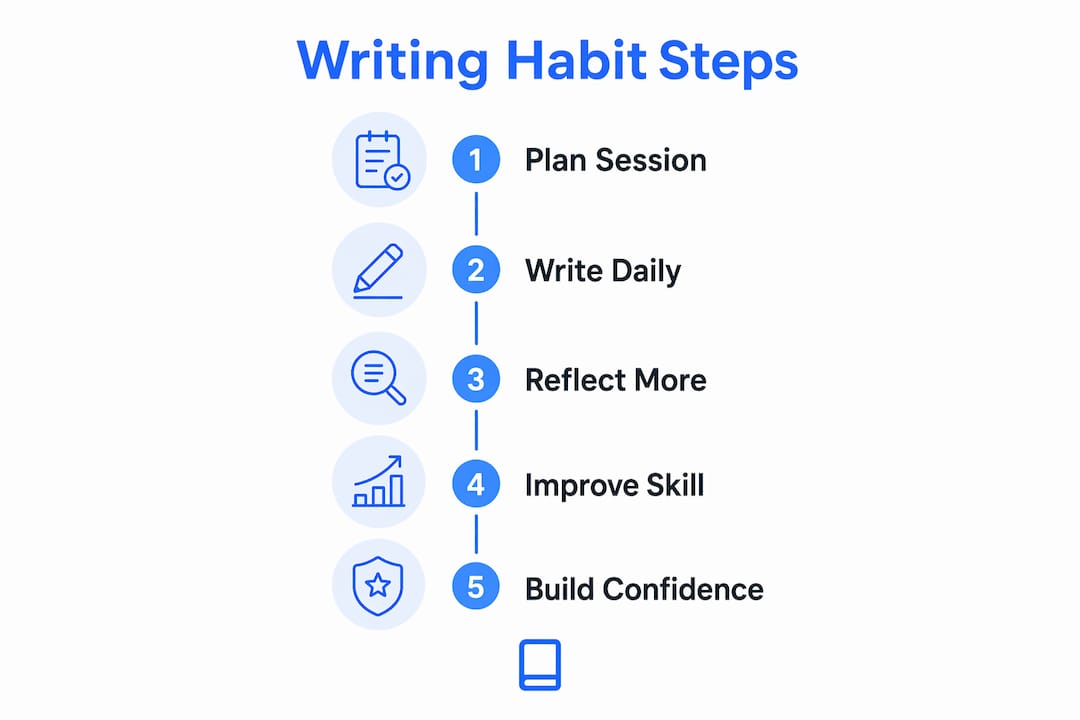
What this tells you is that the importance of writing habits goes beyond word counts. Writing consistently trains you to plan before you draft, monitor your thinking while you write, and review what you have created afterward. Those three actions, taken together, build the kind of self-efficacy that reduces the anxiety most writers feel staring at a blank page.
Pro Tip: Add a two-minute planning ritual before each session where you write one sentence about what you want to accomplish. This small act activates metacognitive awareness and makes the session feel less daunting before you write a single story word.
| Skill developed | What the research shows |
|---|---|
| Writing quality | Significant gains across genres after consistent, strategy-based practice |
| Self-efficacy | Higher confidence predicts greater use of self-regulated strategies |
| Anxiety reduction | Metacognitive strategies outperform cognitive and social ones for reducing fear |
| Performance | Longitudinal improvement linked directly to planning and reflection rituals |
The mental and emotional payoff of writing regularly
There is a reason journaling has survived every wellness trend of the last 50 years. A systematic review of positive expressive writing found that short writing bursts of 15 to 20 minutes on consecutive days reduced distress and improved optimism, happiness, and self-efficacy. Exercises like gratitude writing and "best possible self" reflections produced these results without requiring long sessions or professional guidance.
The mechanism behind this is called affect labeling. When you put emotions into words on a page, a review of 32 studies confirms that it lowers physiological emotional arousal and strengthens prefrontal regulation in the brain. You are literally calming your nervous system by writing your feelings down. That is not a metaphor for clarity. It is a measurable neurological shift.
"Writing creates a mental interruption between experience and emotional interpretation, allowing deliberate meaning-making and protecting creative thought." — University of California research on how writing rewires your brain
For storytellers, the practical benefits of writing regularly stack up fast:
- You process real emotional experiences that become authentic material for your characters and plots.
- You build optimism through regular reflection, which sustains motivation on difficult writing days.
- You reduce the emotional static that disrupts creative thinking before and during drafting sessions.
- You create an emotion-to-meaning processing loop that keeps your creative thinking sharp rather than reactive.
The benefits of writing regularly are not just professional. They are psychological, and that foundation makes your creative work more honest and more sustainable.
Practical strategies for building habits that actually stick
Habit science is clear on one thing: willpower is a terrible foundation for any daily practice. The writers who show up consistently are not more disciplined than you. They have built better systems. The cue-routine-reward loop, a framework from behavioral research, explains how any habit becomes automatic. You need a trigger (a specific time, place, or signal), a routine (the writing itself), and a reward that arrives immediately after.
Here is how to apply this framework when you are learning how to develop writing habits from scratch:
- Choose one non-negotiable cue. This could be a cup of coffee, a specific playlist, or sitting down after breakfast. The cue must be consistent enough to become automatic within two to three weeks.
- Start with five minutes, not fifty. Research on starting small for habits shows that low-entry-cost routines build resilience far faster than ambitious sessions that feel like a chore. You can always write longer, but you cannot skip the session if you have committed to just five minutes.
- Build in a planning micro-ritual. Before writing, spend 60 seconds noting your goal for the session. After writing, spend 60 seconds noting one thing that went well. This mirrors the planning and reflection practices that research identifies as the strongest anxiety reducers in writing development.
- Make progress visible. A calendar with an X for every day you write gives your brain immediate visual reinforcement. Seeing the streak matters more than you expect when motivation dips.
- Pair writing with reading. Reading daily supports habit formation by expanding your vocabulary and structural understanding, creating a feedback loop that keeps your writing practice alive between drafting sessions.
Pro Tip: Place your writing notebook or open your writing app before you go to bed the night before. Reducing friction is more powerful than adding motivation. When the barrier to starting is nearly zero, you will actually start.
If you want a fuller framework for turning these strategies into a consistent creative practice, the Librida article on building a writing routine walks through how to structure your sessions for maximum productivity.
How writing habits make you a better storyteller
Storytelling is not just a technical skill. It is the ability to transform lived experience and observed emotion into meaning that resonates with another person. That transformation requires practice at the cognitive level, not just at the craft level.
Research from the University of California found that writing rewires your brain by creating a deliberate pause between experience and interpretation. For storytellers, that pause is where characters develop depth, where plot choices become emotionally grounded, and where your narrative voice grows distinct. When you write regularly, you train your brain to reach for meaning rather than react with feeling.
Here is what building a daily writing practice does for your storytelling specifically:
- Reduces resistance on low-motivation days. When writing is a habit rather than a decision, you show up even when you are not inspired, and those sessions often produce your most honest work.
- Deepens emotional processing. Regular practice at converting emotion into language makes your fictional characters more psychologically believable because you understand emotional nuance from the inside.
- Builds narrative instinct. The more you write, the more you internalize story structure, pacing, and voice at an automatic level. You stop thinking about technique and start feeling it.
- Feeds a storytelling with AI workflow. Writers who develop strong foundational habits get far more from AI-assisted tools because they bring clear intention and story instinct to every collaboration.
Common misconceptions about daily writing practice
The biggest myth in writing habit advice is that you need long, uninterrupted sessions to make real progress. That belief stops more writers than any actual lack of time. What the research actually shows is that short, consistent sessions with reflection built in outperform irregular marathon sessions for skill development and confidence building.
"The benefit of writing habit is largely about cognitive and emotional processing, not just inspiration or output quantity." — research synthesis from written emotional expression studies
Anxiety and motivation dips are also completely normal. They are not signs that writing is wrong for you. They are signs that you are engaging with something that matters. The solution is not to push through on willpower. It is to design your ritual so that showing up requires as little decision-making as possible. Visible tracking, a locked-in cue, and a tiny minimum session length will carry you through the days when enthusiasm is nowhere to be found.
My honest take on why writing consistency matters
I have worked with writers at every level, from people drafting their first chapter to authors finishing their third book, and the pattern I see most consistently surprises people. The writers who improve fastest are rarely the most talented. They are the ones who have decided that writing is something they do every day, not something they do when they feel ready.
What I have come to understand is that the emotional and cognitive processing that happens through regular writing is not a side effect. It is the mechanism. When you write consistently, you are training your brain to make meaning under pressure, which is exactly what storytelling demands. The writers who treat their sessions as optional end up relearning their voice every time they sit down. The ones who show up daily find that their voice sharpens and their ideas arrive faster.
The counter-intuitive part, and the one I find most useful to share, is that writing quality during your habit sessions does not matter very much at first. What matters is that the loop gets completed: cue, session, reflection, reward. Quality follows from repetition, not from waiting until you are ready to write something worth reading.
— Mikael
Start your writing journey with Librida
If you are ready to move from knowing why daily writing practice matters to actually building it, Librida is designed to support exactly that transition.

Librida's AI-powered platform helps aspiring authors and storytellers shape their ideas into real manuscripts, with tools that keep you productive, organized, and motivated at every stage. Whether you are starting from a single idea or refining a half-finished draft, the program gives you structure when habit alone feels like it is not enough. The resource that Librida's community returns to most is the AI-Powered Success program, built specifically to take writers from beginner to pro with practical, AI-assisted guidance. If writing faster and with more confidence is the goal, this is where to start.
FAQ
Why should I build a writing habit instead of writing when inspired?
Inspiration is unpredictable, but skill development requires repetition. Research shows that consistent writing practice, not intermittent inspired sessions, produces the measurable gains in quality, confidence, and anxiety reduction that writers need to grow.
How long should my daily writing sessions be?
Five minutes is enough to start. Habit research recommends low-entry-cost sessions with immediate rewards to build resilience, and consistency across short sessions outperforms infrequent long ones for long-term habit formation.
Does writing every day actually improve storytelling skills?
Yes. Regular writing trains the brain to convert emotion into meaning, which is the core cognitive skill behind believable characters and emotionally resonant narratives. This improves with practice the same way any skill does.
What is the fastest way to overcome writing anxiety?
Metacognitive strategies, specifically planning before and reflecting after each session, reduce writing anxiety more effectively than motivation-based approaches. A 2026 longitudinal study found this pattern held consistently over 12 weeks.
Can reading support my writing habit?
Reading daily creates a feedback loop that sustains writing practice by expanding vocabulary and structural intuition. University of Waterloo research identifies regular reading as one of the most reliable supports for long-term writing habit formation.