

TL;DR:
- Writing goals are specific, measurable targets that significantly increase the likelihood of completing creative projects by transforming intentions into structured actions. Research shows that writing goals down, paired with accountability and action plans, nearly doubles success rates compared to relying solely on motivation or vague intentions. Implementing SMART goals, milestone breakdowns, and regular reviews creates a reliable system that fosters consistency and progress in writing endeavors.
Writing goals are specific, measurable targets that define what you will write, by when, and how much — and they are the single most reliable predictor of whether a creative project gets finished. Without them, even the most motivated writer defaults to wishful thinking. The importance of writing goals becomes clear the moment you compare writers who set structured targets against those who rely on inspiration alone. Research by Gail Matthews shows that writing goals down combined with action commitments and weekly progress reports produces a 76% goal achievement rate, versus 43% for people who only think about their goals. That gap is not a matter of talent. It is a matter of structure. Platforms like Librida and frameworks like SMART goals exist precisely to close it.
Why establish writing goals for creative productivity
Writing goals work by converting an overwhelming creative project into a sequence of smaller, concrete tasks. A novel feels impossible until you realize that 500 words per day for one year produces 91,250 words — a complete draft. That single reframe changes the emotional weight of the project entirely.

The cognitive mechanism behind this is well documented. Specific, challenging goals direct attention, increase effort, and motivate writers to develop new strategies when old ones stall. Vague goals like "write more" produce vague results. A goal like "complete 600 words before 9 a.m. on weekdays" gives your brain a precise target to organize behavior around.
SMART goals (Specific, Measurable, Achievable, Relevant, Time-bound) are the standard framework for translating creative ambition into daily practice. Jerry B. Jenkins, who has authored over 200 books, recommends pairing goals with scheduled writing time rather than relying on motivation to show up. The schedule is the goal's enforcement mechanism.
Pro Tip: Write your daily word count goal on a physical notepad before you open your manuscript. Handwriting goals forces your brain to encode the intention more deeply than typing it, which increases follow-through.
One underrated benefit of setting writing goals is the reduction of decision fatigue. When you sit down to write without a target, you spend mental energy deciding what to do. A pre-set goal eliminates that friction and lets you start immediately.
- Set a daily word count that feels slightly uncomfortable but achievable (400 to 700 words is a common range for beginners)
- Pair each word count goal with a fixed time block, not just a daily intention
- Track completions visually, using a calendar or habit tracker, to build a streak that motivates continuation
- Review weekly, not daily, to avoid over-correcting on bad days
Do written goals really outperform mental intentions?
The answer is yes, and the evidence is specific. Gail Matthews' study found that participants who wrote their goals, created action commitments, and sent weekly progress reports to an accountability partner achieved their goals at nearly double the rate of those who only thought about them. For writers, this means the act of writing down "I will finish chapter three by Friday" is not ceremonial. It is functional.
Mental intentions fail for a predictable reason: they stay abstract. Without a written record, your brain treats a goal as a preference rather than a commitment. The moment a competing priority appears, the unwritten goal dissolves.
"Most failures in writing goal adherence stem from poor goal design rather than a lack of discipline." — Author's Pathway
Implementation intentions take written goals one step further. Instead of "I will write every morning," you commit to: "If it is 7 a.m. and I have finished breakfast, then I will open my manuscript and write for 30 minutes." A meta-analysis of implementation intentions found an effect size of d=0.65 on goal achievement, which is a large and meaningful improvement. The if-then structure removes the need for willpower by making the action automatic.
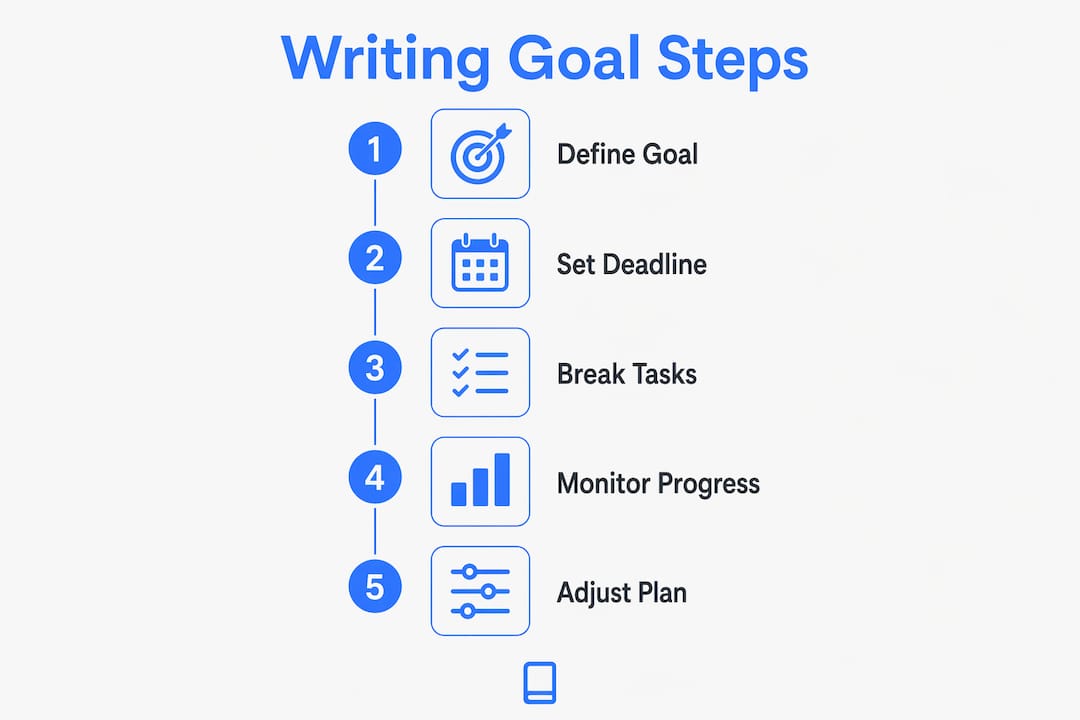
Here is a four-step process for building a written goal system that holds:
- Write the goal in specific, measurable terms (word count, chapter, or scene)
- Attach an action commitment: the exact time, location, and trigger for writing
- Identify one accountability partner or self-check method (a weekly email to yourself works)
- Schedule a weekly review to assess progress and adjust the next week's targets
Accountability does not require another person. A weekly review journal entry, a shared document with a writing group, or even a public commitment on a writing forum all activate the same behavioral mechanism.
How to design writing goals that actually stick
The difference between a goal you keep and one you abandon usually comes down to design, not discipline. Poor goal design is the leading cause of writing goal failure, and it is entirely fixable.
The table below contrasts aspirational goals with SMART goals to show what the difference looks like in practice:
| Aspirational goal | SMART alternative |
|---|---|
| "Write my novel this year" | "Write 500 words per day, Monday through Friday, for 12 months" |
| "Get better at dialogue" | "Rewrite one dialogue scene per week using the techniques in Story by Robert McKee" |
| "Finish my short story" | "Complete a 3,000-word draft of 'The Crossing' by March 31" |
| "Write more consistently" | "Open my manuscript at 8 a.m. every weekday and write for 25 minutes" |
Notice that every SMART version includes a number, a time frame, and a specific behavior. That specificity is what makes the goal trackable and, more importantly, completable.
Feedback loops are the second design element most writers skip. Goal-setting theory treats feedback as a necessary moderator. Without it, goals become disconnected from reality. A weekly review that asks "Did I hit my target? Why or why not?" keeps your plan calibrated to your actual life.
Pro Tip: Connect each daily writing goal to the larger project it serves. If your daily goal is 500 words, write at the top of your session: "This gets me to chapter five, which completes the first act." Linking daily goals to your creative purpose prevents the motivational collapse that hits mid-project.
The third design element is challenge level. Goals that are too easy produce boredom. Goals that are too hard produce avoidance. The sweet spot is a target that requires focus but is achievable on a normal day, not just your best day.
How to break big writing projects into manageable milestones
Long-form writing projects fail most often not because writers lack talent, but because they lack a map. Working backward from your end goal to plan weekly milestones is the most reliable method for translating a large ambition into daily action.
Here is how to apply that method to a 90,000-word novel:
- Set the finish date first (for example, December 31)
- Count the available writing weeks between now and then
- Divide the total word count by the number of weeks to get your weekly target
- Break each weekly target into daily sessions based on your schedule
- Build in two buffer weeks per quarter for illness, travel, or life interruptions
Jerry B. Jenkins, whose output includes the Left Behind series, treats writing like a professional appointment. He schedules writing time in advance and protects it the same way a surgeon protects an operating room slot. The goal is not inspiration. The goal is showing up.
The table below shows how a 90,000-word project breaks down across different daily commitments:
| Daily word count | Days per week | Weeks to first draft |
|---|---|---|
| 300 words | 5 days | 60 weeks |
| 500 words | 5 days | 36 weeks |
| 750 words | 5 days | 24 weeks |
| 1,000 words | 5 days | 18 weeks |
Missed days are not failures. They are data. A weekly review is more effective than daily self-judgment for maintaining strategic focus, because it smooths out the noise of individual bad days and keeps you oriented toward the larger milestone. If you miss Tuesday, write on Saturday. The manuscript does not care which day the words arrived.
For writers building their first manuscript development process, the milestone approach also reduces the psychological weight of the project. You are never writing a novel. You are writing this scene, today, in this 30-minute block.
Key takeaways
Establishing writing goals transforms creative ambition into a structured, measurable system that produces finished work through consistent daily action, written commitments, and regular feedback.
| Point | Details |
|---|---|
| Written goals double achievement | Writing goals down with action plans raises success rates to 76%, versus 43% for mental intentions alone. |
| SMART design prevents failure | Specific, time-bound goals outperform vague intentions by giving your brain a precise behavioral target. |
| Implementation intentions close the gap | If-then planning links situational cues to writing action, removing the need for daily willpower. |
| Weekly reviews beat daily self-judgment | Reviewing progress weekly maintains strategic focus without the rumination that derails motivation. |
| Milestones make big projects manageable | Breaking a 90,000-word novel into weekly targets removes overwhelm and creates a clear, completable path. |
What I've learned from watching writers set goals the wrong way
Most aspiring writers I've worked with set goals that are either too large or too vague, and then blame themselves when those goals collapse. "Write a novel this year" is not a goal. It is a wish with a deadline attached. The writers who actually finish are the ones who treat their writing time like a professional obligation, not a creative mood.
The insight that changed how I think about creative goal setting is this: the goal is not the destination. The goal is the daily behavior that makes the destination inevitable. A writer who commits to 500 words every weekday morning does not need to think about finishing a novel. Finishing becomes a mathematical outcome of showing up.
I've also seen writers burn out from over-tracking. Checking your word count every 10 minutes is not accountability. It is anxiety dressed up as productivity. Weekly reviews, as the research supports, give you enough distance to see real patterns without drowning in daily noise. Pair that with a consistent writing routine and the results compound over months, not days.
The writers who struggle most are those who treat goal-setting as a one-time event. Setting goals in January and never revisiting them is like setting a GPS destination and then ignoring every reroute. Your plan needs to be a living document, reviewed weekly, adjusted honestly, and always tied back to the creative work that made you want to write in the first place.
— Mikael
Turn your writing goals into a finished book with Librida

Librida's AI-Powered Success guide is built for writers who want to move from goal-setting to manuscript completion without losing momentum. The resource covers the evidence-based strategies discussed in this article, including SMART goal design, milestone planning, and accountability systems, and applies them directly to the book creation process. Whether you are writing your first chapter or refining a full draft, Librida gives you the structure, AI tools, and practical frameworks to keep your creative goals on track. Stop planning to write. Start building the system that makes finishing unavoidable.
FAQ
What does it mean to establish writing goals?
Establishing writing goals means defining specific, measurable targets for your writing activity, such as a daily word count, a chapter deadline, or a project completion date. These targets convert vague creative intentions into scheduled, trackable commitments.
How many words should a beginner write per day?
A daily target of 300 to 500 words is a practical starting point for beginners, since 500 words per day for one year produces over 91,000 words. The key is consistency over volume.
Why do most writing goals fail?
Most writing goals fail because of poor design, not poor discipline. Goals that lack specificity, a time frame, or a feedback mechanism become abstract intentions that dissolve under competing priorities.
How does accountability improve writing goal success?
Gail Matthews' research shows that combining written goals with action commitments and weekly progress reports raises goal achievement to 76%, compared to 43% for unwritten intentions. An accountability partner or self-check system activates the same behavioral effect.
What is an implementation intention in writing?
An implementation intention is an if-then plan that links a situational cue to a writing action, such as "If it is 8 a.m. and my coffee is ready, then I will open my manuscript and write for 30 minutes." This structure makes the writing behavior automatic rather than dependent on daily motivation.