

TL;DR:
- Writing templates are structured frameworks that eliminate the need for structural decisions, allowing writers to focus exclusively on content creation. They enhance consistency, quality, and scale by providing a reliable, repeatable system that reduces cognitive load and startup friction. Using templates does not suppress creativity; instead, it clarifies the structure, enabling original ideas to emerge more freely.
Writing templates are structured, reusable frameworks that guide where content goes, in what order, and with what purpose, so you spend zero time negotiating format and all your time generating ideas. Every writer who has stared at a blank document for ten minutes before typing a single word has experienced the problem templates solve. The role of writing templates is not cosmetic. It is cognitive. Templates remove the structural decisions that drain mental energy before real writing even begins. Tools like Grammarly, Notion, and AI-assisted platforms such as Librida all incorporate template logic because the evidence is clear: structure precedes speed.
Why use writing templates to beat the blank page
The blank page problem is not a creativity problem. It is a decision problem. Before you write a single sentence, your brain must answer: What section comes first? How long should the intro be? What information belongs where? Each of those micro-decisions draws from the same limited cognitive pool that you need for actual writing.
Startup friction reduction is the core mechanism here. A template answers all structural questions in advance, so the time between opening a document and writing your first content sentence drops to near zero. That is not a minor convenience. It is the difference between a writing session that produces 800 words and one that produces 80.
Behavioral scientist BJ Fogg's research on habit formation shows that reducing friction is the single most reliable way to increase follow-through on any behavior. Roy Baumeister's work on decision fatigue demonstrates that willpower and cognitive focus deplete with each choice made, regardless of how trivial that choice seems. Writing templates apply both principles directly. By offloading structural decisions, templates free the central executive of your working memory to focus entirely on content quality and original thinking.
Pro Tip: Pick templates that feel liberating, not restrictive. A good template tells you what sections to fill in, not what words to use. If a template makes you feel boxed in, strip it back to three or four anchor prompts and build from there.
The writers who benefit most from templates are not beginners who need hand-holding. They are experienced creators who recognize that cognitive load reduction is a professional advantage, not a creative crutch.
How templates create consistency, quality, and scale
One of the clearest benefits of writing templates is what they do to output quality over time. When you write from scratch every time, your structure varies. Some posts bury the lead. Others skip transitions. Quality becomes a function of how focused you were on a given day rather than a reliable standard you can reproduce.

Templates fix that. A fill-in-the-blank template library shifts your effort from structural decisions to content execution, which is where your skill and voice actually live. Bloggers who use template libraries report producing 10 to 15 posts per session at consistent quality levels, compared to starting from scratch each time. That is not just faster. It means your audience gets a predictable, professional reading experience regardless of which piece they encounter first.
The role of templates in book writing is equally significant. Academic researchers using structured journal templates in AI-assisted pipelines achieved section completeness of 96.7% in long-form writing projects. That figure reflects what happens when structure is handled systematically rather than improvised. Technical writers, academic authors, and content teams all use templates for the same reason: consistency at scale is impossible without a repeatable system.
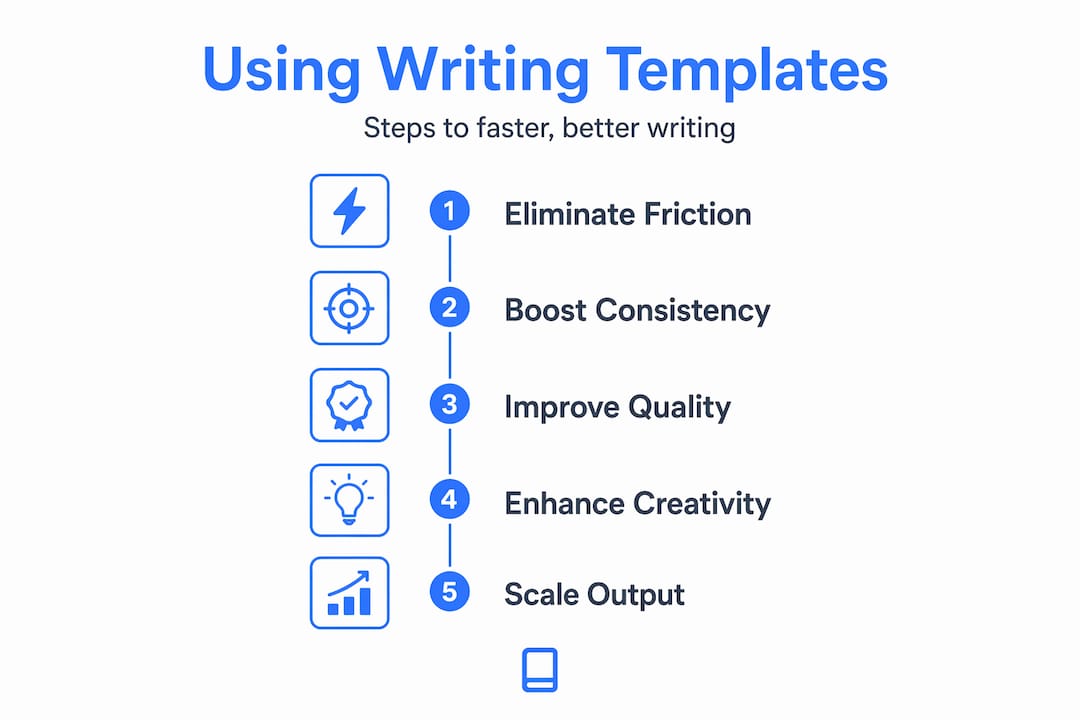
Here is a direct comparison of the two approaches:
| Factor | Template-based writing | Writing from scratch |
|---|---|---|
| Time to first sentence | Near zero | 5 to 15 minutes average |
| Structural consistency | High across all pieces | Varies by session and mood |
| Delegation potential | High (clear format to hand off) | Low (requires full context each time) |
| Quality floor | Stable minimum standard | Unpredictable |
| Creative focus | Directed at content and voice | Split between structure and content |
Templates are systems, not shortcuts. Structure quality stays stable while you direct your creative energy toward the content that actually differentiates your work.
Do templates kill creativity? Here is what the evidence says
The most common objection to using templates is that they produce generic, formulaic writing. That objection confuses structure with content. A template defines where your hook goes, where your evidence lands, and where your conclusion sits. It says nothing about what your hook should be, which evidence you choose, or how your conclusion sounds. Those decisions are entirely yours.
Think of it the way architects think about floor plans. A floor plan specifies room placement and dimensions. It does not specify the furniture, the color palette, or the art on the walls. Two architects working from the same floor plan produce completely different homes. Two writers working from the same blog template produce completely different articles.
Research on phrase-based writing instruction supports this directly. Phrase menus and templates speed sentence construction initially, but the practice model calls for writers to gradually reduce reliance on them as personal style develops. Templates are scaffolding. You use them most heavily at the start, and you customize them more aggressively as your voice matures.
Genre-based writing instruction that uses structured frameworks has been shown to improve writing quality across multiple genres over time. The structure does not suppress originality. It creates the conditions where originality can appear consistently rather than only when inspiration strikes.
Pro Tip: Treat your template as a living document. After every ten pieces, review which sections you always rewrite and which you follow closely. Adjust the template to match how you actually write well, not how you think you should write.
- Vary your opening hook type across pieces: anecdote, statistic, direct claim, question
- Swap out your proof points and examples every time, even when the structure repeats
- Write your own transitions rather than copying them from the template
- Add a personal observation or original analogy in at least one section per piece
These four habits keep template-based writing from sounding templated.
How to build a personal template library that actually gets used
Building a template library sounds like a project. It does not have to be. Start with the format you write most often. If you publish blog posts, create one template for that format. If you write email newsletters, start there. One template used consistently beats a library of ten templates that sit unused.
Here is a practical process for building and refining your library:
- Identify your three most common writing formats. Blog posts, social captions, email pitches, and book chapters are the usual candidates. Pick the one that costs you the most startup time and build that template first.
- Map the structure of your best existing piece in that format. Open your strongest blog post or article and label each section: hook, context, main claim, evidence, counterpoint, conclusion. That labeled structure is your first template draft.
- Strip it to prompts. Replace your actual content with questions or instructions. "Hook: Open with a specific claim or surprising fact (2 to 3 sentences)" is more useful than a placeholder sentence.
- Use it for three pieces without editing the template. Resist the urge to revise after the first use. You need at least three runs to see where the template genuinely helps and where it creates friction.
- Refine based on results. After three pieces, adjust the sections that felt forced. Add a section if you kept writing one that the template did not include.
- Integrate AI for structural generation, not content. Tools like Librida can generate a structural outline based on your topic and audience. Use that outline as your template skeleton, then fill it with your own research, examples, and voice. This keeps originality intact while removing the setup work.
- Build delegation into the template. If you work with a team or use AI assistance, clear fill-in formats reduce the time spent explaining what you need. The template becomes the brief.
A smarter writing workflow treats templates as infrastructure. You build them once, refine them occasionally, and rely on them daily. The compounding effect on output volume and quality is significant within weeks, not months.
Key takeaways
Writing templates work because they remove structural decisions before writing starts, freeing your cognitive resources for content, voice, and original thinking.
| Point | Details |
|---|---|
| Templates eliminate startup friction | Structural decisions made in advance drop time-to-first-sentence to near zero. |
| Consistency scales with templates | A template library produces stable quality across 10 to 15 pieces per session. |
| Structure does not suppress creativity | Templates define where content goes, not what that content says or how it sounds. |
| Build from your best existing work | Map your strongest piece to create your first template draft immediately. |
| AI handles structure, you handle content | Use AI tools to generate outlines, then fill them with your own voice and examples. |
Templates changed how I write, and I resisted them for years
I spent the first several years of my writing career treating templates as something beginners needed. Real writers, I told myself, just wrote. That belief cost me hours every week and produced inconsistent work I was not always proud of.
The shift happened when I started tracking where my writing time actually went. The answer was uncomfortable: a significant portion went to structural negotiation before I had written a single real sentence. Which section first? How long should this part be? Does this belong here or later? None of those questions had anything to do with the quality of my ideas.
When I finally built a set of templates for my most common formats, the first thing I noticed was not speed. It was calm. The anxiety of the blank page disappeared almost entirely. My writing routine became predictable, and predictable routines produce more output than inspired bursts ever did.
The creativity concern turned out to be completely backward. With structure handled, I had more mental space for original thinking, not less. My examples got sharper. My arguments got tighter. The template was not limiting what I said. It was clearing the path so I could say it better.
If you are skeptical, start with one template for one format. Give it ten uses before you judge it. The results will make the argument better than I can.
— Mikael
Start writing faster with Librida's AI-powered templates
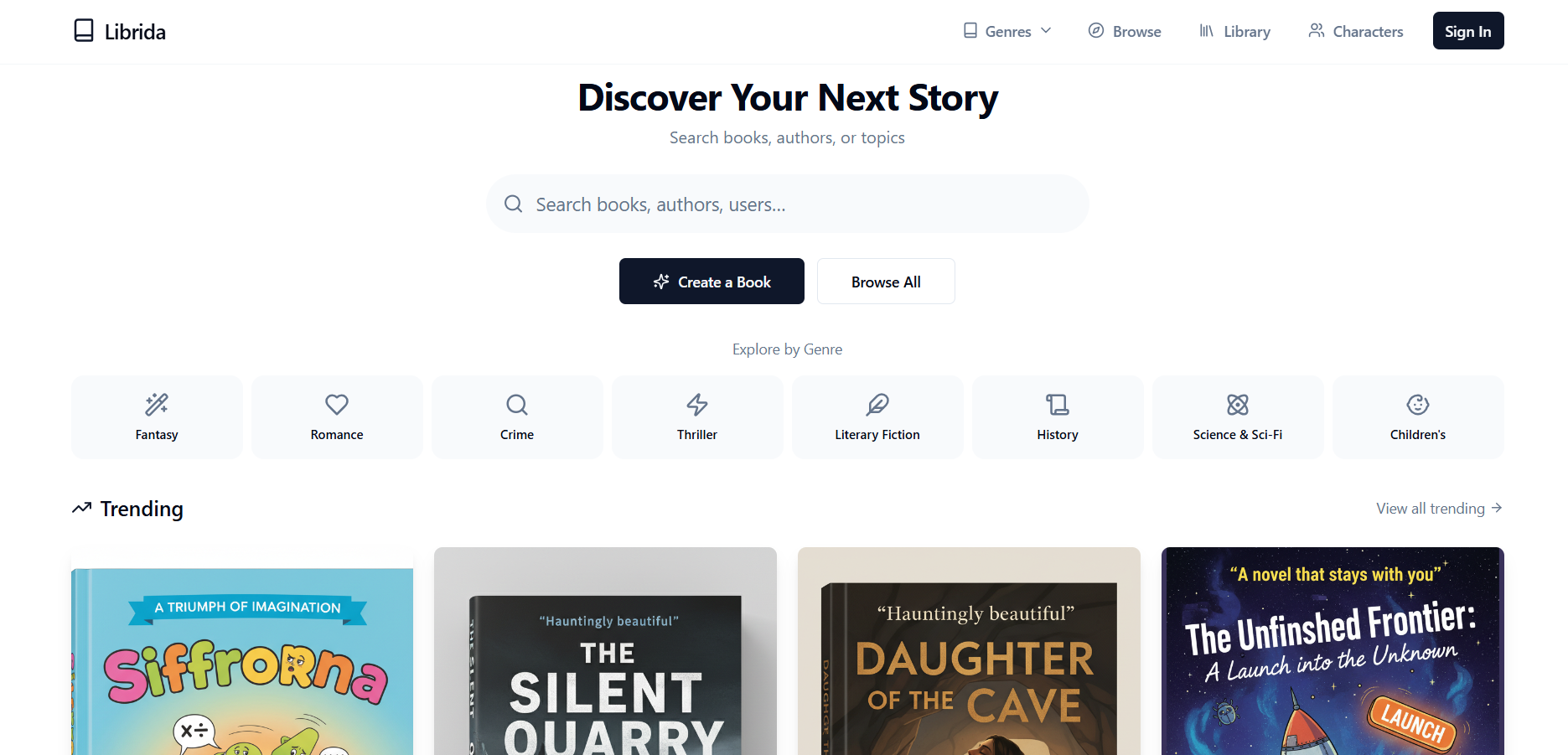
Librida is built for writers who want to produce more without sacrificing the quality or originality that makes their work worth reading. The platform combines AI-powered structural tools with a template framework that handles the setup work so you can focus on the writing itself. You define your topic and audience. Librida generates the structural scaffold. You fill it with your voice, your research, and your stories. For anyone serious about AI-assisted book creation, Librida offers a practical starting point that removes friction without removing creative control. Try it and see how much faster your first sentence arrives.
FAQ
What is the main reason to use writing templates?
Writing templates remove structural decisions before you start, which eliminates startup friction and frees cognitive resources for content generation. The result is faster writing at a more consistent quality level.
Do writing templates make all content sound the same?
Templates define structure, not content. Two writers using the same template produce different articles because their examples, voice, and arguments are entirely their own.
How do templates help with book writing specifically?
The role of templates in book writing is to enforce section completeness and structural consistency across long-form projects. Research using structured journal templates in academic writing pipelines achieved 96.7% section completeness, demonstrating how templates prevent the gaps and inconsistencies that plague long manuscripts.
How many templates do I need to start?
One template for your most common writing format is enough to start. Build it from your best existing piece, use it ten times, then refine before adding more formats to your library.
Can I use AI tools to create writing templates?
AI writing platforms can generate structural outlines based on your topic and audience, which serve as ready-made template skeletons. The key is to supply your own content separately so the final piece reflects your voice rather than the AI's defaults.