

TL;DR:
- By 2026, AI in creative writing primarily functions as a structural and editorial collaborator rather than a prose generator, helping writers accelerate workflow while maintaining their voice. Most professional writers use AI for outlining, brainstorming, and continuity management, leading to increased productivity and income, but must carefully humanize and evaluate output to preserve originality and authenticity. Technological innovations like Word Compiler and Shadow-Loom address coherence and causality challenges, emphasizing strategic AI integration over prompt engineering.
By 2026, AI in creative writing is defined not as a prose generator but as a structural and editorial collaborator that professional writers use to accelerate workflow without surrendering voice. According to a 2026 Authors Guild survey, 23% of writers use generative AI professionally, with the majority applying it to grammar checking and brainstorming rather than prose generation. Only 7% use it to write actual sentences. That distinction matters enormously. The ai trends in creative writing 2026 reveal a profession that has absorbed AI into its toolkit without handing over the pen. Tools like Grammarly, Word Compiler, and Shadow-Loom are reshaping how authors plan, draft, and refine stories, and Goldman Sachs Q2 2026 analysis shows 78% of AI-using content creators report increased income as a result.
How writers are using AI tools in creative writing workflows in 2026
The most common applications of AI in professional writing workflows are structural, not stylistic. Professional writers separate story beats from prose style, using AI to iterate on plot architecture while keeping voice and sentence-level decisions entirely human. This division of labor is the defining feature of how working authors actually use these tools.
The practical breakdown looks like this:
- Grammar and proofreading: Grammarly and similar tools catch surface errors and suggest tonal adjustments, freeing writers to focus on higher-order decisions.
- Brainstorming and ideation: AI generates multiple plot directions, character motivations, or thematic angles in seconds, giving writers a menu of options rather than a blank page.
- Outline and structure development: Writers feed a premise into an AI tool and receive a scene-by-scene skeleton they then rewrite entirely in their own voice.
- Ancillary content: Query letters, synopses, back-cover copy, and social media posts are common AI-assisted outputs that save hours without touching the manuscript itself.
The final step in every professional workflow is humanization. Maintaining voice requires humanization passes and deliberate voice editing after any AI draft, because raw AI output carries detectable patterns that trained readers recognize. Tools designed specifically for this step, including WalterWrites Humanizer, address surface-level AI patterns, though they cannot replicate a singular literary voice.
Pro Tip: Treat AI output as a first-draft outline, not a first-draft manuscript. Rewrite every AI-generated sentence in your own voice before any editor sees the document.
What technological innovations are shaping AI-assisted creative writing in 2026?
The most significant technical barrier in AI-assisted long-form fiction has been the context window problem: AI models forget earlier chapters, contradict established character traits, and drift from the author's original tone. Two frameworks released in 2026 address this directly.

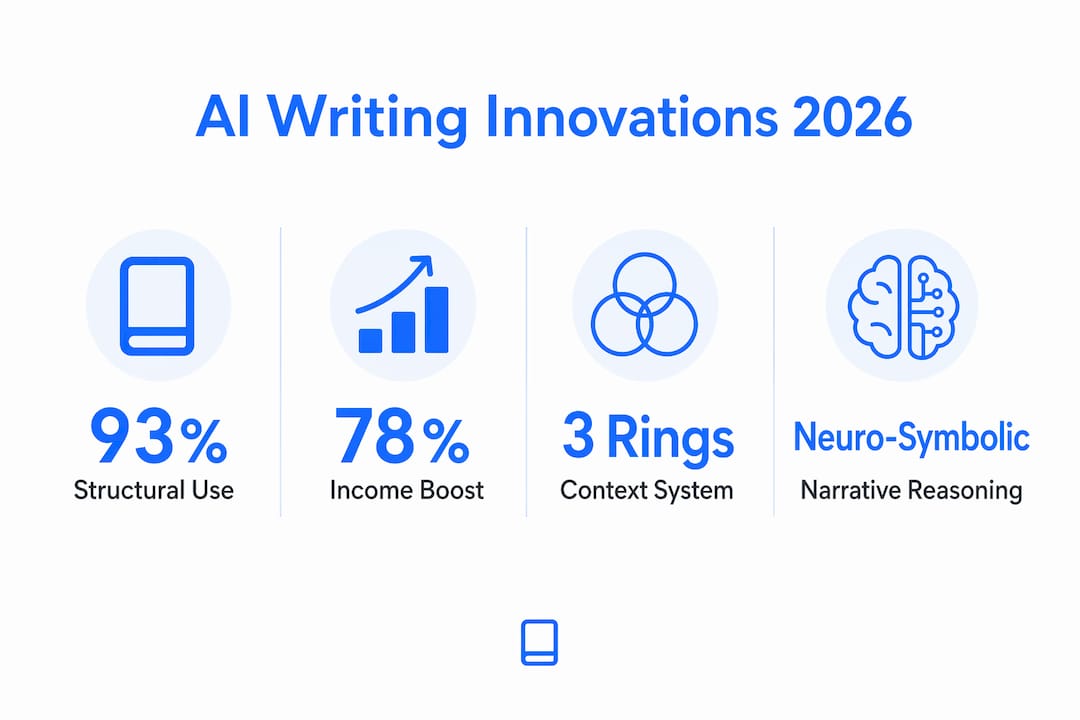
Word Compiler's three-ring context system manages voice, continuity, and scene-specific details as separate, layered inputs. The outer ring holds the author's style guide and character bible. The middle ring tracks plot continuity and world-building rules. The inner ring handles scene-level specifics. This architecture means the model never generates prose without access to the full creative context, which solves the coherence failures that plagued earlier AI writing tools.
| Framework | Core innovation | Primary benefit |
|---|---|---|
| Word Compiler | Three-ring context architecture | Maintains voice and continuity across long-form fiction |
| Shadow-Loom | Neuro-symbolic causal narrative reasoning | Constraint-guided prose with affective scoring |
| Grammarly | Real-time grammar and tone analysis | Surface-level editing and style consistency |
Shadow-Loom integrates neuro-symbolic causal narrative reasoning with affective scoring, drawing on narratology and cognitive science to generate prose that respects causal story logic. Rather than predicting the next likely word, Shadow-Loom models what should happen next given the story's established cause-and-effect chain. This is a fundamental shift from text completion to narrative simulation.
Both tools represent a broader move in the 2026 writing industry: from prompt engineering toward context compilation. Writers are no longer typing instructions into a chat box. They are building structured creative environments that constrain and guide AI output with precision.
Pro Tip: Before using any AI tool for long-form fiction, build a story bible first. Character names, voice samples, world rules, and plot constraints fed into the context layer will produce dramatically more consistent output than prompts alone.
What are the impacts of AI on professional writers' productivity, skills, and income?
The income data is the clearest signal that AI adoption is working for writers who use it strategically. 78% of AI-using content creators report increased income and productivity, a figure from Goldman Sachs Q2 2026 analysis. This is not a marginal improvement. It reflects a structural shift in how writing work gets done and priced.
Hybrid human-AI workflows increase draft speed by 40 to 60%, which means a writer who previously delivered one article per day can now deliver two without sacrificing quality. That productivity gain translates directly into higher earnings for freelancers and faster manuscript completion for novelists. You can explore specific AI productivity strategies for authors that detail how to structure these workflows without burning out.
"The premium skill is no longer fast typing. It is AI editorial judgment: the ability to evaluate, refine, and strategically frame AI output with a human audience in mind." — Industry analysis, EyeSight
Writers handling AI output must focus on evaluation, editing, and strategic framing rather than raw drafting speed. This reframes what it means to be a skilled writer in 2026. The new competencies include:
- AI content editing: Reviewing and rewriting AI drafts for voice, logic, and emotional resonance.
- Workflow management: Structuring multi-tool pipelines that move from ideation through drafting to final polish.
- Creative strategy: Deciding which parts of a project benefit from AI assistance and which require purely human judgment.
Automation risk is highest in formulaic writing: product descriptions, templated blog posts, and standardized reports. It is lowest in investigative journalism, literary fiction, and expert-driven analysis where specialized knowledge and singular voice are the product.
What are the key challenges and ethical considerations for AI use in creative writing?
AI assistance carries a measurable cost to originality that writers and editors must actively manage. A 2026 experimental study found that AI-assisted stories scored 5.4% higher on creativity metrics but showed 10.7% greater trope reliance compared to fully human-written work. Higher creativity scores with more clichéd structure is a paradox that reveals exactly where AI falls short: it generates novel combinations of familiar patterns rather than genuinely new narrative territory.
Readers notice. Literary fiction audiences can statistically distinguish AI-generated prose from human prose, which means the humanization step is not optional for writers working in quality-sensitive genres. The self-publishing checklist for 2026 addresses how to maintain editorial standards when AI is part of the production pipeline.
Pro Tip: Run a trope audit on any AI-assisted draft. Search for the five most common genre tropes and ask whether each one is earning its place or simply filling space. Replace at least two with something specific to your story's world.
Human editors working with AI output must perform three distinct checks before any manuscript goes to publication:
- Continuity audits: Verify that character details, timeline events, and world-building rules are consistent across all chapters.
- Voice alignment: Read every AI-touched paragraph aloud and flag any sentence that sounds like a different author.
- Fact verification: AI models hallucinate details, especially in historical fiction and nonfiction. Every factual claim needs a source check.
The deeper ethical question is authorial identity. AI-assisted plot development acts as a mirror for human values, clarifying thematic intent before generation begins. But when AI writes the sentences, the question of who made the creative choices becomes genuinely complicated. The writing community has not reached consensus on disclosure standards, and publishers are applying inconsistent policies. Writers who want to protect their professional reputation should document their process and be prepared to explain exactly what role AI played in any given work.
Key takeaways
AI in creative writing 2026 functions best as a structural and editorial collaborator, not a prose author, and writers who master that distinction are the ones reporting higher income and faster output.
| Point | Details |
|---|---|
| AI is a structural tool, not a prose writer | 93% of professional AI users apply it to grammar, brainstorming, and outlining, not sentence generation. |
| Context architecture solves coherence | Word Compiler's three-ring system and Shadow-Loom's causal reasoning keep long-form fiction consistent. |
| Income rises with strategic AI use | 78% of AI-using creators report increased earnings, according to Goldman Sachs Q2 2026 data. |
| Trope reliance is a real risk | AI-assisted stories show 10.7% more trope reliance, requiring deliberate human originality checks. |
| Editorial judgment is the new core skill | Evaluating and refining AI output with audience intent in mind is now more valuable than drafting speed. |
Why the human-AI writing partnership still needs a human in charge
I have spent enough time watching writers adopt AI tools to know that the biggest mistake is not using AI too much. It is using it at the wrong stage. Writers who feed AI a blank page and ask for a story get something technically coherent and creatively hollow. Writers who feed AI a fully developed premise, a character bible, and a scene-by-scene outline get something they can actually work with.
The tools that excite me most in 2026 are the ones that treat the author as the architect. Word Compiler does not write your novel. It holds your creative decisions in place while you write. Shadow-Loom does not invent your plot. It models the causal logic of the story you have already designed. That is a fundamentally different relationship with AI than most people imagine when they hear "AI writing tool."
What I tell every writer I work with: master the editorial judgment layer first. Learn to read AI output critically, the way a developmental editor reads a first draft. Identify where the logic breaks, where the voice slips, where a trope is doing the work that a real idea should be doing. That skill is worth more in 2026 than any prompt engineering trick. The writers who build it now will be the ones still working when the next generation of tools arrives.
The future of AI in writing is not a replacement story. It is a collaboration story, and the human half of that collaboration still carries the creative weight that matters most.
— Mikael
How Librida helps writers master AI-powered creative workflows
Librida is built for writers who want to use AI without losing what makes their work theirs. The platform integrates AI tools that support editorial workflow, brainstorming, and manuscript development, giving authors the structure to move from idea to finished book without surrendering creative control.
If you are ready to move from experimenting with AI to building a repeatable, professional workflow, the AI-Powered Success guide on Librida is the most direct path. Written for writers at every level, it covers how to integrate AI tools into your process, increase your output, and protect your voice throughout. The writers seeing the biggest gains in 2026 are not the ones using the most AI. They are the ones using it most deliberately.
FAQ
What are the main AI trends in creative writing for 2026?
The defining trend is AI as a structural and editorial collaborator rather than a prose generator. Professional writers use tools like Grammarly, Word Compiler, and Shadow-Loom for outlining, brainstorming, and continuity management while keeping sentence-level writing human.
Does using AI for writing increase income?
Goldman Sachs Q2 2026 analysis shows 78% of AI-using content creators report increased income and productivity. The gains are largest for writers who use AI for workflow acceleration rather than full prose generation.
Can readers tell if fiction was written by AI?
Literary fiction readers can statistically distinguish AI-generated prose from human-written prose. This is why voice editing and humanization passes are standard practice among professional writers who use AI assistance.
What is Word Compiler and how does it help fiction writers?
Word Compiler is a context compiler that uses a three-ring architecture to hold an author's voice guide, continuity rules, and scene-specific details simultaneously. It prevents the coherence failures that occur when AI models lose track of earlier story decisions in long-form fiction.
What ethical issues should writers consider when using AI?
The primary concerns are trope reliance, authorial identity, and disclosure. AI-assisted stories show 10.7% higher trope reliance than fully human work, and the writing community has not reached consensus on how to disclose AI involvement to publishers and readers.